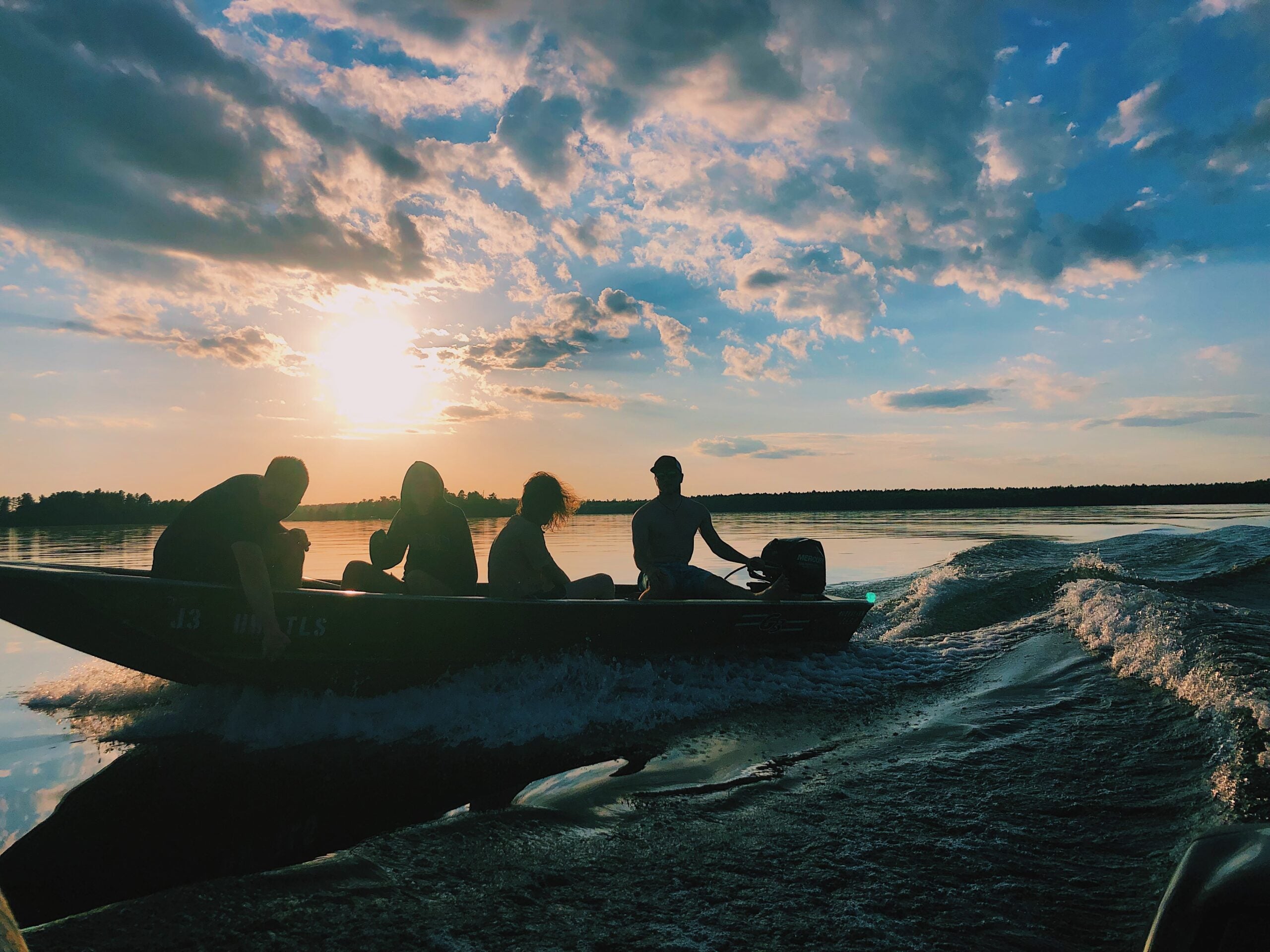
For nearly a century, Trout Lake Station in Boulder Junction has been at the center of environmental research in Wisconsin. Now, a new documentary aims to show how the year-round field station’s work extends far beyond lake shorelines.
“The Hidden Impact of a Northwoods Research Station,” an eight-minute film produced by Trout Lake Station staff, explores the ways federal and state funding support research, education and community engagement in northern Wisconsin.
In a conversation on WPR’s “Morning Edition,” Station Director Gretchen Gerrish said she hopes the documentary makes clear that federal funding isn’t an abstract concept, but a real investment in local communities.
News with a little more humanity
WPR’s “Wisconsin Today” newsletter keeps you connected to the state you love without feeling overwhelmed. No paywall. No agenda. No corporate filter.
“My goal is that people understand that National Science Foundation dollars aren’t all stuck in Washington, D.C. or at the ivory towers of a university setting,” Gerrish said. “There are many ways that those National Science Foundation dollars make it directly into our local communities and economies. Those dollars also directly support many of the natural resources and waterways that hold high value for us.”
Operated by the University of Wisconsin-Madison’s Center for Limnology, Trout Lake Station has been supporting research since 1925.
While Trout Lake Station has weathered financial uncertainty before, Gerrish said the loss of support from long-standing programs like the National Science Foundation’s Long-Term Ecological Research Network would mean not only job cuts, but also the disruption of data sets that stretch back more than four decades.
The documentary frames those challenges while celebrating the resilience of a field station that has shaped science and policy for generations.
“Trout Lake Station will continue to fight and survive,” Gerrish said.
The following interview was edited for brevity and clarity.
Shereen Siewert: The film makes a case for public science. What kind of response are you hoping for from the public and from lawmakers?
Gretchen Gerrish: I’m hoping that people see these National Science Foundation dollars in their own communities, that they see the value that they’re bringing to the waters, to the children, to education and to our economy. And that they really consider evaluating how they support their Legislature, their legislators and their decisions, and they advocate for what they do value in their homes, their lands and their waters.
SS: What are the potential consequences if those dollars disappear?
GG: It would mean about half of our budget would disappear. That means we’re looking at job losses. In terms of the facility, I feel as though we’d still work hard to maintain it. The UW strongly supports Trout Lake Station, and we feel like we’d be able to keep the operation going, but many of the extras we provide for the community could be lost.
Each year we run outreach programs for the local schools in the region, bringing in students on a regular basis. The staffing we have now allows us to do that without charging anything for these events, reaching thousands of people each year. Those opportunities are all provided as part of that funding, so they could be in jeopardy.
SS: Does this current moment, with potential changes in funding at the federal level, feel more precarious than past challenges?
GG: I don’t see this as a point of collapse. I see this as a point of concern, and I think the broader issue is one of value, thinking about how we value Wisconsin’s waters, and where people really want to see investment in those systems. In northcentral Wisconsin, water is our economic driver affecting property values, recreation, tourism, fishing and more.
One of the most concerning parts is that this is a National Science Foundation program that’s been funded for 42 years. There are 28 sites within that program, and these sites have been providing the core data that allows us to look at long-term change. If you end a 42-year data set, it will take another 42 years to create it. Once you cut it off, it takes a lot of time to reclaim long-term understanding. The fact that we’ve been doing that at a national level so we can compare what’s happening across the U.S. is outstanding.
SS: What is the relationship between the research station and the local economy?
GG: Trout Lake Station has existed for about 100 years, employing thousands of individuals along the way. Many of those individuals live here year-round, and I’m one of them. I live here full time, raise my boys here and participate in the community. I’m engaged in outreach and volunteer work. A lot of the staff are well known within our small towns in the area. The research station creates jobs and supports the economy. As a University of Wisconsin mini campus, we also employ about 40 students each year. We also bring in large grant dollars that have an impact on the region.
SS: Can you give us an example of how your research directly influenced lake management policy or public understanding in Wisconsin?
GG: There are many ways that Trout Lake Station research has had an impact on our management decisions at the state, regional and global levels. Back in the 70s, there was a massive project on acid rain. That project took place over a 10-year period. They studied what happened when pH levels in the lake went down and how the fish populations and plankton all responded to that. Then they looked at the recovery of that lake.
That project went to the congressional floor and is part of the Clean Lakes and Clean Waters Act. It really was a representative study that led to changes that helped to scrub sulfur out of that atmospheric pollution. When was the last time you heard someone talk about acid rain affecting our lakes? It’s been a long time. The study that took place was incredibly impactful in showing clear evidence of how much risk there was as acid rain was falling both in this region as well as in the Adirondack region in New York.
If you have an idea about something in central Wisconsin you think we should talk about on “Morning Edition,” send it to us at central@wpr.org.