The feasibility of a sandhill crane hunting season in Wisconsin has been fiercely debated for years.
A current bill — the third since 2011 to propose such a hunt — has passed out of committee in both the Wisconsin State Assembly and state Senate. Proponents hope to bring the bill to a vote before the current legislative session ends.
Recently Brad Heidel, the executive director of the Wisconsin Waterfowl Association, and Ryan Michalesko, the communications and advocacy specialist at the International Crane Foundation, visited WPR’s “The Larry Meiller Show” to separately address the pros and cons of the current proposal.
News with a little more humanity
WPR’s “Wisconsin Today” newsletter keeps you connected to the state you love without feeling overwhelmed. No paywall. No agenda. No corporate filter.
Crane congestion?
Supporters of the bill contend that the numbers favor a hunt.
“We have a population goal set by the U.S. Fish and Wildlife Service of 30,000 cranes in the state of Wisconsin,” Heidel stated. “Right now, the U.S. Fish and Wildlife Service is telling us we’ve got over 112,000 cranes in Wisconsin.”
Michalesko said those numbers are distorted.
“They say that’s the minimum number needed to have a hunt,” Michalesko argued. “In reality, that’s the minimum number for intervention. Should the population get that low, we would need to step in and do something.”
Bird flu and crane hunt: A concerning combination?
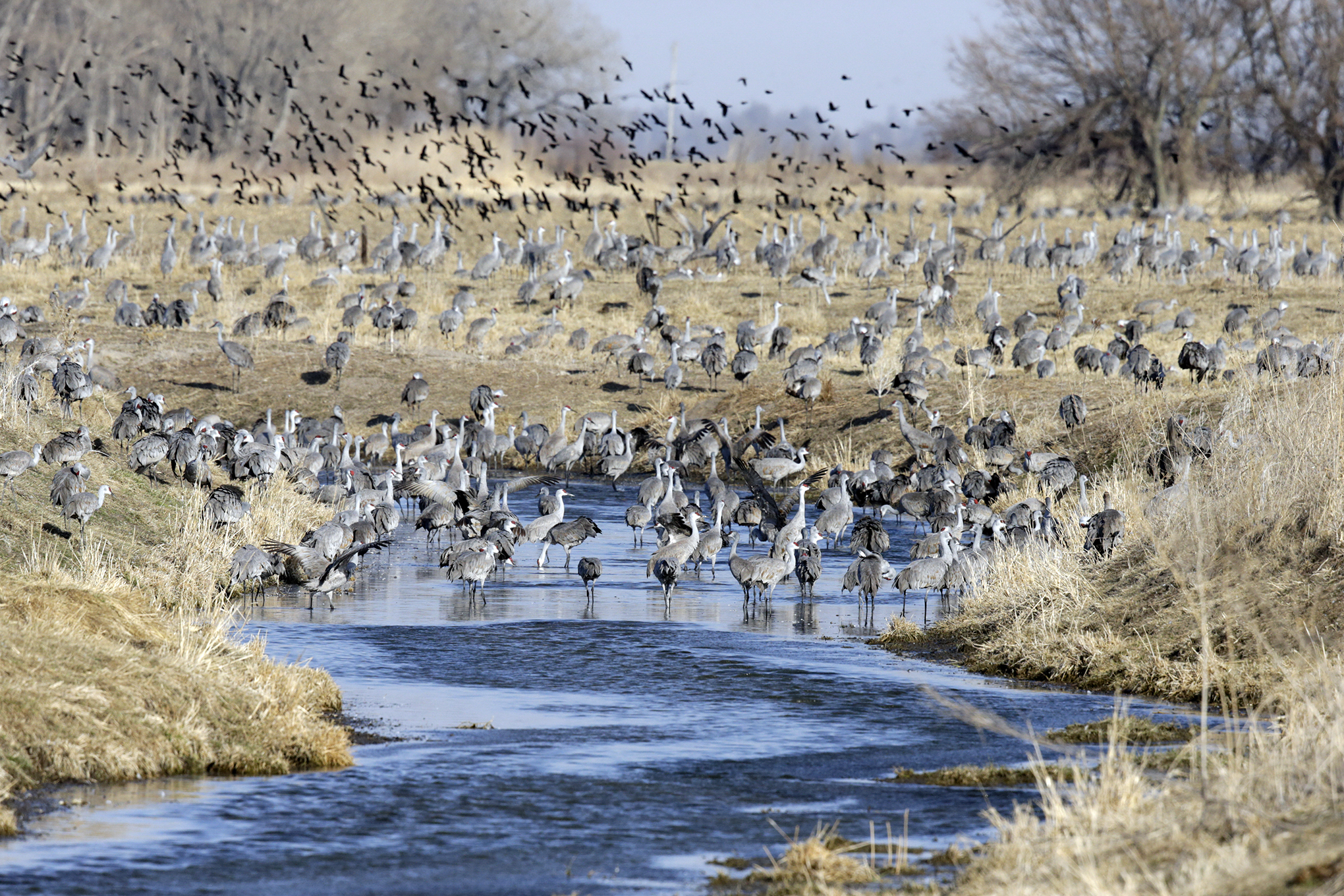
In 2025, an estimated 1,500 sandhill cranes in Indiana died of bird flu, leading to worries that an outbreak in Wisconsin combined with a sanctioned hunt could endanger the sandhill crane population.
Michalesko referenced Eurasian cranes that have suffered “consistently large, unprecedented outbreaks of Highly Pathogenic Avian Influenza.” He asserted that a similar outbreak could “completely wipe out our population.”
Heidel declared a hunt would be shut down if those concerns ever became a reality.
“The U.S. Fish and Wildlife Service has the ability to end the hunt at any point in time based on population risks,” Heidel contended. “This will be a very, very closely monitored hunt. If something like that was going to happen, they would shut it down. And everyone would be OK with that.”
Farm aid
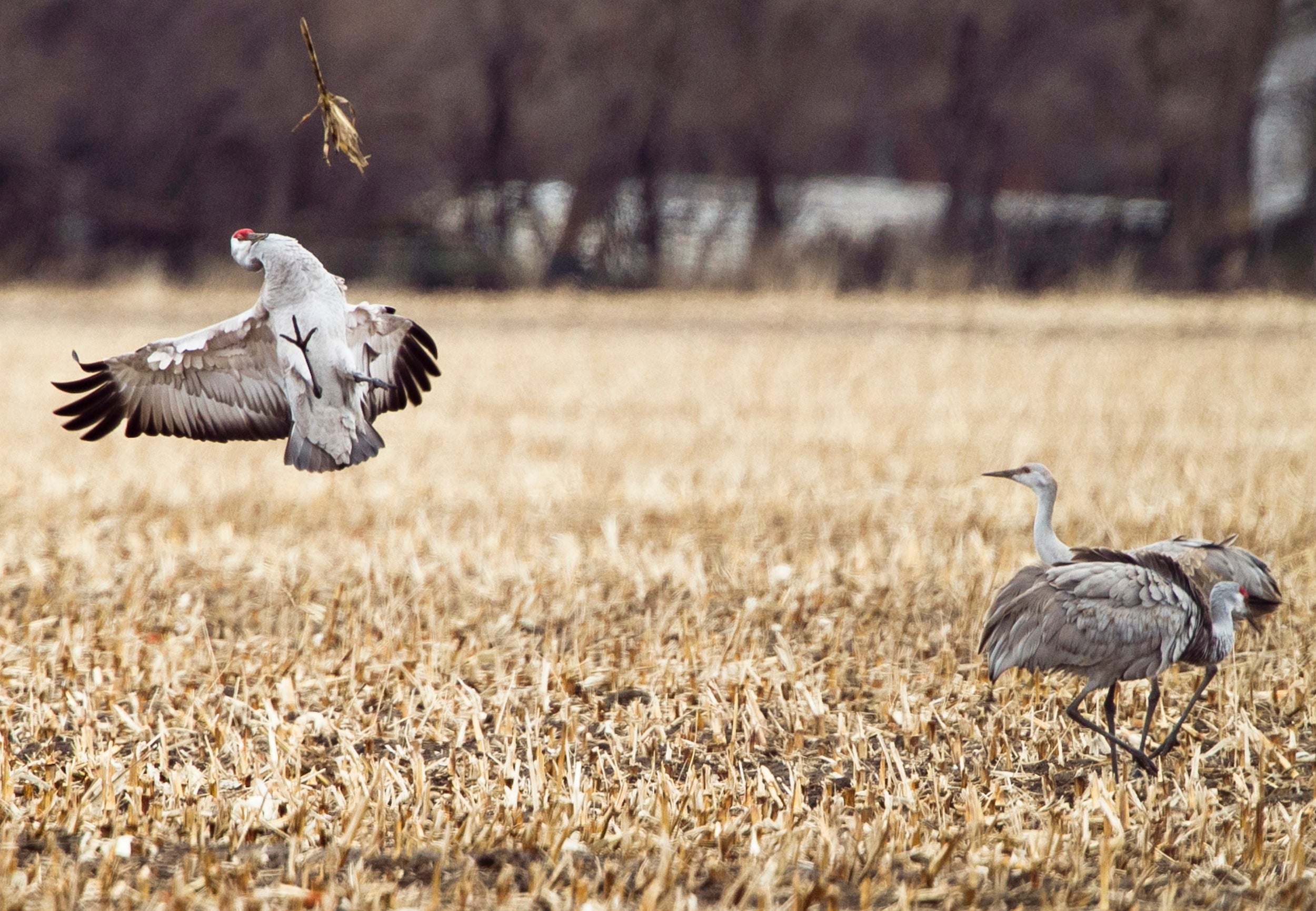
Proponents say a crane hunt would provide necessary financial assistance to farmers. “Our agriculture is seeing some significant losses due to sandhill cranes,” Heidel remarked.
With an authorized crane hunt, farmers who suffer crop damage due to cranes would be allowed to access money through the existing DNR damage abatement program. Supporters say that fund could prosper with the addition of a crane hunt.
“The sandhill crane licensees would be a new source of income for the DNR and a new source of income for that abatement fund as well,” Heidel claimed.
Michalesko asserted that the current bill is of minimal help to farmers.
“There was a whole process to write a bill that would create a hunt and include a lot of really great programs for farmers in that bill,” Michalesko argued. “That bill has been stripped back to where this is pretty much only a hunt.”
In addition, Michalesko suggested that the abatement program could actually be hurt by a crane hunt.
“During both the Assembly and Senate committee testimonies, we heard from the state migratory game bird biologists that the fund would be completely overrun by sandhill cranes,” Michalesko said. “So not only are we not putting enough money into that fund to actually help farmers through this bill, we are draining it for the farmers that already rely on it for other species.”
Heidel argued that farmers support the hunt.
“You can talk to the Wisconsin Corn Growers Association and they’ll be the first to step up and say, ‘We need this hunt to help our farms out.’”
Survey says
Meiller referenced a 2024 survey conducted by the University of Wisconsin Survey Center that indicated 17 percent of state residents supported a sandhill crane hunt while 48 percent opposed the idea.
Heidel questioned the legitimacy of the survey.
“That survey was actually put together with the International Crane Foundation,” Heidel asserted. “I can tell you that over 94 percent of (Wisconsin Waterfowl Association) members are in support of the sandhill crane hunt.”
Hunt hypotheses
Both Heidel and Michalesko said they’re basing their positions on data.
“We want this to be a science-based decision,” Heidel asserted. “We would work hand in hand with the Wisconsin DNR and federal agencies to ensure that this is a responsible sandhill crane hunt.”
Michalesko claimed a lack of data is central to his stance.
“That’s a big part of what we’re trying to get across, is that we don’t have the information to make a good judgment on this, and neither do the groups that are calling for a hunt.”
For the birds
Heidel stated that in addition to helping farmers, a hunt would add to the state’s long-standing hunting tradition.
“Hunters care just as much about the sandhill crane population as everyone else in the state of Wisconsin,” Heidel asserted. “These are birds we all love. But we also love the opportunity to get out in the field and pursue.”
Michalesko referenced a 2022 study that showed that fewer people identify as hunters than as bird watchers: “Hunters are important, but they’re not the only people that are constituents and worried about these birds. This is our time to stand up for the birds.”