Dan Freedman thinks the health care industry can be transformed by 3D printing.
“The most variable thing that we build objects for is the human body,” he told WPR’s “Wisconsin Today.” “If you’re printing anything for a person, it’s going to be different for just about everybody. And that’s where 3D printing really shines.”
Over his career as a chemist, Freedman — now a dean at the University of Wisconsin-Stout — has observed increased use of and innovation around 3D printing. For instance, he has seen a 3D printer make a prosthetic leg for a sheep.
News with a little more humanity
WPR’s “Wisconsin Today” newsletter keeps you connected to the state you love without feeling overwhelmed. No paywall. No agenda. No corporate filter.
In Freedman’s office, he even has an exact replica of the bone, muscle and soft tissue of his shoulder — 3D printed based on an MRI scan.
“You could print a (replica of a person’s) heart in a flexible material that would let a surgeon actually practice cutting it and suturing it, much as they would when they actually did the real surgery,” he said.
Now Freedman wants to turn the university’s 3D printing lab into one of the most advanced in the nation. He has been working with associate professor and biomedical engineer Anne Schmitz, who studies materials for 3D printing and how artificial intelligence can advance the industry.
Over the past six months they’ve added five industrial, state-of-the-art 3D printers to UW-Stout’s lab. That’s in addition to the 15 existing desktop-sized and smaller printers already on campus. They want to make the technology and the expertise available to students and businesses.
“You don’t have to go out and get the half-a-million dollar 3D printer because you want to do one widget,” Schmitz said. “By having a center, we make that a lot more accessible. We have this really large-scale printer. We can do one widget for you. We can do another widget for ‘Company B’, so really we’re bringing in enough projects to make that financially feasible and accessible.”
Freedman and Schmitz recently co-wrote an article for The Conversation detailing some of the latest innovations in 3D printing for health care. They shared some of those innovations with “Wisconsin Today.”
3D helps with precision and customization
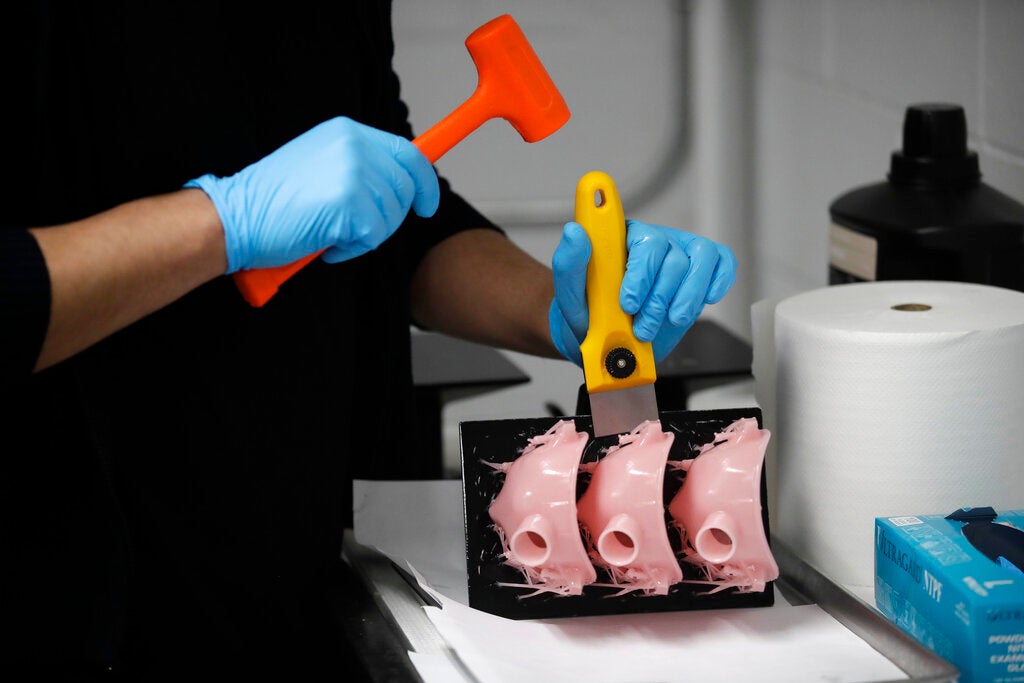
At its core, 3D printing is putting one layer of something down at a time.
These printers use different materials like plastic, nylon, carbon fiber and even calcium from bones. This is important, because 3D printing in health care requires customization, Schmitz said.
Unlike in manufacturing — where a piece of machinery makes countless identical objects — in health care, each 3D printed object can be tailored to the person. For example, traditional spine or hip implants often come only in standard shapes and sizes, even though each person’s needs are different.
By using a 3D printer, health care professionals can make a precise fit for the replacement bones in the hip or spine. They can also tailor prosthetic hands and limbs to each person.
Pharmaceutical industry uses 3D printing for coating
In the pharmaceutical industry, drug makers are using printers to personalize drug dosages and delivery systems, according to Freedman and Schmitz.
Freedman said people tend to think of medication as a one-chemical pill that is swallowed and dissolves in the stomach. But how fast the coating dissolves is carefully calibrated so the drug hits a person’s system over a set period of time.

Since printing is designed to build things in layers, it can be helpful when designing the coating or packaging around pharmaceuticals.
Freedman and Schmitz point to the antiepileptic drug Spritam, which in part is made with 3D printing. It was approved by the Food and Drug Administration in 2015 to deliver very high dosages of its active ingredient.
The future is 4D
3D printed objects are already in use in health care facilities. One of the most common is Invisalign braces, Schmitz said.
But the future of 3D printing is 4D printing.
“The fourth dimension is time,” Schmitz said. A 4D printed object for health care means that it can change shape over time, adapting to the body’s needs.
The technology uses 3D printing combined with smart material that is flexible. Although it will take time for this technology to become commonplace, researchers are working on 4D printed stents.
The stents can respond to changes in blood flow, designed to expand or contract as needed, reducing the risk of blockage, Freedman and Schmitz said.