Researchers at the University of Wisconsin-Eau Claire are developing a glove that uses technology similar to deep brain stimulation to help treat symptoms of Parkinson’s disease in a non-invasive way.
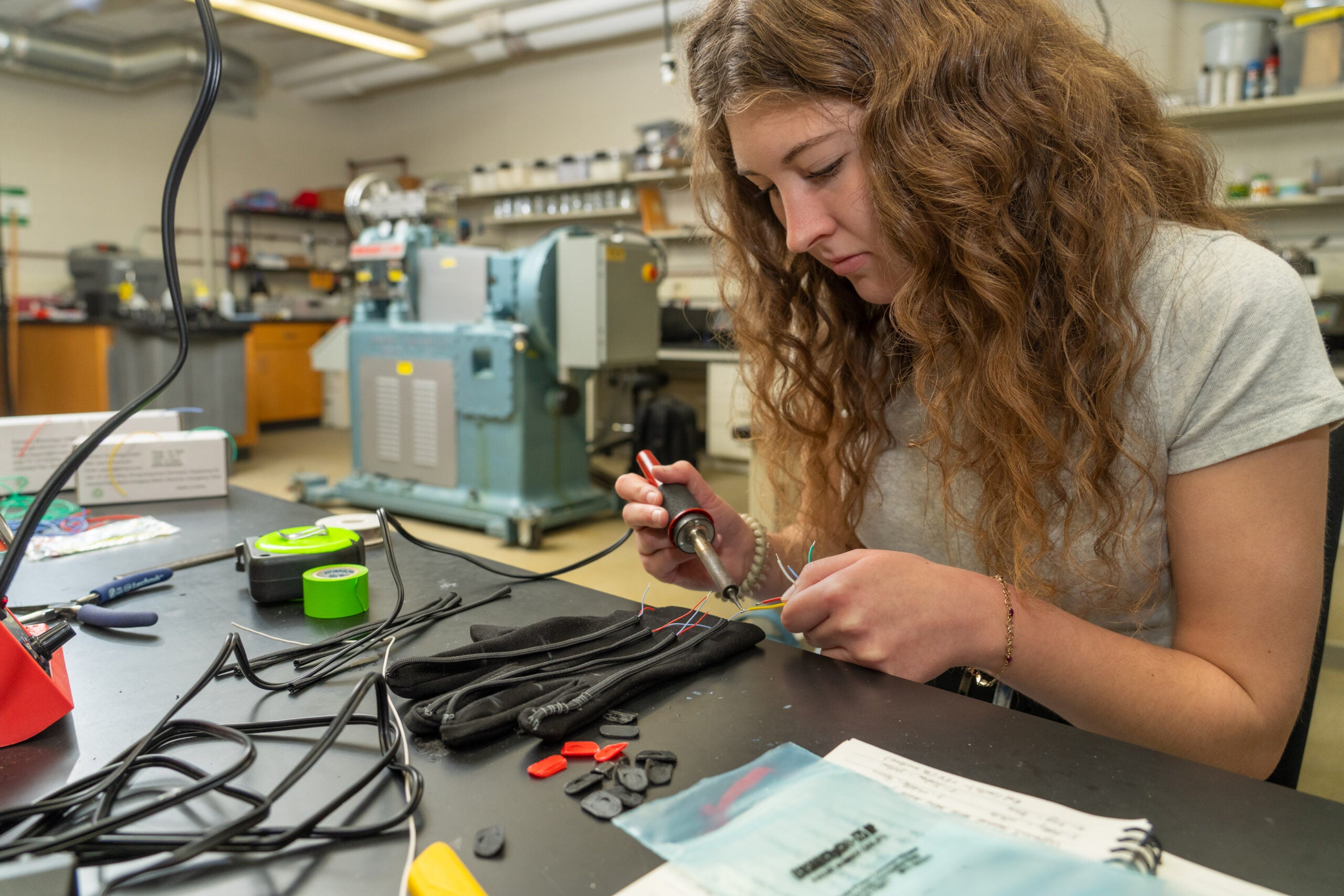
Based on a study from Stanford University, Calla Dexheimer, exercise physiology Master’s student at UW-Eau Claire, is working on the glove for her thesis.
“This is extremely exciting,” Dexheimer told WPR’s “Wisconsin Today.” “With the aspiration of getting my Ph.D., this is the perfect project for me combining all my skills that I’ve learned.”
News with a little more humanity
WPR’s “Wisconsin Today” newsletter keeps you connected to the state you love without feeling overwhelmed. No paywall. No agenda. No corporate filter.
UW-Eau Claire professor Nick Beltz told “Wisconsin Today” that he brought the idea to Dexheimer after first learning about it from people who participate in the Parkinson’s Exercise Program he leads.
“Come to find out that individuals in our community were building these gloves in their garage,” Beltz said. “They were trying to improve their own quality of life.”
Stanford University researchers pioneered the glove, and shared their design publicly. The Eau Claire-area garage engineers picked it up from there.
Now, supported by a grant from the Mayo Clinic and UW-Eau Claire Research and Innovation Council, Dexheimer and Beltz hope to further develop this technology, and make it more accessible to people with Parkinson’s disease.
According to Dacy Reimer, nurse practitioner and director of medical advising and education at the Wisconsin Parkinson Association, this is an example of Parkinson’s disease treatment research that she hopes can help people manage their symptoms in a more consistent way. That’s a topic at the forefront of Parkinson’s treatment research.
“There are four cardinal features of Parkinson’s: tremor, stiffness, slowness and what we call ‘postural instability,’ which really means balance problems,” Reimer told “Wisconsin Today.” “Some people notice that they have good times and bad times throughout the day. We call that ‘motor fluctuations.’”
These fluctuations can get in the way of people’s daily lives, Reimer said, which is why a lot of the innovative medication research right now focuses on keeping a steady amount of medication in the bloodstream throughout the day.
“They can plan ahead and then they can execute their day without their medications wearing off and their symptoms popping through and ruining the day for them,” Reimer said.
Instead of medication, the glove Dexheimer is working on relies on electricity to help manage motor symptoms of Parkinson’s disease.
“We’ve taken a gaming glove, put motors into the fingertips and sewn wires down the front side into a front pack that the participants will wear,” Dexheimer said. “The motors are sending out a stimulation, like a buzzing sensation in their fingertips, that’s supposed to mimic a type of deep brain stimulation.”
According to Reimer, a deep brain stimulator is an electrode surgically placed in the brain. The electricity can then be programmed in unique ways for individual patients.
“It has to do with controlling electricity, much like you do a heart pacemaker,” Reimer said. “This is a pacemaker for the brain. It can be very effective.”
Now, Dexheimer and Beltz are working with people in their community to help refine the glove’s form and function.
“Once we get this rolling, we add to the generalizable body of knowledge on the potential for these gloves,” Beltz said.