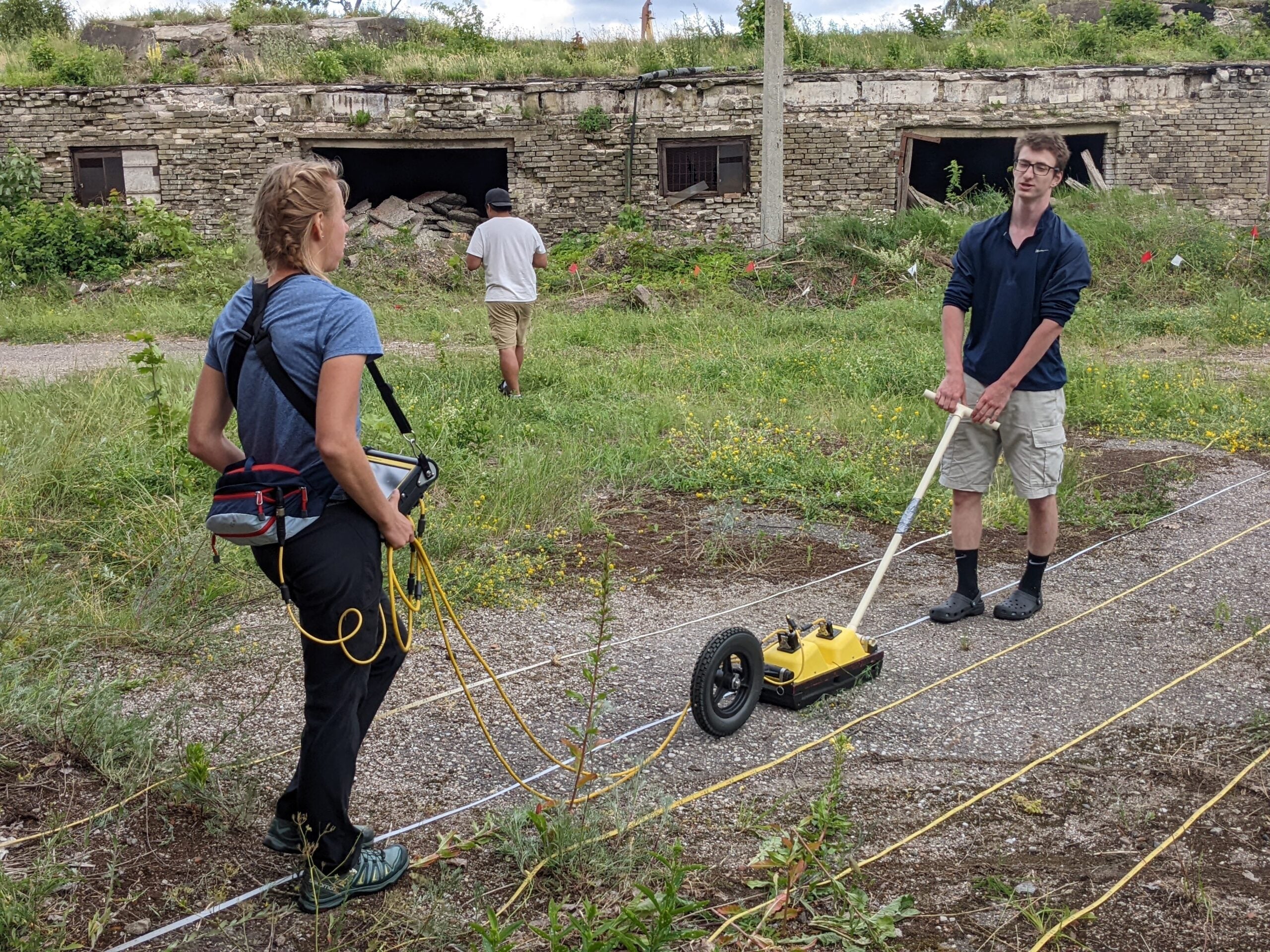
Over the past seven years, a University of Wisconsin-Eau Claire professor and dozens of students have been finding and documenting evidence of one of the darkest chapters in human history.
Using ground penetrating radar, they’ve located several mass gravesites from the Holocaust across Eastern Europe.
Professor Harry Jol and his teams of students have been piecing together testimony from Holocaust survivors, archived Nazi aerial photographs and subsurface radar images since 2018, in hopes of solving puzzles in what he calls “a very deep and dark area to do research in.”
The goal is grim: find proof of massacres beneath the soil.
“A lot of these places of learning, places of worship, places where people played, had all disappeared in the landscape,” Jol said. “And what we started finding out is that these places are still here, but underneath the market square or underneath the elementary school or underneath the roadway. And then the question is, ‘Where are all these people?’”
News with a little more humanity
WPR’s “Wisconsin Today” newsletter keeps you connected to the state you love without feeling overwhelmed. No paywall. No agenda. No corporate filter.
Jol said requests for his specialty research have come in a variety of forms. Jewish organizations have asked his team to verify suspected mass graves. They’ve also been contacted by people in developing nations worried about paving over history.
“We’re often asked, ‘We think this is a low area, a depression area. We don’t know if it’s a mass execution site, or if it is just low ground, and we can build the railway next to it, right?’” said Jol.
In 2016, Jol was part of an international team of researchers that found a long-lost escape tunnel near Vilnius, Lithuania that was dug by Jewish prisoners forced to burn the bodies of up to 100,000 people murdered by Nazi soldiers.
The discovery made international news, and the work of Jol and his students have been featured in multiple documentaries that have run on the National Geographic Channel, Nova and the BBC. But he said the most impactful moments during his time in Eastern Europe were when a student recognized the scale of another mass gravesite they detected and told him, “I was walking on 1,000 people today.”
“This is something that no one has found for 80-plus years, and now we can tell their their children or their grandchildren or family members that this is that location,” said Jol.
He said the UW-Eau Claire research team has been joined at survey sites by surviving relatives of Holocaust victims, and he remains in touch with several more. Jol said he’s recruiting another batch of students for another four-week research trip in the summer of 2026.

Wisconsin Public Radio, © Copyright 2026, Board of Regents of the University of Wisconsin System and Wisconsin Educational Communications Board.