There are nearly 1,000 Native American tribes. But according to the Bureau of Indian Affairs, there are 574. What happened to the other 400?
The answer is right there on the Bureau’s website with a prefix and a caveat that may not even register if you’re not Indigenous — the term “federally recognized.”
Federal recognition is a legal status that grants sovereignty to tribes, allowing them to have a government-to-government relationship with the United States.
News with a little more humanity
WPR’s “Wisconsin Today” newsletter keeps you connected to the state you love without feeling overwhelmed. No paywall. No agenda. No corporate filter.
Recognized tribes have rights that unrecognized tribes do not. Non-recognized tribes missed out on Covid relief funds. They don’t have access to funding for language preservation. They are not covered by the Indian Child Welfare Act, the Indian Arts and Crafts Act or any other laws designed to protect tribes. Unrecognized tribes are sometimes not even recognized by other tribes.
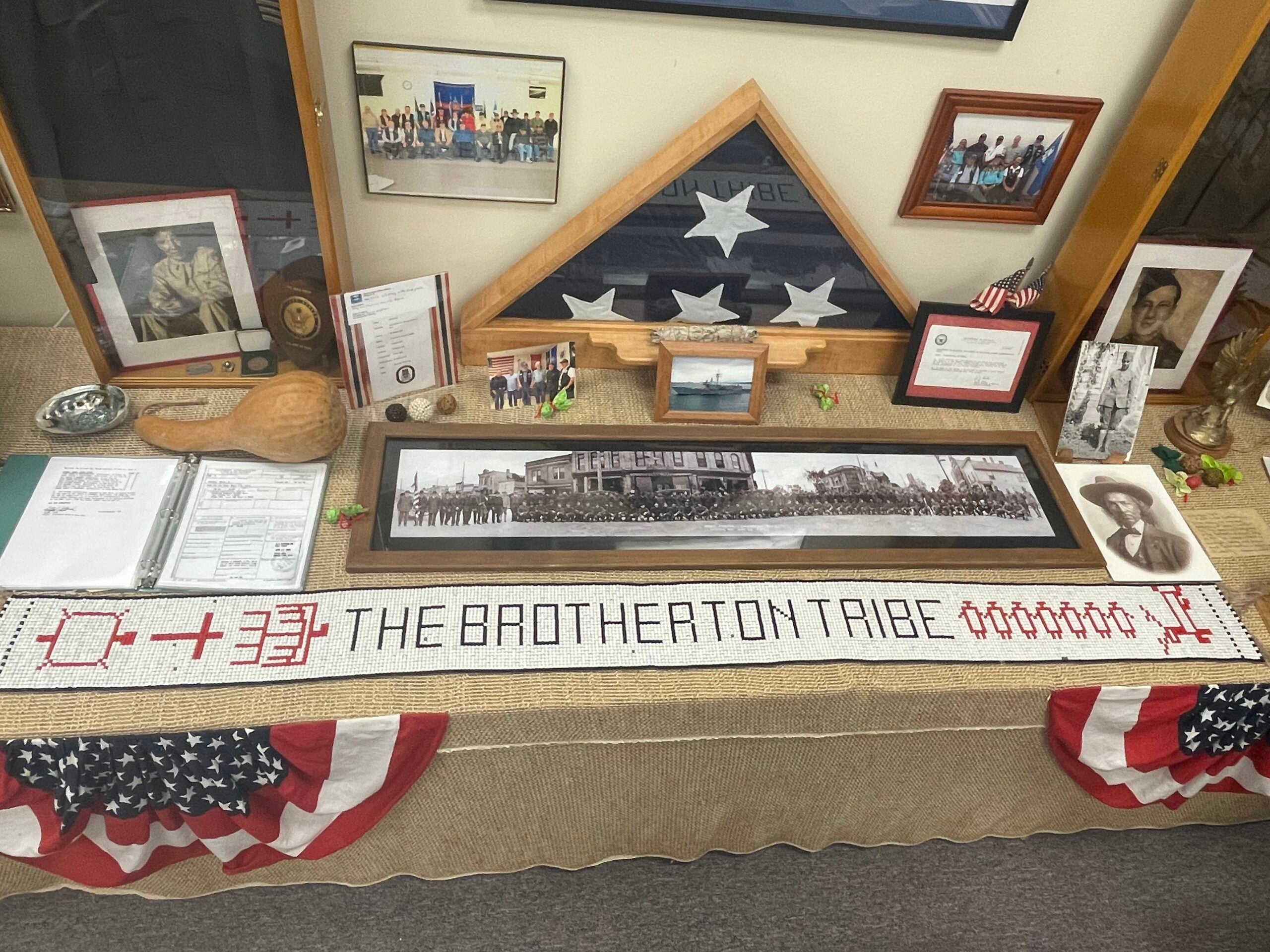
“There was a time when a lot of other tribes did not recognize us,” Phyllis Tousey, chair of Wisconsin’s only unrecognized tribe, the Brothertown Indian Nation, explained to WPR’s “Wisconsin Today.”
“I can remember when I was a lot younger, if you said you were a Brothertown Indian, somebody might say, ‘What, who?’ That can be quite detrimental to your self-concept and your identity,” she said.
For the Brothertown, lack of federal recognition has even threatened the tribe’s ability to preserve its own heritage. Tousey told a story about how a non-Native man came in possession of a trove of tribal documents that he tried to sell to the tribe for $1 million. “We had no ability to reacquire that,” she said.
The Oneida Nation, a recognized tribe that often acts as an ally to the Brothertown and has some shared history, stepped in to protect and preserve the Brothertown’s collection.
The story highlights the vulnerability of unrecognized tribes; they are at risk of losing control of their own history.
On their own terms
In a “Los Angeles Times” article, Indigenous scholar and author Olivia Chilcote wrote, “In pursuing federal recognition, tribes confront the United States’ enduring power to define Indigenous identities on its own terms.”
Chilcote is an assistant professor of American Indian Studies at San Diego State University and the author of “Unrecognized in California: Federal Acknowledgment and the San Luis Rey Band of Mission Indians.” She is also a member of that tribe.
Many tribes — more than 100 — that lack recognition lost that status in the 1950s and ’60s, when Congress passed a series of laws ending the government-to-government relationship between tribes and the U.S. This so-called “termination era” of federal policy was cast as a way to grant tribes greater freedom from the government. The era actually resulted in loss of crucial rights — and millions of acres of land.
However, the majority of tribes that lack recognition today never had that status in the first place, Chilcote explained.
“Some had the status at one time, but for various reasons the government-to-government relationship ceased and wasn’t actually terminated through legal mechanisms,” Chilcote wrote in an email.
This is the case for the Brothertown. In the 19th century, the government terminated the Brothertown’s sovereign status without the tribe’s knowledge.

The long struggle
The Brothertown people were forced to move many times over the course of their history, eventually making their way from the East Coast to Wisconsin. When the government tried to force the tribe to move again in the 1830s, this time to Kansas, the tribe refused via legal maneuvering. They requested allotment of their land and for U.S. citizenship.
“There was a belief that owning our land individually — which tribal people were not used to — and being citizens would protect us and would prevent us from being removed to Kansas,” Tousey said.
“I believe that our ancestors, our leadership, looked around and realized, of course, that no one was asking the non-Indians to move so their land could go to someone else,” Tousey said.
The strategy worked. The Brothertown were able to stay in Wisconsin. But unbeknownst to the tribe, the government had terminated the Brothertown’s sovereign status when they became citizens.
The tribe has spent the last 45 years trying to get the government to fix this problem. For three decades, the Brothertown worked to gather the necessary documentation to apply for federal recognition. But the government rejected the tribe’s petition in 2012, informing the tribe they should have been petitioning for restoration, not recognition.
The onus is on tribes to correct the government’s wrongdoings in this arena, and it’s not easy. In California alone, which has the most unrecognized tribes of any state, 81 tribes have petitioned for recognition, while only one succeeded.
“I make sense of [the history and current federal recognition process] in understanding that in a lot of ways, it’s by design,” Chilcote said. “Because … the United States is a settler colonial nation. It’s a kind of colonization that happens here in the United States, in Canada, Australia, New Zealand … all with that same goal of taking Native people’s land. And the lack of access to land, in many cases, then creates this condition in which tribes lack federal recognition.”
The Brothertown are still fighting for restoration of that government-to-government relationship today.
“We are still here. We are still operating as an Indian tribe, but we are doing that on our own power,” Tousey said. “This is a hard road, but we’ve been through a lot.”