Earlier this year, school leaders across Wisconsin asked the Republican-controlled Legislature to boost funding for special education services in public schools.
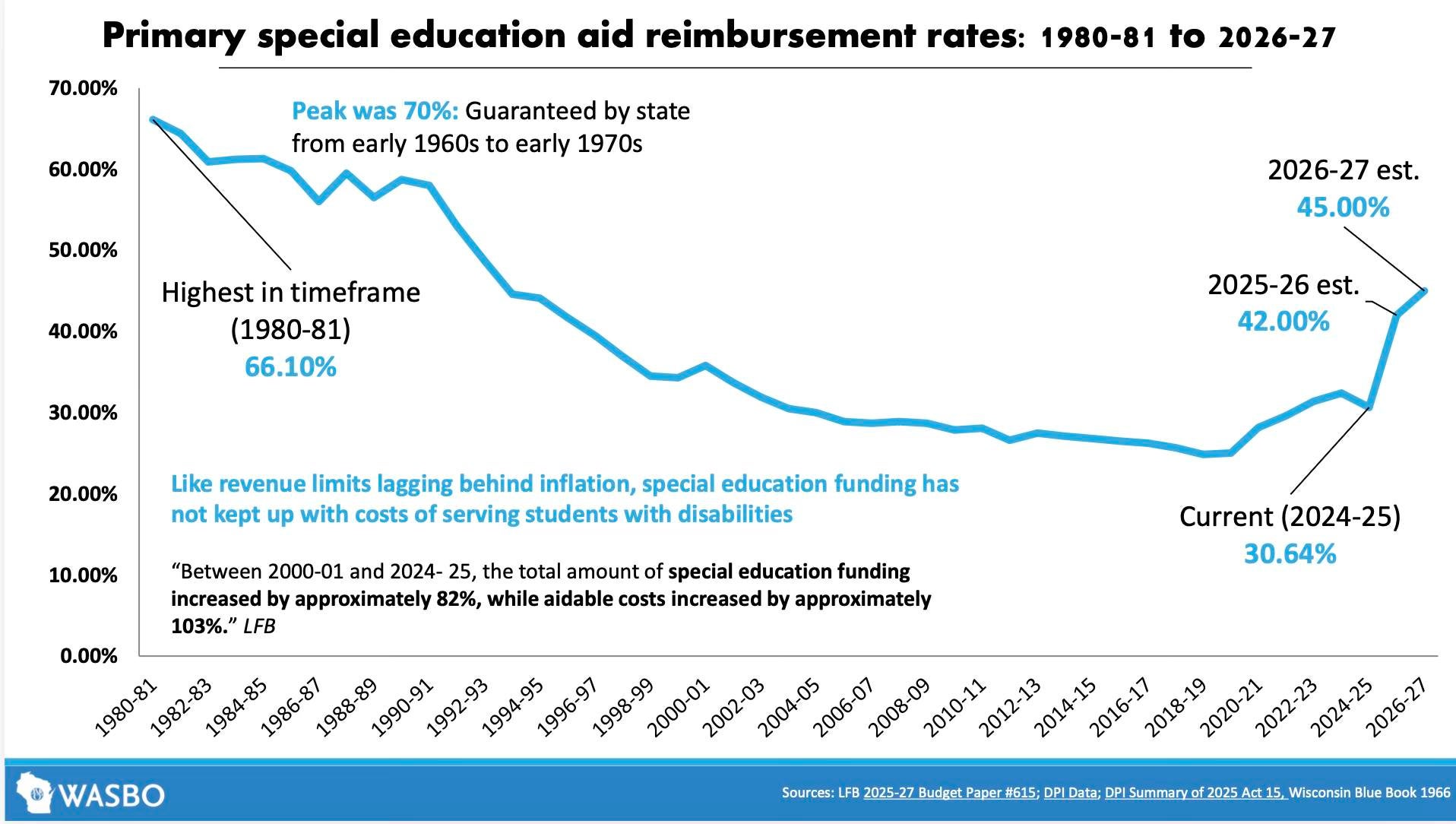
The biennial budget included a reimbursement rate from the long-standing 32 percent to 42 percent this year and 45 percent next year.
In exchange, public schools are not receiving an increase in general aid over the biennium.
News with a little more humanity
WPR’s “Wisconsin Today” newsletter keeps you connected to the state you love without feeling overwhelmed. No paywall. No agenda. No corporate filter.
Gov. Tony Evers praised the bipartisan deal as the largest increase to special education in the state’s history.
But some education advocates, including the Wisconsin Public Education Network, said the budget remained “woefully inadequate to meet school districts’ needs.”
An email sent to school officials on Nov. 17 by the Department of Public Instruction shows that could be correct.
Public Schools are receiving $140M less than expected
School districts are going to receive about $140 million less than they originally expected to provide special education services this year.
The state will be reimbursing the services — which public schools are legally obligated to provide — at 35 percent, instead of the expected 42 percent.
That’s because school districts spent more on special education than the Legislative Fiscal Bureau estimated, according to DPI.
“State categorical special education aid is a sum-certain appropriation as determined by the legislature, which means that it is paid from a fixed pot of money,” according to DPI. “In some cases, the overall reimbursement rate is lower than originally estimated by the Legislature.”
Peggy Wirtz-Olsen, president of the Wisconsin Education Association Council, said the lower reimbursement rate will mean more districts will have to ask taxpayers for money through referendum in 2026.
“Lawmakers who voted for this state budget have turned their backs on our most vulnerable children, failing to deliver on promised special education funding and leaving our students without the supports they need to succeed in school,” Wirtz-Olsen said in a statement.
Joint Finance Committee co-chairs Sen. Howard Marklein, R-Spring Green, and Rep. Mark Born, R-Beaver Dam, did not respond to requests for comment from WPR.
School districts bracing for lower reimbursement rate
The Green Bay Area Public School District shifts about $32 million from its operating budget to support special education programs, which are seeing a rising need.
Green Bay Schools CFO Angie Roble said even though the state budget included a 42 percent reimbursement rate this year, she budgeted conservatively at 39 percent based on history.
Hearing the district would only get 35 percent was surprising, Roble said.
“Coming in 7 percent light of what school districts were anticipating is disappointing,” Roble said.
In Green Bay, this equates to about $1 million.
The district is already operating with a $3.6 million deficit. Roble says that deficit will now grow.
“Anything we are not able to cover the cost of this year, we will use our fund balance,” Roble said. “We are trying to figure out what could possibly be cut, and what could hold off on, to at least reduce the deficit at least back to what we started at this year.”
Beth Swedeen, executive director of the Wisconsin Board for People with Developmental Disabilities, said the change in reimbursement rates is upsetting to all school districts across the state that were budgeting for the money to help cover costs.
“Schools have been starved for decades,” Swedeen said.