A growing number of Wisconsin school districts are employing teachers who hold emergency licenses.
A recent report from the Wisconsin Policy Forum found the number of temporary teaching licenses reflects staffing needs, particularly in small and urban districts. Emergency licenses are temporary authorizations that allow people with education or career experience to teach without having obtained a permanent teaching license.
The state Department of Public Instruction issued about 4,000 emergency licenses in the 2023-24 school year. That’s up about 1 percent from the previous school year, but it’s a nearly 20 percent increase from 2022, according to the report.
News with a little more humanity
WPR’s “Wisconsin Today” newsletter keeps you connected to the state you love without feeling overwhelmed. No paywall. No agenda. No corporate filter.
The increase in emergency teaching licenses was higher in extracurricular subjects. For example, from 2022 to 2024, emergency licenses in Spanish grew by 49 percent. Physical education grew by 96 percent.
The three subject areas with the most emergency licenses were special education, regular education and elementary/middle education. These grew by a collective 10.9 percent over the last year, according to the report.
Concerns raised
The National Council on Teacher Quality has raised concerns about emergency teaching licenses.
Heather Peske, president of the organization, says it is a mistake to give “unqualified, emergency-licensed teachers responsibility over student learning.”
“These teachers go into classrooms without the content knowledge and skills they need to be successful with students,” Peske said in a statement. “They are less effective. And they teach the most vulnerable students at higher rates.”
The Policy Forum report found the statewide rate for emergency licenses among educators was 3.6 percent. But that rate is not uniform across districts.
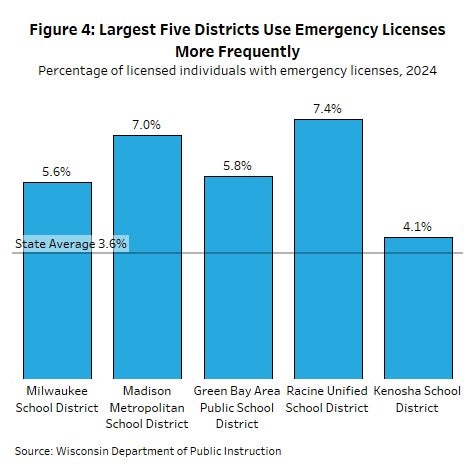
Districts with 500 to 1,000 students had an average rate of 3.3 percent in 2024; districts with 1,000 to 3,000 students averaged 2.9 percent. For the largest districts, those serving more than 3,000 students, rates were just above the statewide average at 3.7 percent.
The five largest districts in Wisconsin each had districtwide rates above the state average. Districts in suburban and town settings had average rates of 2.3 percent and 3 percent, respectively.
Teacher shortages are not universal across the state
Policy Forum researcher Donald Cramer, who authored the report, said while it is widely believed there is a teacher shortage in the state, there are still many teachers graduating from Wisconsin universities.
“But there are shortages in specific areas and specific regions in the state,” Cramer said.
Cramer believes many of the people seeking an emergency license are choosing a non-traditional route into the classroom after getting a bachelor’s degree in something else and deciding later they want to teach.
“Instead of going back to school for four years and getting an education degree, they’re taking their English degree or their science degree and taking this route,” Cramer said. “Because when they were 18 years old, they didn’t realize that they wanted to become teachers.”
The most typical route to become a teacher in Wisconsin is to earn a bachelor’s degree in education, meet the state’s licensing requirements and earn a Tier II provisional license.
Teachers who do not follow that route can obtain a Tier I temporary license if they have earned a bachelor’s degree and passed a background check.
Educators with Tier I licenses are allowed to work in schools for up to three years while they work towards a Tier II license. Some teachers who get a Tier I license may also have a Tier II license in another subject area.

Wisconsin Public Radio, © Copyright 2026, Board of Regents of the University of Wisconsin System and Wisconsin Educational Communications Board.