Many of Anthony Bukoski’s characters in the new collection “The Thief of Words” style themselves after fictional antiheroes like Tennessee Williams’s Blanche DuBois or Elvis Presley’s character Danny Fisher in the movie “King Creole.” They listen to Jerry Lee Lewis, Gene Vincent and Chuck Berry.
Bukoski was born and raised in Superior and lives there today. He said pop figures of the 1950s and ’60s play such a big part in his book because he wasn’t allowed to enjoy them when he was growing up.
“My father was strict, and he followed the Catholic Legion of Decency. As a boy, I could only see movies that were morally unobjectionable for all,” Bukoski told WPR’s “Wisconsin Today.” “(My stories are) a chance for me to imagine what I could not experience as a boy.”
News with a little more humanity
WPR’s “Wisconsin Today” newsletter keeps you connected to the state you love without feeling overwhelmed. No paywall. No agenda. No corporate filter.
“The Thief of Words” is full of references to Bukoski’s own life, like his Polish background and his complicated relationship with his father, particularly after his father’s death.
Bukoski recently spoke with “Wisconsin Today” about “The Thief of Words” and the many references culled from his own life for the book.
The following has been edited for clarity and brevity.
Rob Ferrett: Some of the pop culture references, including the Elvis movie “King Creole” are from the late 1950s or early 1960s. This is a time that often gets treated with nostalgia. You don’t. Many of the people in your stories are adrift and unhappy. What are your thoughts on our nostalgia toward that era and the stories you tell of it?
Anthony Bukoski: Partly I write about these things because I wasn’t allowed to see too many movies. Yet I wanted, as most curious young people do, to learn about another side of life.
And the titles appealed to me — “A Streetcar Named Desire.” And characters, I’d hear my friends talk about Elvis as King Creole, for instance, a rebel in New Orleans. These characters I found so appealing.
The king plays a big part in this (collection), as do Jerry Lee Lewis, Gene Vincent, Chuck Berry and others from that period.
RF: Reading your book, I realized I don’t see a lot of books with Polish-American people in places like Superior and Louisiana in the post-World War II era. What drew you to their stories?
AB: My grandparents on both sides came from the old country. I went to a Polish church. It’s now been razed, so we can’t attend St. Adalbert Church anymore, but this is very much a part of my life, my upbringing. I went to a Polish Catholic grade school, St. Edward’s in the east end of Superior. It’s informed my life and improved it. It gave me some foundation, some place, some culture to which I can belong.
RF: Superior is a character almost bringing the different stories in this book together. What is this sense of place to you?
AB: I desire no place but Superior. My wife and I have … lived in the most beautiful places. Lexington, Massachusetts. We lived in Natchitoches, Louisiana, which is a gorgeous town and which appears in this book of stories.
But always my heart longed to return to my home. I know what to expect here. I know what to expect of the weather, of the landscape, the botany, many other aspects of this place (that) are so richly my life that I couldn’t be happy anywhere else.
RF: The title story, “The Thief of Words,” is told from the perspective of a boy growing into a young man and his views of his father. How does the story draw from your own life?
AB: We’re recording this interview at the home of my friend Tom Johnson. We’re about a quarter-mile from the flour mill. It’s not King Midas anymore. I don’t even know what they do down there anymore, but my father … worked in the flour mill.
He walked, sometimes seven days a week, down the tracks, under the viaduct, beside the ravine, past the oil dock, on into the flour mill, which was a terrible, noisy, dangerous place. He did it day after day after day, and he rarely took the car to work, though it was a quarter mile walk, if not more. He rarely took the car because he didn’t want to get it dirty. So there he was, and then the poor guy takes his lunch bucket and comes home after work and has a beer, maybe a beer and a shot. And then he plays the accordion in the evening. What a difficult and demanding life. And yet he endured. He endured, and he was sometimes difficult to my sister, Mary, and to me.
And he is (difficult) in the story. In the story he robs the children when they want to talk and tell their father at supper about what has happened in their lives during the day, he starts telling his own stories, and, in a sense, robs them of the chance to tell their stories. The boy in the story resents this. But then later in life … the boy remembers his father, and in doing so, he calls out father in two languages. The one language he’s calling father, and in Polish he’s saying “ojciec.”
RF: Quoting from the story here, “I don’t hate my old man. He’s like he is, for a reason. He never got to be what he wanted.” The charity and grace that ends with, is that something that you experience in your own life?
AB: I’m trying to. I keep asking (for) my father’s forgiveness, though he’s been gone since 1985. I pray for that forgiveness. And on the other hand, I hold certain grudges, but who doesn’t have grudges toward their parents?
My father had more strength than I have ever had, psychologically, physically, probably emotionally. I haven’t one-tenth of the strength that he had, and here he worked all of those years. I’m glad that I could express this kind of confession in the book.
RF: Your characters seem to be trying to find a home. Among other people, you were born in Superior, you return there and you’ve said, that is the place for you. What is it that makes Superior your home above all others?
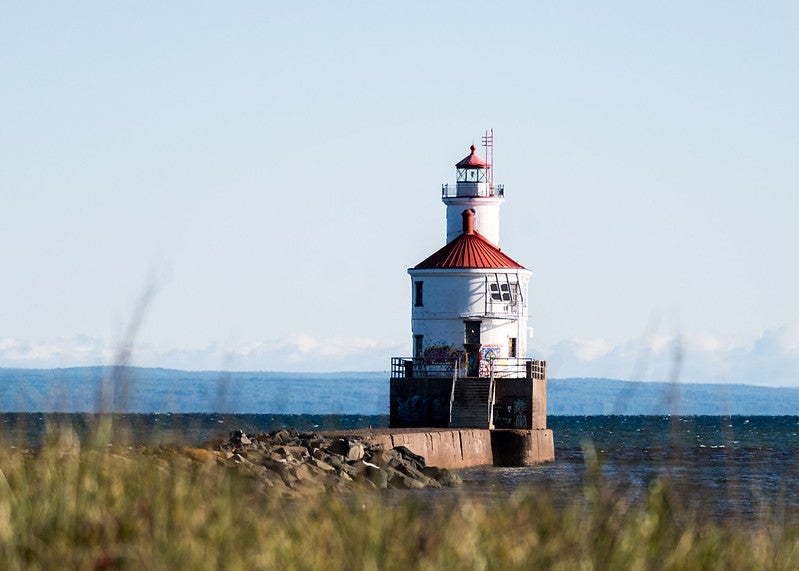
AB: It’s the smell of the oil refinery. Nothing like living 25 or 30 years smelling hydrogen sulfide when the wind comes out of the south. We had the only oil refinery in the state of Wisconsin. You can hear also — to someone aware of these things and in love with these things — you can hear boats in the harbor. You can sometimes, when there is a strong northern wind off of Lake Superior … I swear, you can smell fish from the lake as far inland as a mile away.
All of these markers — sensual markers, actual physical markers — the viaduct, the creek, all of these things appeal to me. And I know when things will bloom. I know when the lilacs will come out, later than other places in the state of Wisconsin. I know that the peonies will follow them. There’s so much to say about this place and so much to love about it, and that’s what I have tried to do through eight books. It never leaves me.