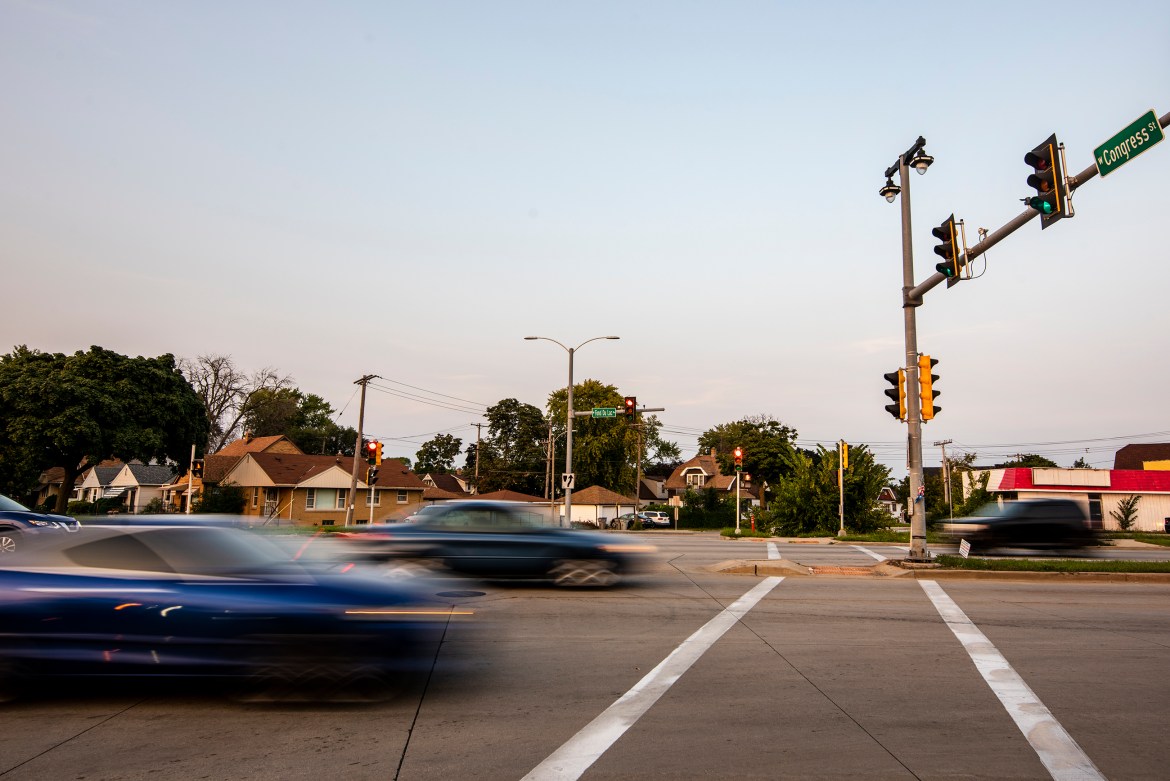
A Republican-backed bill seeks to change the process for adding wheel taxes in Wisconsin by requiring approval from local voters before those vehicle registration fees can be imposed.
Fourteen Wisconsin counties and more than 50 municipalities have wheel taxes in place. Residents in those communities must pay that added fee each year when they register a car, truck or motorcycle.
In Wisconsin, those fees range from $10 to $40 a year in each jurisdiction. Drivers in some Wisconsin communities have to pay both a local and a county wheel tax.
News with a little more humanity
WPR’s “Wisconsin Today” newsletter keeps you connected to the state you love without feeling overwhelmed. No paywall. No agenda. No corporate filter.
A group of GOP lawmakers say the fees amount to taxation without direct representation, and they’re calling for a requirement that taxpayers approve wheel taxes through referendum before they can be imposed.
Meanwhile, local government leaders have raised alarms about the bill, saying it would make it harder for communities to fund road paving and other transportation projects.
Proposal could lead to repeal of wheel taxes in scores of communities
Under the proposal, a new wheel tax could only be imposed if it’s approved by a majority of voters in a referendum.
The bill also would affect the scores of communities that already have wheel taxes, by opening the door for those fees to be eliminated.
Under the proposal, an existing wheel tax would be repealed if local voters don’t agree to uphold the wheel tax during an election that happens within 18 months of the bill becoming law.
“Just as schools must go to referendum when they want to raise revenue, local government should do the same when proposing a wheel tax,” said state Rep. Dave Maxey, one of the bill’s authors. “Taxpayers deserve transparency, accountability, (and) above all, a voice on how their money is spent.”
Maxey’s district includes New Berlin, where Common Council members discussed a wheel tax before withdrawing the proposal earlier this year.
Last year, counties, cities and villages across Wisconsin collected nearly $67 million from their wheel taxes. Under state law, those communities have to use that money for transportation-related purposes.
Bill draws opposition from local government leaders
The Wisconsin Counties Association and the League of Wisconsin Municipalities both registered against the bill. State law limits the ability of local governments to raise property taxes without voter approval, and supporters of the wheel tax say the fee is one of few options that communities have to bring in money.
Evan Miller, a lobbyist with the league, said elected officials already take input from their constituents. He argued the bill would create an unnecessary barrier.
He said local communities are already struggling to fund road repairs while faced with rising costs for equipment and labor. For many communities, he said wheel taxes are a predictable source of revenue even as other funding sources — like money from the state and federal government — fluctuates year over year.
“The wheel tax is the only remaining viable and reliable solution for municipalities to fund local transportation projects on their 21,000-plus road miles,” Miller told legislators.
He said the revenue allows communities to cover transportation expenses without “without requiring levy limit exemptions, referenda or cuts to other municipal services like police, fire, parks and libraries.”
So far, the bill has the backing of more than a dozen legislative Republicans with no Democrats listed as sponsors. But not every Republican supports the proposal.
GOP state Rep. Todd Novak, of Dodgeville, opposes it. In Wisconsin, city councils or village or county boards vote on whether to impose a wheel tax, and Novak pointed out that voters already have a chance to choose those elected officials.
“I’m hearing it (the bill) out of a courtesy to you both, because you’re both my friends,” Novak told the bill’s authors. “As a local government guy, if they don’t like a wheel tax, they can replace the board.”
Novak chairs the Assembly Committee on Local Government, which heard testimony on the bill last week. He previously served 12 years as the mayor of Dodgeville.
Growing number of communities use wheel taxes
In 2011, only four Wisconsin communities had a wheel tax, according to the Wisconsin Policy Forum.
In this years since, that number has exploded, with wheel taxes imposed in scores of communities. That includes small towns like the village of Potosi, which has a $10 wheel tax, as well as cities like Green Bay, which has a $25 wheel tax, and suburbs like Fitchburg south of Madison, home to a $40 wheel tax.
In Madison, the city’s wheel tax is $40 on top of the $28 wheel tax for Dane County. Both the city of Madison and the Dane County Cities and Villages Association have registered against the bill.
Madison’s wheel tax raised $7 million last year to fund to the city’s Metro Transit bus system. Madison’s Chief of Staff Sam Munger said the bill would impose “yet another onerous restriction” on the ability of local governments to pay for infrastructure.
“Wisconsin state law already imposes drastic restrictions on local municipalities that prevent them from using diverse and progressive revenue sources,” Munger said in a statement. “These state restrictions have forced property taxes ever higher to cover the cost of basic services.”
Meanwhile, multiple local governments throughout Wisconsin are considering raising existing wheel taxes. In Eau Claire, the city manager has asked the Common Council to approve increasing the city’s wheel tax from $26 to $50, to bring in an additional $1 million in revenue.
In addition to the city’s tax, Eau Claire County has a wheel tax at $30.
In Milwaukee, Mayor Cavalier Johnson has proposed raising that city’s wheel tax from $30 to $40 to bring in an additional $3 million a year, although Urban Milwaukee has reported that Milwaukee’s Common Council has taken steps to delay action on that proposal. That added fee would be imposed in addition to Milwaukee’s County’s $30 wheel tax.
In a statement provided to WPR, Johnson’s office criticized the bill.
“The city of Milwaukee has a responsibility to maintain its transportation infrastructure and has very limited funding to cover those costs,” city spokesperson Jeff Fleming said. “This latest legislative proposal would simply make it harder for Milwaukee to maintain our roadways.”

Wisconsin Public Radio, © Copyright 2026, Board of Regents of the University of Wisconsin System and Wisconsin Educational Communications Board.