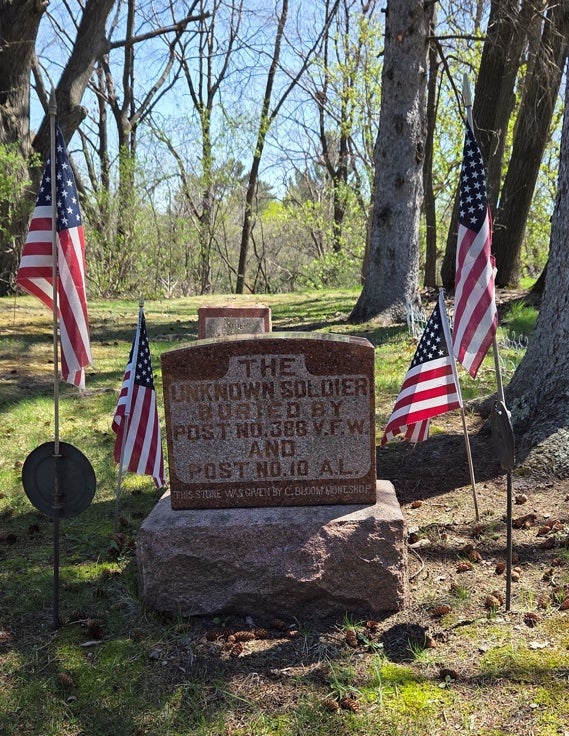
A grave long marked only as “Unknown Soldier” in a quiet corner of Restlawn Memorial Park in Wausau was opened last month, as part of a statewide effort to identify missing service members through DNA technology.
The exhumation, carried out June 6, is part of the Missing in Action Recovery and Identification Project at the University of Wisconsin-Madison Biotechnology Center. That project works to identify remains of service members declared missing in action, many of whom still have living relatives.
In this case, investigators believe the unidentified man was a World War I veteran who had fallen on hard times and died by suicide.
News with a little more humanity
WPR’s “Wisconsin Today” newsletter keeps you connected to the state you love without feeling overwhelmed. No paywall. No agenda. No corporate filter.
In a conversation on “Morning Edition,” Ryan Wubben, a member of the MIA Recovery and Identification Project team, said little is known about the man who died in 1930. Local Veterans of Foreign Wars members arranged his burial, but his name and story were lost to history — until now.
“What we know is that he wasn’t from the area,” Wubben said. “This gentleman had come from somewhere else. He didn’t have a name anyone knew.”
Now, investigators are hoping to find a match for the man’s DNA in a worldwide forensic database. If they’re successful, the man’s body can be returned to his family, 95 years after his death.
The exhumation in Wausau is one of several projects supported by the MIA Recovery and Identification Project, which works in coordination with the U.S. Department of Defense.
Wisconsin residents with a family member missing in action can participate in the project by providing a DNA sample to help identify remains. To learn more or get involved, visit mia.biotech.wisc.edu.
The following interview with WPR’s Shereen Siewert was edited for brevity and clarity.
Shereen Siewert: What does it feel like to be part of this effort?
Ryan Wubben: In one of the first cases I worked on, the son of the missing airman invited us to the funeral at Arlington National Cemetery, and I was able to attend with my family. There’s nothing quite like that feeling. It’s all the pomp and circumstance of a full burial with military honors. Knowing that you had an integral part in recovering the remains of that airman is a feeling that you won’t get anywhere else. It is quite special.
SS: What do you know so far about the man whose body was exhumed?
RW: Most of the records that the investigators have are handwritten notes from 1930. It sounds like he was down on his luck. In this case, we are looking to identify a gentleman who clearly was suffering from the trauma of being a combat veteran in World War I and, unfortunately, took his own life. Now it’s up to us to try to help him out by giving back his name.
SS: Tell us about the processes involved in this project.
RW: There was a team of us back on June 6 who worked together on this. Finding the exact spot where he was buried was a bit of a challenge. It’s an old cemetery with an area back in the corner without many gravestones, and many remains are interred there. We had the help of a team from the University of Wisconsin-Oshkosh with ground-penetrating radar to make sure we found the exact remains we were looking for. He was found and exhumed that day. After that, his body went to the Marathon County Medical Examiner’s Office. A DNA sample was taken and brought to the University of Wisconsin Biotechnology Center, a world-class DNA lab with a variety of protocols and techniques at their disposal. They can use even snippets of DNA to expand upon and, hopefully, make an identification. Once a full DNA profile is obtained, that is matched against forensic genealogy databases. Our hope is that we will find a living relative somewhere who is a match so we can identify this gentleman and return him to his family.
SS: How long will the process take?
RW: That’s a little unclear. Much of this is still cutting-edge technology. The actual sequencing is done on a machine and takes just a day or two. That’s a quick process, but the challenge is putting this information into a database and trying to find matches out there. That’s lengthier, though we’re only about a month from when this started compared to the decades that have passed since his death.
SS: Tell me a little more about what your team does and who is involved in these projects.
RW: Part of our job involves working with the U.S. Department of Defense. We go out into the field, groups of archaeologists, graduate students and undergrads who have gone to World War II aircraft crash sites in France and Belgium where there are many air crew members still missing in action. When we find remains, and we have done so on several occasions, we hand those off to a central identification lab. For this case, we worked primarily with the Wisconsin Department of Criminal Investigation and the Marathon County Medical Examiner’s Office, who ultimately called us to assist with this.
If you have an idea about something in central Wisconsin you think we should talk about on “Morning Edition,” send it to us at central@wpr.org.