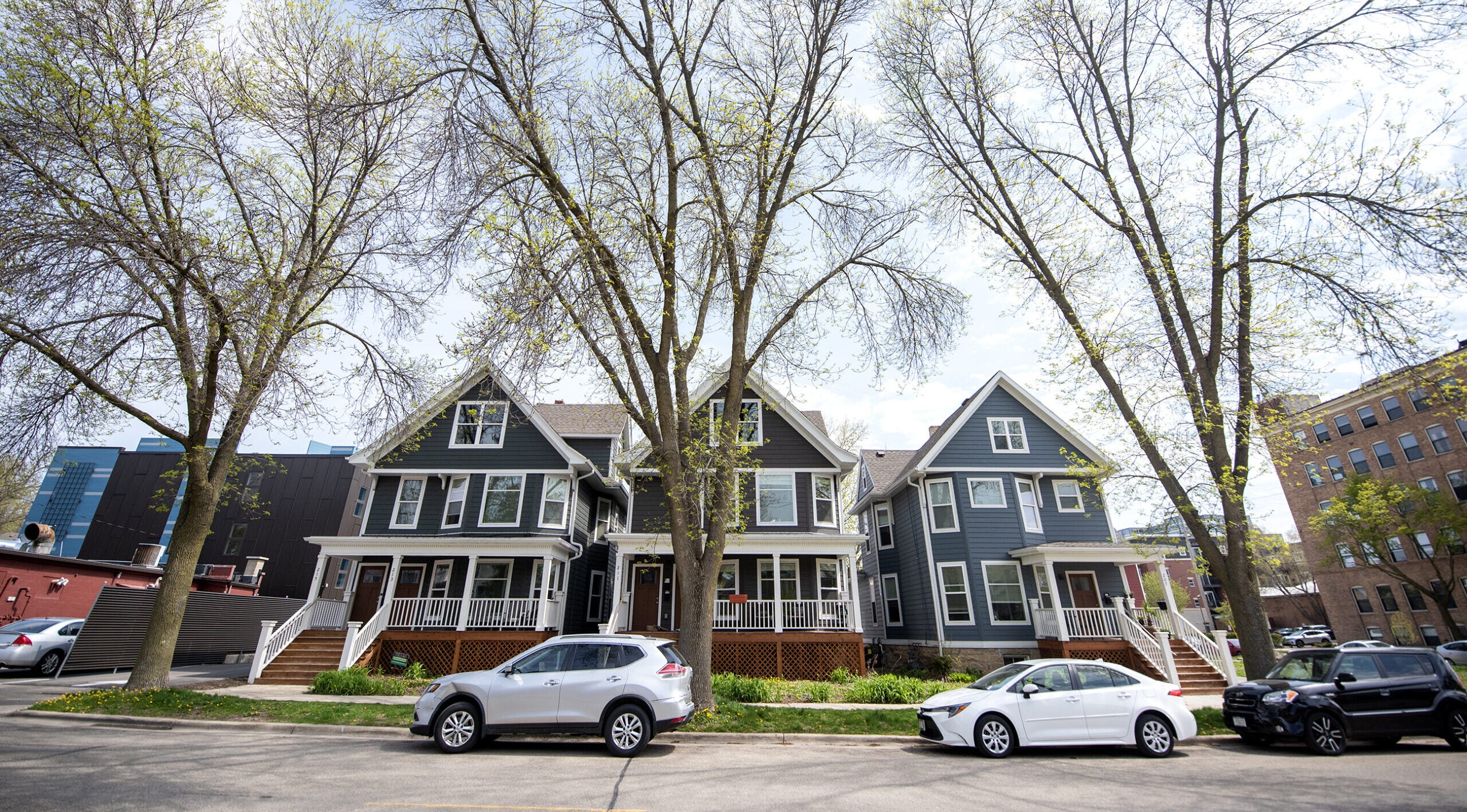
When a grand, old tree is cut down, it can take generations to replace it.
Now, Madison officials are trying to protect those trees with updated rules for construction projects.
Madison Mayor Satya Rhodes-Conway plans to introduce the changes at a Common Council meeting Tuesday night.
News with a little more humanity
WPR’s “Wisconsin Today” newsletter keeps you connected to the state you love without feeling overwhelmed. No paywall. No agenda. No corporate filter.
Madison City Forester Ian Brown said the city’s forestry department helped develop the proposed amendments based on that community feedback and on best practices from the International Society of Arboriculture.
“Madison, as we know, is a community that really values trees and canopy.” Brown said. “What we saw was that there could be situations where trees were not being fully valued or fully accounted for within projects, and so (we’re) trying to strike a balance between developing and redeveloping a community like Madison … but also trying to weigh and balance the needs of the trees and the future canopy.”
A few large trees provide the greatest benefit
In particular, Brown said the changes aim to shield older, bigger trees.
A recent study from the Wisconsin Department of Natural Resources found that, in Madison, just 10 percent of trees account for more than half the city’s leaf cover. Those are the trees with trunks measuring more than 15 inches in diameter.
“A small number of very large trees provide the vast majority of the benefits,” Brown said. “You get some benefit, I suppose, from small stature trees or immature trees, but really it’s the big ones that count.”
A leafy canopy provides shade, increases property values and improves air quality. Trees also reduce flooding by absorbing rainwater and counteracting soil erosion.
And more greenery just makes Madison a more pleasant place to live, Brown said.
“Think about people who want to window-shop on the sidewalk,” Brown said. “They’re much more likely to do that if they can do so from the shade of the tree, as opposed to baking in a concrete jungle.”
Currently, Madison’s ordinances establish what’s known as a tree protection zone within a 5-foot radius of a tree. Within that zone, contractors need special permission to disturb a tree or its surrounding soil.
But Brown said a 5-foot radius is often too close for comfort when it comes to trees with thick trunks, sprawling roots and long branches.
Instead, the amendments would expand Madison’s tree protection zone based on the size of the tree. Within that zone, builders would need permission from
Madison’s Urban Forestry and Engineering departments before disturbing the tree.
That doesn’t mean that trees within that zone will never be chopped down. But Brown said it would allow the city’s arborists to be consulted earlier in the process.
“(In many cases,) forestry was being invited to the table, or literally invited to the job site when either the damage had already been done, or was in the process of being done, and there was very little that we could do at that point,” Brown said. “So coming to that conversation when lines were being drawn, site plans are in development, and you know how that space will be occupied by the equipment or by the developer itself, is a really important part of the process.”
City would have the power to pull permits because of tree-related violations
Additionally, the amendments would a create new mechanism for enforcing tree-related rules.
Currently, developers can be fined for violating the city’s tree protection rules. But Brown said that isn’t always a deterrent.
“If you had someone with financial means, it’s very easy to say, ‘I’m going to write a check’ and just move forward,” Brown said. “Trees themselves, the large trees and this canopy … would take decades to replace. You can’t just write a check to make the community whole.”
Under the changes, the city would have the power to halt a construction project by suspending a permit because of tree protection violations. In more serious cases, the permit could be revoked.
City officials have acknowledged that some trees still will be cut down to make way for new construction projects. But a Madison news release described tree removal as a “last resort.”
Under the amendments, the organization that removed the tree would be responsible for paying into a newly created street tree replacement fund.
That money would be earmarked for rebuilding the city’s tree canopy. That’s in contrast to the city’s current system, in which money paid by the builders who damage or uproot trees goes to Madison’s general fund.
As of late Monday, Alders Michael Verveer, Tag Evers, Davy Mayer and Will Ochowicz were listed as sponsors of the proposal.

Wisconsin Public Radio, © Copyright 2026, Board of Regents of the University of Wisconsin System and Wisconsin Educational Communications Board.