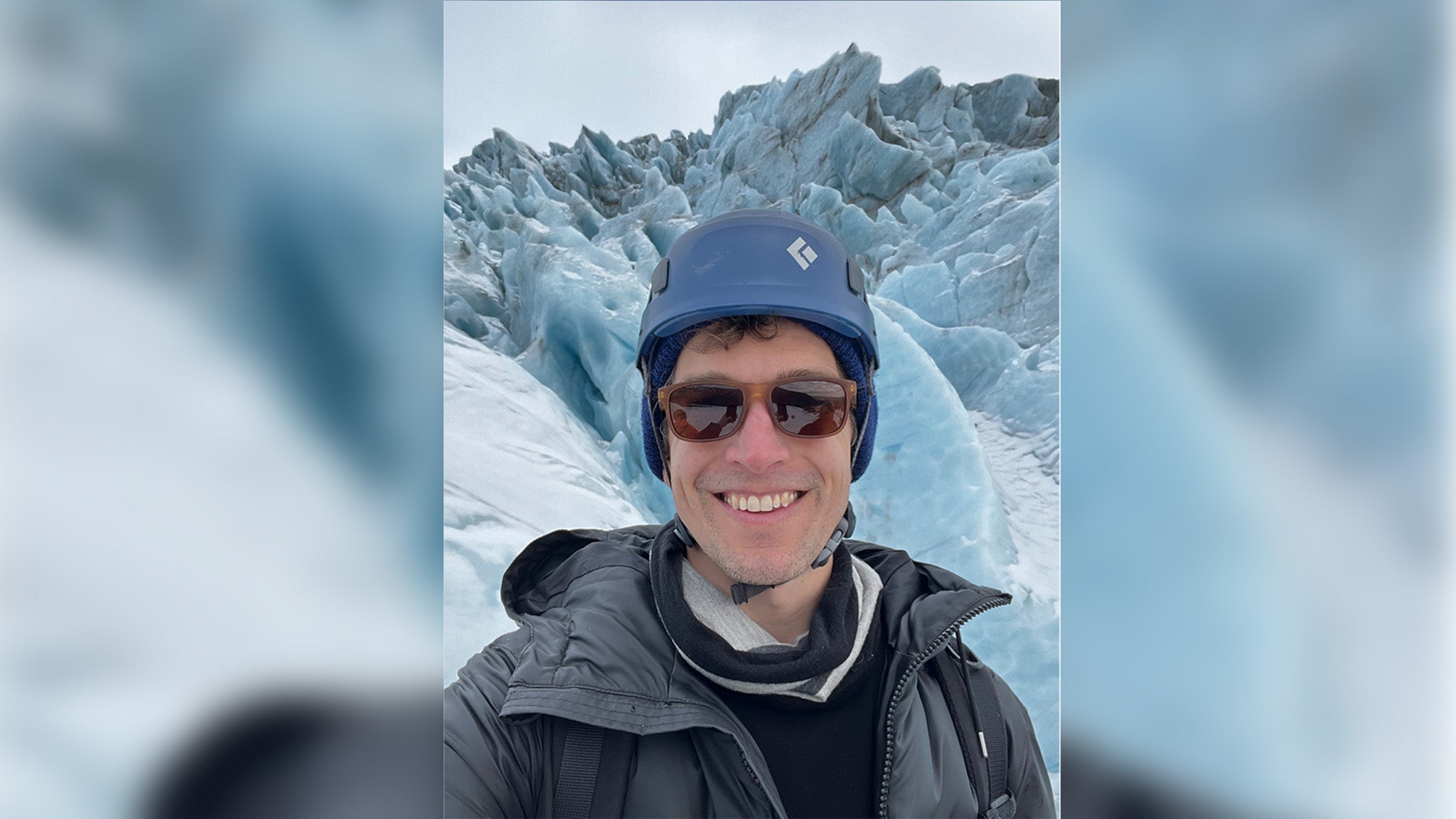
This summer, climate reporter Alec Luhn went missing for six days in a Norwegian national park.
Luhn, who planned for a four-day trip, became trapped on a mountain after a terrifying fall, suffering from a broken femur, as well as other injuries.
“I basically went ahead when I probably should have turned back,” Luhn said recently on WPR’s “Wisconsin Today.”
News with a little more humanity
WPR’s “Wisconsin Today” newsletter keeps you connected to the state you love without feeling overwhelmed. No paywall. No agenda. No corporate filter.
Luhn is originally from Stoughton. After graduating from the University of Wisconsin-Madison, where he studied journalism and Russian language and civilization, he wrote freelance investigative news articles for what is now Wisconsin Watch. He later relocated to Moscow to work as a business reporter and then international correspondent, before moving to London in 2022 when Russia invaded Ukraine.
Luhn now focuses on climate journalism.
He’s an experienced hiker and was looking forward to traversing a remote, riskier path within Norway’s Folgefonna National Park. The park boasts a massive glacier — 200-square miles of ice and surrounding valleys.
Luhn said he’s been drawn to glaciers ever since first flying over the Alaskan panhandle.
“I guess I’m never fully off the clock because in my free time I’m going off chasing glaciers,” he said. “It sounds silly and I’ll certainly be more careful about it in the future. But that’s what I love to do, and that’s what I’m doing.”
On “Wisconsin Today,” Luhn talked about his experience on the mountain, his survival strategy and his thoughts of family.
The following was edited for brevity and clarity.
Rob Ferrett: How are you doing now after recovering from some serious injuries?
Alec Luhn: It’s been a rough ride. My legs are still healing from all of this and I’m still pretty incapacitated. I can walk around, take a few steps, but when I go out of the house, I go in a wheelchair. My legs are trying to recover from breaking the femur but then also the frostbite injuries to my feet.
RF: If you’re willing to relive the experience with us a little bit, what ended up happening on this hike in Norway?
AL: It was the first day, I headed up the valley and saw the first tongue of the glacier, where there is this amazing ice fault that’s coming down the mountain. There are waterfalls all around it.
What was really the problem, I think, was that the sole started coming off my hiking boot earlier in the day. I didn’t really want to go back to the city. So, rather than turning around, I just used some athletic tape to tape up the sole to the boot. But in doing that, I think it reduced the traction a bit.
I was coming along this really steep slope and suddenly I took a step and slipped. The next thing I knew, I was flying down the mountain. First, I was sliding, then I was rolling, then I was bouncing off rocks and stuff, just picking up more and more speed. And I thought, “This is it. This is the moment. This is really, really bad.” It’s like what you see in the movies or read about in books. This is the start of something really bad.
RF: What sticks in your mind over those obviously painful and difficult six days?
AL: On the sixth day, it was a little clearer. There was a little break in the clouds. That was when the helicopter was able to come and start scanning the mountain for me. And that was an incredible moment. It came up over the ridge, started scanning the mountain pretty close to me, a couple hundred yards away, but it didn’t see me. I started waving and yelling. That’s what the final adventure was, when the helicopter flew away.
At that point, I said, “That either was my last shot or my last shot is about to happen when the helicopter comes back.” I took off my rain jacket so I’d be in my red puffy jacket to be a bit more visible, and I put my red bandana on top of my tent pole to make a kind of flag. Then about 40 minutes later, the helicopter came back and I was waving this bandana, waving at the helicopter. Finally, I saw the door of the helicopter, the side door opened up, and I saw somebody wave back at me. That’s when I knew that it was finally going to be over.
RF: I can’t imagine what was in your brain when you finally realized that they’re coming for you.
AL: The main thing was just relief that I was going to see my family again. That’s really what had kept me going the whole time. I tried to focus on the tasks at hand and not think too much about the what-ifs and hypotheticals, not let my mind wander, or I’d drive myself insane.
But the one thing I did really think about was that, if I would die up on this mountain, my biggest regret would be not being able to spend more time with my family and friends — my wonderful wife, my parents, my siblings. I just felt like I hadn’t spent enough time with them. And that this would be the real tragedy, if I didn’t make it through. So, I decided I was going to do everything in my power to make it through and get to see my family again.