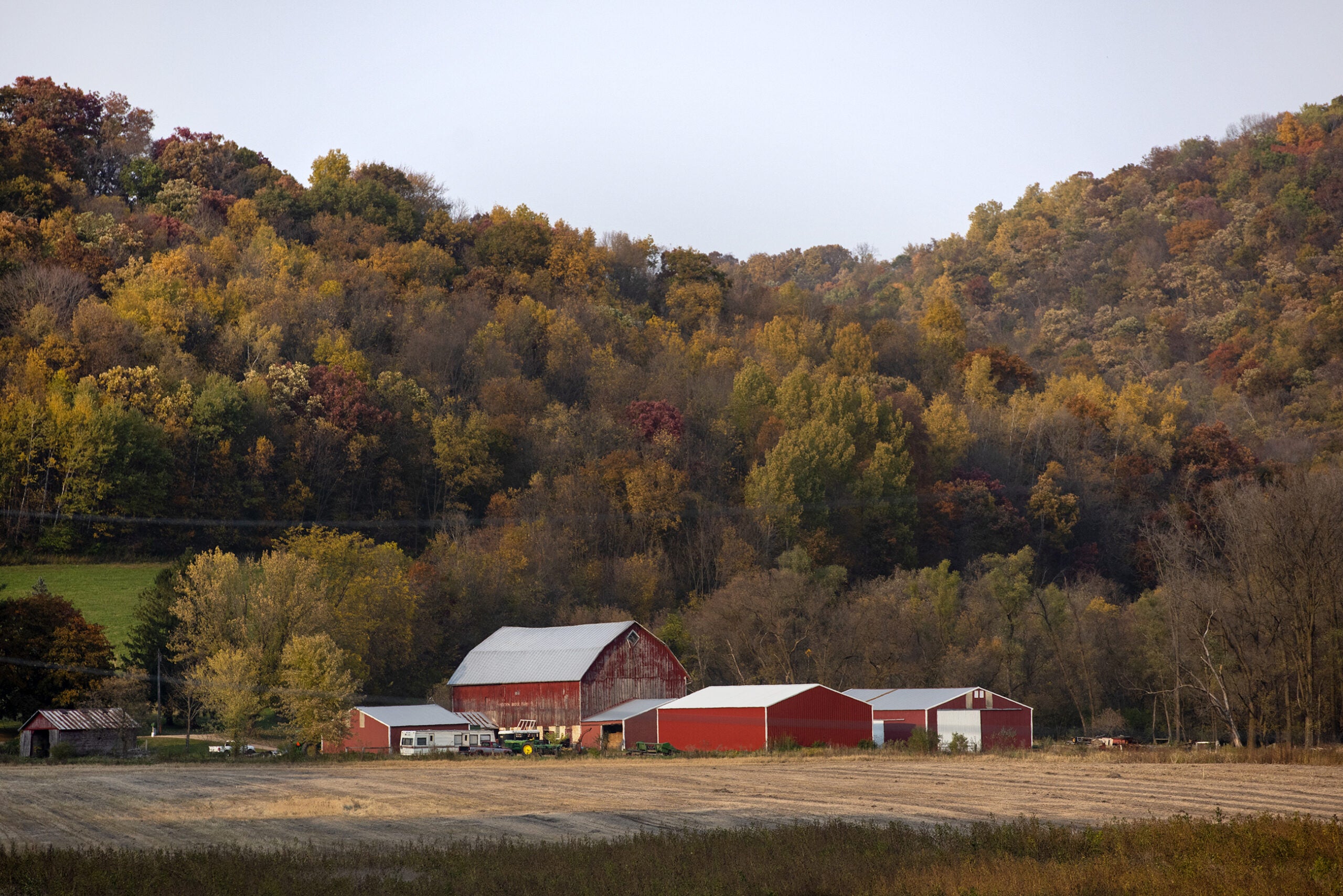
A new book makes the case that farmers in Wisconsin and throughout the Midwest were not bystanders to America’s rise as a world superpower — but key to its ascent in the first half of the 20th century.
In “Global Heartland: Cultivating the American Century on the Midwestern Farm” author Peter Simons explores the role farmers in Wisconsin, Minnesota and throughout the Midwest played in America’s rise to power, from massively bolstering production in World War I to supplying American allies like Great Britain in World War II.
Simons told WPR’s “Wisconsin Today” that this chapter of American history challenges stereotypes of American farmers as isolationist or disconnected from a changing world.
News with a little more humanity
WPR’s “Wisconsin Today” newsletter keeps you connected to the state you love without feeling overwhelmed. No paywall. No agenda. No corporate filter.
“They weren’t just accepting what others were serving up, but they saw their work as essential to building a world that came after,” Simons said.
The book comes as the Trump administration has enacted a slew of tariffs on nearly all imported products to the United States, sparking fears of a recession as consumer confidence fell to a five-year low in April.
The Trump administration has claimed, in part, that tariffs are to bolster domestic production — echoing arguments on tariffs and America’s role abroad that government officials made nearly a century ago.
“It’s obviously a bit different now than it was in the 1940s and 1950s,” Simons said. “But [newly announced tariffs] are really reversing 60 or 70 years of American agricultural policy, foreign policy and really the fundamental sense of Americans and how they relate to the rest of the world.”
Simons explained how Midwestern farmers not only were crucial for America’s ascent to power in the 1900s, but also experienced historic benefits from international involvement themselves.
The following was edited for clarity and brevity.
Kate Archer Kent: I was astounded at how Wisconsin’s agricultural production skyrocketed in 1918 during World War I. Wisconsin produced the most oats in the nation, more corn than it had ever grown, and enough wheat and rye to make the state self-sustaining. What increased our state’s output this much?
Peter Simons: There are a number of different factors, but the most basic one is that it turned out to be incredibly profitable during the war because there was an incredible demand for these products. So farmers would divert other crops into those that were most needed overseas and start growing more than they ever had before.
The other thing that happens is agricultural technology, like tractors, had been in development for quite some time leading up until World War I. With the sudden loss of farm hands, family members, whoever was going either to fight abroad or they were going to factories to make the weapons that were going to be used abroad … there was a shortfall in agricultural labor. And so the very rapid adoption of these technologies helped create higher yields than states like Wisconsin had ever seen before.
Of course, because they’re building tanks and trucks and all these other things that they need for war, there’s not enough material to actually build all the tractors that are needed. So the state agricultural departments will send out bulletins telling you how to try to craft your own tractor or create your own plow. This is a moment where we see really intensified adoption of agricultural technology.
KAK: The Lend-Lease Act was enacted in March 1941 and formalized aid to Britain, months before America formally entered World War II. What was the Lend-Lease Act and how did it lead to growth in America’s agricultural exports?
PS: The way that we usually understand Lend-Lease is through arming America’s allies overseas. The idea being that if we can give them the material that they need to fight the war against Germany, maybe the United States won’t have to send their own troops [and] that this will hold the Germans at bay and they’ll win the war eventually.
What was interesting to me is that the announcement of the Lend-Lease Act was, in part, made at a Farm Bureau Federation meeting in Washington, D.C. … It goes to show that agriculture was foremost in the minds of [President Franklin D. Roosevelt] and his cabinet as they were crafting the Lend-Lease Act. All of these other wartime materials were essential, but you couldn’t have the war without all of this food.
It immediately pulls American farmers into the war far before factories start filling with people who are building bombers and munitions and all these other things. The farmers don’t have any choice because it’s just sort of built into the market. The government is buying their farm products. And so the farmers are, in a way, the first American contributors to World War II. They’re very skeptical at first, because there is a sharp memory of World War I and there’s common knowledge that you have a recession after every war.
But as Lend-Lease continues, farmers are starting to notice that they’re enjoying better rates of return on their crops than they ever had in recent history. There’s suddenly a sustained market that they hadn’t known since the 1900s. They’re starting to see the benefit of supplying overseas consumers, even if it might be in wartime, that trade is becoming ever more essential to their own livelihood.
KAK: The Smoot-Hawley Tariff Act from 1930 leaps from your pages now, considering the times we’re in. Modern debates around tariffs seem to echo some arguments made about a century ago around issues like protecting domestic production. What lessons can we learn from the Smoot-Hawley Tariff Act that might be relevant to American farming today?
PS: There was an intense debate between Henry Wallace, who then is secretary of agriculture, and someone named George Peek, who’s also in the USDA, about the best path forward for American agriculture. Is this something in which we benefit by engaging the rest of the world, or do we need to focus on the United States instead?
The American Dairy Association had no interest in the 1940s in prolonging the shipments of dairy overseas. They just want to convince Americans that they should consume more dairy than they do right now. They look to Scandinavia in particular, and say, “Look at how much milk Scandinavians drink. Look how much cheese they eat. We need to convince Americans to do the same.” Well, this turns out to be a nonstarter because American goods continue to go overseas.
The American farm economy is one in which there is an incredible amount of intervention to make American farming operate the way it does today. So I don’t want to make any sort of pitch for some sort of mythological version of a market that, without barriers, benefits American farmers. But I can say that, in the past, it has proven that finding overseas markets has been one of the prime drivers of benefits to American farmers.