

Josh Silver credits a 1977 federal law brought by U.S. Sen. William Proxmire, a Wisconsin Democrat, for effectively ending redlining.
In a recent interview with WPR’s “Wisconsin Today,” Silver described the Community Reinvestment Act, better known as the CRA, as a genius yet simple way to empower disenfranchised communities by increasing their access to credit and capital.
Redlining was a common practice where financial institutions denied services, like home mortgages, to entire neighborhoods based on racial makeup. In the 1930s the federal government created redlining maps for most American cities. The maps had red lines drawn around neighborhoods that were considered hazardous or risky.
News with a little more humanity
WPR’s “Wisconsin Today” newsletter keeps you connected to the state you love without feeling overwhelmed. No paywall. No agenda. No corporate filter.
The CRA requires banks to invest in all the communities they serve regardless of income or racial makeup. To this day, banks get “report cards” — or CRA ratings — on how well they comply.
The ratings are publicly available so anyone can see how banks are lending, for instance, to Wisconsin communities of color or low income communities.
Silver, who worked for The National Community Reinvestment Coalition for more than 30 years, said the law provides an accountability mechanism and has increased lending in traditionally underserved, formally redlined communities.
But he added the law doesn’t go far enough. In the age of mobile banking and a complex financial market, the law needs urgent reforms so cities like Milwaukee aren’t left behind.
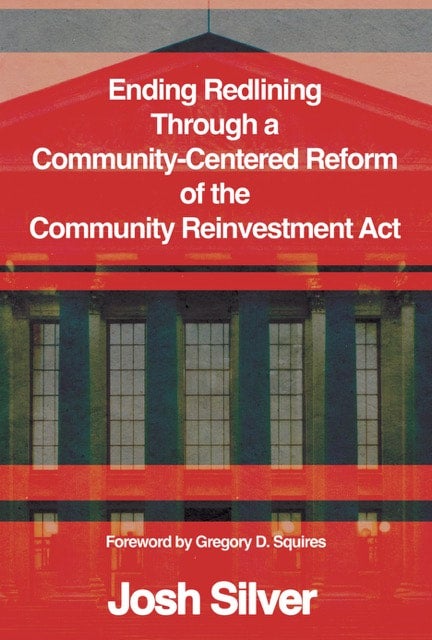
Silver talked with WPR about his new book, “Ending Redlining through a Community-Centered Reform of the Community Reinvestment Act.”
This interview has been edited for clarity and brevity.
Rob Ferret: You give a real world example of how the Community Reinvestment Act works: the Metropolitan Milwaukee Fair Housing Council and UMB Financial Corporation. What was their agreement and how does it relate to the CRA?
Josh Silver: Because of the CRA, banks are required in merger applications to demonstrate a public benefit. So what some banks do is make “community benefits agreements” with community organizations. The Metropolitan Milwaukee Fair Housing Council was one of several organizations to strike an agreement with the UMB Financial Corporation after their merger with Heartland Financial.
UMB pledged to make $5 billion in loans and investments over a five-year period. This is a win-win. There were more loans after the merger than before and banks found profitable lending opportunities. And neighborhoods get a chance to revitalize and build wealth.
RF: You see the need for change especially as banking has evolved over the years. What kind of changes are you advocating for?
JS: First of all, I think CRA should be broadly applied throughout the financial industry. Independent mortgage companies should have CRA compliance, for instance. Some states like Massachusetts actually do cover independent mortgage companies with CRA.
Also, the CRA exams assess banks’ lending and investment performance and give them a report card. We need to make the performance measures more objective. An example would be, what percentage of loans to low income neighborhoods are in good standing versus outstanding?
RF: What about internet banking?
JS: After revisions, the CRA that we live with now was basically made in 1995. In 1995 the internet barely existed and now there is a good amount of lending done through the internet.
Bank branches are still very important but there’ll be more and more lending done through the internet and outside of branch networks.
A 2023 regulatory update to CRA took that into account and examined banks in geographic areas where they were making lots of loans but did not have branches. But the Trump administration has announced its intention to repeal the Biden-era 2023 CRA regulation.
RF: Do you have concerns about the Trump administration watering down the CRA?
JS: It is happening already but there are cycles in our country. In future years, regardless whether it’s Republican or Democrat, I hope a future administration is more friendly to CRA.
We are creating a very impressive constituency for CRA. There are thousands of banks and nonprofits in this country. Every day those organizations are working in partnership to do home lending, small business lending, community development like healthcare centers and childcare centers, and they are documenting their CRA success stories.
At Congressional hearings you’ll see banks testifying that CRA is an important, valuable law that has helped them serve previously overlooked communities and has led them to profitable lending and banking opportunities.
Overall, I don’t think there are the votes in Congress to repeal it because it makes capitalism work better in all communities. People who are willing to work hard and play by the rules should get a home loan or small business loan, regardless of the color of their skin. And there’s a lot of people in the banking industry that understand why this is important for their bottom lines.