With the country in the midst of a severe housing shortage, it might seem like a no-brainer to simply turn vacant office buildings into apartments.
Milwaukee developer Johnny Vassallo told WPR’s “Wisconsin Today” that the reality is a little more complex.
“You already have the building, so it’s like, ‘Oh, this should be easy, right? We’ll just make it into apartments,’” Vassallo said. “But it’s really complicated. You know, the ceiling heights, the floor plates, how the elevators are located, how you’re going to run plumbing. So you need a very sophisticated team, and you need the right building, and then you need to work with people who have done this before.”
News with a little more humanity
WPR’s “Wisconsin Today” newsletter keeps you connected to the state you love without feeling overwhelmed. No paywall. No agenda. No corporate filter.
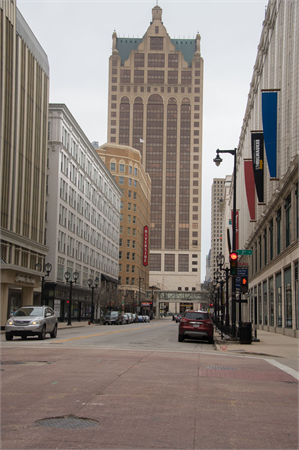
Despite the complexities, Vassallo is in the midst of converting one of Milwaukee’s largest office towers, 100 East, into an apartment building with more than 350 units, including 75 that would be considered “workforce housing.”
These types of projects are growing in popularity as a couple of national trends converge — the lack of housing and the shift toward working from home that occurred with the pandemic. Time magazine reported that 2024 saw a record number of 55,300 housing units from office space.
Milwaukee’s office vacancy rate is about 24 percent, according to the firm Cushman & Wakefield. The apartment rental market is much tighter. Last year, the vacancy rate was 3.7 percent, according to the Milwaukee Journal Sentinel. Housing advocates, banks and municipalities consider a vacancy rate between 5 and 8 percent to be “healthy,” meaning supply isn’t so low that it is driving up housing costs and restricting residents’ options, or the supply isn’t so high as to be putting landlords out of business, creating blight or discouraging development.
Tom Daykin, a commercial development reporter for the Journal Sentinel, told “Wisconsin Today” that Milwaukee has been converting offices to housing for a number of years.
“I would say, going back at least 15 years or so, with some of our older downtown historic buildings, office buildings that were really obsolete for today’s modern office users,” Daykin said. “Developers were acquiring those buildings and then converting them to apartments, some of this being fueled by being able to obtain federal and state historic preservation tax credits.”
Excess office space
Despite the surplus of office space, Milwaukee’s downtown hasn’t become a ghost town like some cities, Daykin said.
“I’m not sure how much people are aware of this … but Milwaukee has actually fared pretty well, for a couple of fundamental reasons,” he said. “No. 1, we never overbuilt our office market downtown as much as maybe other cities did. And No. 2, I think we’ve done a better job of having a mix of both daytime uses downtown, such as offices, and what are sometimes called nighttime uses or residential. And as a result, coming back out of COVID, I think we’ve had a quicker recovery compared to, say, Chicago, Minneapolis and some other cities.”
But with interest rates high, conversion projects are expensive. Federal tax credits, either for historic renovation or affordable housing, can make them more affordable for developers, Daykin said. Luxury housing can give developers a higher return on their investment, but there’s evidence that that market is topped out in Milwaukee.
“Last year in downtown Milwaukee, we had two [luxury] high rises open that at this point are probably about half full,” Daykin said. “So there’s some question as to how strong the market is to continue to do that type of housing.”
Affordable housing credits can help developers convert offices to apartments but restrict the profits developers will get over time. A type of housing that’s even in greater demand is what’s known as “workforce housing,” aimed at people who earnin around the median income.
A young, historic building
The 100 East project is benefiting from historic tax credits, which is unusual since the building opened in 1989, just 36 years ago. Typically, buildings need to be 50 years or older to be considered historic. The 100 East building obtained the status last year.
Vassallo said the building merits the status because it is unique and worth preserving. It’s located on the site of the old Pabst Building.
“It was very historic, and the developers tore it down,” he said. “And when they were allowed to rebuild it, it had to have a lot of postmodern, significant historical attributes. And so the building is one of a kind. To me, it’s the prettiest building in the city.”
Vassallo said he and his partners hope to get final approval for the 100 East project in the next two months and start work by the end of the year. They hope to begin renting apartments in two years.
Daykin said office conversions won’t solve Milwaukee’s housing shortage, but they could be part of the solution.
“We need more housing, period, which is something that I think everyone agrees on,” he said. “It’s a basic element of supply and demand. If you want to mitigate against cost increases of any project, including housing, increase your supply.”