Staffing shortages and federal shakeups in the food safety system have led some experts to warn that the public could see more foodborne illnesses like the recent listeria outbreak linked to chicken fettuccine alfredo.
Paula Soldner, chair of the National Joint Council of Food Inspection Locals, told WPR’s “Wisconsin Today” that the political climate this year has exacerbated long-term staffing challenges.
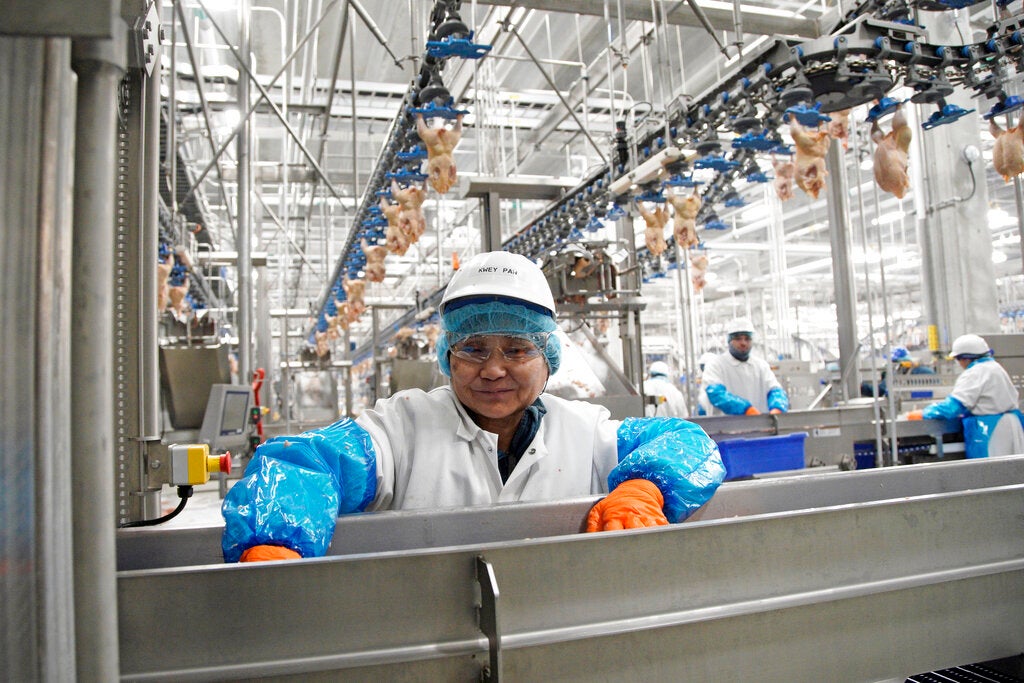
The U.S. Department of Agriculture, or USDA, this month notified union leaders of the Food Safety and Inspection Service that it is planning to end contracts for thousands of employees. This will have a “huge impact” for inspectors, who need to be able to raise concerns without fear of retaliation in order to do their job effectively, Soldner said.
News with a little more humanity
WPR’s “Wisconsin Today” newsletter keeps you connected to the state you love without feeling overwhelmed. No paywall. No agenda. No corporate filter.
“People don’t want to come and work for the federal government, knowing the environment that we are working in right now,” said Soldner, who has worked as a food safety inspector in southern Wisconsin for more than 30 years and is set to retire later this month.
“In cases where they may find an unsafe product (or) improperly labeled product, the inspectors are getting very reluctant to raise their hand to contact their supervisors because there is no protection for that inspector to raise a problem up the chain of command,” she said.
The loss of contract protections could also mean that more inspectors will leave. Soldner said she knows of a district office that recently hired 10 inspectors. Within a week, five of them quit, and the remaining inspectors had to pick up the slack.
“Now they’re going to be (doing) double the work, so the workload measurement is now going to increase, so there is going to be less oversight” of food processing plants, Soldner said.
She said she has already heard of recent situations when inspectors raised a concern about food safety at a plant they were inspecting and were met with silence.
Soldner also expressed concerns about the close ties of department administrators to the industry they are charged with regulating. Justin Ransom, a former executive at Tyson Foods, was recently appointed to be administrator of the Food Safety and Inspection Service.
“When I came in as an inspector in May of 1987, we regulated what the industry did. Now, industry regulates what the inspectors do,” Soldner said.
Foodborne illness outbreaks and product recalls dampen consumer confidence
While agencies like the USDA oversee and regulate food safety at the production level, it is the work of public health agencies to monitor what happens when foodborne pathogens reach the public and cause illness and outbreaks.
“Our foodborne disease surveillance and tracking systems really provide the ultimate measure of how effective the food companies and the regulators are at ensuring the safety of the food,” said Craig Hedberg, a professor of environmental health sciences at the University of Minnesota and co-director of the Minnesota Integrated Food Safety Center of Excellence.
The Centers for Disease Control and Prevention recently scaled back FoodNet, a federal-state surveillance program that tracks foodborne pathogens. Rather than investigating eight pathogens, they will now focus only on salmonella and E. coli.
One of the pathogens that will no longer be tracked under the scaled-back FoodNet program is listeria, which sickens an estimated 1,600 people per year and kills 260, according to the Centers for Disease Control and Prevention. Last year, a listeria outbreak linked to Boar’s Head deli meat left 10 people dead and dozens hospitalized.
While listeria is a notifiable disease, meaning that health care providers are still required to report infections to health departments, removing it from FoodNet means that researchers like Hedberg will have fewer data to work with when monitoring the trends.
“The real problem with cutting funds for FoodNet is that it, in a way, normalizes the idea that foodborne disease surveillance is both expensive and non-essential, when, in fact, we have really good evidence that the amount of money that we put into foodborne disease surveillance in the long run saves money,” Hedberg said.
All of this is happening as consumer confidence in the U.S. food safety system is at an all-time low, according to a new survey from the International Food Information Council.
Hedberg said cuts to any single program won’t necessarily destabilize the food safety system, but a lot of them could add up.
“Cumulatively, the effect is to reduce the capacity of our public health system to respond effectively when an outbreak happens, and then to translate that knowledge into better prevention measures down the road,” Hedberg said.