
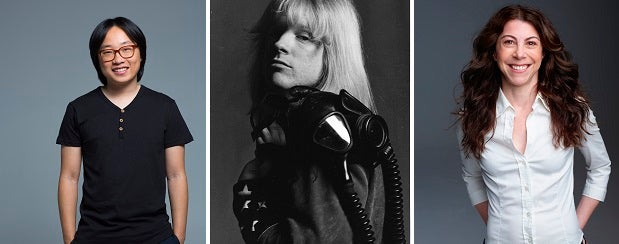
Comedy writer Nell Scovell broke into Hollywood in the eighties by “writing like a man.” Now, she’s an inspiration and advocate for female comedy writers. Musician Larry Norman was a little too rock-n-roll for the church and a little too Christian for rock, but he never stopped his pursuit of both. Jimmy O. Yang went from being an outsider in Hong Kong, to being an outsider in the US until he pursued his passion of stand-up comedy.
Featured in this Show
-
Nell Scovell Has Likely Made You Laugh, Even If You Didn’t Realize It
For more than 30 years, Nell Scovell has made people laugh with jokes that she’s written for shows including “The Simpsons,” “Late Night with David Letterman” and “Murphy Brown.” She’s put words into the mouths of people like former President Barack Obama, comedian Bob Newhart and Kermit the Frog.
Scovell started her illustrious television comedy writing career with a “spec script” — or an unsolicited script — she wrote for Garry Shandling’s sitcom, “It’s Garry Shandling’s Show,” which aired on Showtime from 1986 to 1990. As the title indicates, it was a show in which Shandling portrayed a self-obsessed, neurotic comedian named Garry Shandling.
The show broke new ground and the fourth wall, the space that separates a performer from the audience, because Shandling spent as much time interacting with his audience as his fellow cast members.
“So I send this script in and they buy it,” Scovell told WPR’s “BETA.” “And I end up flying to Los Angeles and I meet with Garry. And he pays me this compliment where he tells me, ‘You write like a guy.’ So that was the late ’80s, and I think there was this belief that guys wrote hard jokes that made you laugh, while women wrote softer jokes that made you think, ‘Oh, how delightful.’”
Scovell mentioned Judd Apatow’s new HBO documentary, “The Zen Diaries of Garry Shandling.”
“What’s interesting if you watch it is, you know, Garry is very insecure and a lot of his jokes are about relationships. And so it only occurred to me recently that Garry wrote like a girl. And, by the way, I totally mean that as a compliment,” she said.
In 1988, Scovell became only the second female writer to be hired to work on “Late Night with David Letterman.”
“There were parts of the job I absolutely loved. In the afternoon, we would get our Top 10 topic. And you would go into your office and for 45 minutes you would just write all the jokes you could think of,” Scovell said. “I still remember my very first entry into the Top 10 list was for the ‘Top 10 Least Popular Summer Camps.’ And I slid in at No. 10 with Camp Tick in beautiful Lyme, Connecticut.”
Although she considered it to be a dream job, Scovell quit after about five months.
“I realized I just wasn’t going to thrive there. I wrote a piece in 2009 for “Vanity Fair” about how it was a hostile environment for women. This whole thing was kicked off by Letterman going on air in 2009 and stating bluntly, ‘I have had sex with women I work with,’” Scovell recalled.
Scovell went back and forth with her decision to write the column for “Vanity Fair” for fear of the repercussions it could have had on her career.
“In 2009, I wanted to make this point not just about sexual harassment and sexual favoritism, but to pivot to gender discrimination in the writers’ room. Because at that time, both Letterman and Leno had zero female writers. And I also want to add in 33 years on the air, the Letterman writers’ room never included a single person of color,” said Scovell. “So I stood up and I spoke out about this oversight and pointed out that you literally couldn’t do worse when it came to diversity. And I did think it could end my career and it ended up being one of the best things I ever did.“
“BETA” host Doug Gordon reference a comment that Scovell made in another interview in which she said she thinks that empathy is undervalued in a lot of comedy writers’ rooms — asking her if that means that comedy writers are creating characters who are lacking in empathy, and that the majority of the characters we see are unsympathetic, self-obsessed characters.
Scovell loved that theory: “If I had thought of it myself, I would have put it in the book. I think that’s incredibly smart. You should write an Op-Ed about it.”
At press time, Gordon is still working on the Op-Ed. He’s written a rough draft but as we all know … writing is rewriting.
-
Larry Norman Was The Godfather Of Christian Rock
Musician Larry Norman has rubbed elbows with music royalty. Literally.
On a fateful elevator ride at Capitol Records in 1968, Norman bumped into Sir Paul McCartney. The former Beatle chatted Norman up and said he enjoyed his music. In a potentially apocryphal story, McCartney was later quoted as saying Norman could’ve been a major artist of the ’70s if he’d just stopped singing about Jesus. True or not, that sentiment was the crux of what made Norman’s life and career so fascinating.
Norman had the respect of his musical peers, but baffled them with his persistence in channeling his talents toward Christian themes. On the flip side, religious leaders considered rock ‘n’ roll the tool of the devil and deemed Norman a heretic.
“He was sort of a pioneering cultural figure at a time in which there was really no space to stand in the place he wanted to stand,” author Gregory Thornbury told WPR’s “BETA.”
Using Norman’s personal archives, Thornbury explores this contradiction in his new biography on the singer, “Why Should the Devil Have All the Good Music.”
Norman may not have become the artist McCartney predicted, but his musical contributions stand alongside other epochal artists like Bob Dylan, Janis Joplin, Jimi Hendrix and The Doors. He also inspired other iconic artists like Bono, Black Francis of the Pixies and Dizzy Reed of Guns N’ Roses.
Norman never stopped exploring the reflection of spirituality in his music even as the movement he helped launch — Christian Rock — warped from his early and earnest guidance.
“He felt like the church was spending 90 percent of its time talking about things that someone who is not a person of faith would never even care about,” Thornbury said.
Norman’s seminal album “Only Visiting This Planet” was classified as a masterpiece. Sonically, it was on par with any album of the era — being produced at George Martin’s AIR Studios. Norman’s lyricism on the LP set about challenging the mainstream church leaders and their seemingly hypocritical support of the Vietnam War. It also served as a harsh commentary to the culture at large with reflections on institutional racism and the “buffoonery of American politics.”
While Norman’s work was challenging to some, it spoke to others. He became a reassuring voice to faithful youth who struggled with the convictions of abstaining in the free love culture.
“There’s this gorgeous song called ‘Pardon Me’ with these beautiful string arrangements that are about sort of the conflicted feelings a young person of faith might have about their first, you know, sexual encounters and is it okay to abstain,” said Thornbury.
This approach widened the gap Norman was straddling with the album going in directions rock didn’t want to go and talking about things the church wasn’t willing to. Norman proudly defied the attacks on his music by faith leaders, pushing back at his concerts.
“He was very satirical about it and you know humor is the best way to defuse an enemy,” said Thornbury.
Norman’s later work would pivot from overtly speaking about Jesus to being more personal and Thornbury believes this led to his staying power.
“What he discovered is if he wrote about what he knew, which was his own struggles, it connected with his audience,” said Thornbury. “He could draw people into his own narrative and they felt like he was talking about the same stuff they were going through.”
Norman passed away in 2008 and, according to Thornbury, likely would be disgusted by today’s American evangelicalism and its misguided priorities.
“If he would sort of look at the Gospel-Industrial complex, I think Larry would say these people that are cozying up to power are lambs being led to slaughter,” Thornbury said. “So, I think he’d be hot and bothered if he were around today.”
And that’s why Norman’s legacy remains of a man apart.
“He really was an artist,” Thornbury said. “He sat by his own fence post and whistled his own tune and made people pay attention.”
All photos in the above slideshow are courtesy of the Norman Estate
-
From Hong Kong To LA — Jimmy O. Yang's Journey To The American Dream
Jimmy O. Yang is best known for playing Jian Yang on HBO’s “Silicon Valley.” The character reminds Yang of himself at an early age when he first immigrated to the United States.
“He’s an immigrant just like myself. I always felt like whenever I’m playing Jian Yang, I’m playing a version of myself 15 years ago,” Yang said.
The comedian and actor is now a U.S. citizen and has authored his memoir, “How to American: An Immigrants Guide to Disappointing Your Parents.”
Yang writes about how immigrating to this country paralleled a lot of the “outsider” feelings that he was having in his native Hong Kong. Born to parents from Shanghai, Yang and his family were mocked for speaking Cantonese with a Shanghai accent.
“So that was like some early lessons in like assimilation, ah, because I was not the Hong Kong kid really, even though I was born and raised there,” Yang tells WPR’s “BETA.”
When Yang arrived to the states at 13 years old, he found it just as challenging to assimilate in America while also finding new friends, learning a new language and a new culture.
“Just step by step, I tried to make myself as American as possible and a lot of it I learned from watching television,” he said.
Yang consumed hours of the BET channel. He flowered while discovering the culture of the hip-hop and stand-up comedy the network specialized in. BET programming also became a main source of Yang learning English.
“It was just like these new art forms and everybody seemed so, like, having so much fun and so animated and cool,” Yang said. “And that was like the version of America that I looked up to, that I wanted.”

Actor Jimmy O. Yang. Photo credit: Ali Paige Goldstein/HBOYang followed his passion into stand-up after a chance commencement speech by “Silicon Valley” creator Mike Judge at his graduation from the University of California-San Diego. Judge spoke about leaving a lucrative career in a field that he hated to take a chance in comedy.
“It was a pretty big impact I think, because my parents growing up — my dad used to always tell me ‘pursuing what you love is how you become homeless,’” he said.
Best known for creating MTV’s generational avatars “Beavis and Butthead,” Judge would go on to create iconic comedy films like “Office Space” and “Idiocracy.” Yang drew on those words of inspiration and left an internship to pursue his comedy career.
In a twist of fate, Yang and Judge would cross paths again. Judge cast Yang in “Silicon Valley” giving Yang his big break.
“He didn’t know I went to UCSD, he didn’t know I was sitting there in the commencement speech and he cast me,” Yang said. “And I told him the first day of table reads, I was like, ‘Yo, you were the guy that was at my commencement speech that really kind of inspired me to do this.’”
Yang’s role in “Silicon Valley” put him on the map. He was able to land bigger roles and turned heads with a dramatic turn in Peter Berg’s acclaimed film documenting the Boston bombing attacks, “Patriots Day.” On the red carpet for the premiere, Yang brought his proud parents for a front row seat to see him do what he loves. And in between taking selfies with star Mark Wahlberg, Yang’s dad let his son know how proud he was of him.
“In the Asian culture we don’t really say (I love you), but when we do say it, it means so much,” Yang said. “Now, my dad still hasn’t said that to me, but sometimes he’ll say ‘I’m proud of you,’ and that means so much.”
Episode Credits
- Doug Gordon Host
- Doug Gordon Producer
- Adam Friedrich Producer
- Steve Gotcher Producer
- Steve Gotcher Technical Director
- Gregory Thornbury Guest
- Jimmy O. Yang Guest
- Nell Scovell Guest
Wisconsin Public Radio, © Copyright 2025, Board of Regents of the University of Wisconsin System and Wisconsin Educational Communications Board.