In Spring 2026, Istanbul Bilgi University will host a visiting associate professor from the University of Wisconsin-Stout to teach courses in its Marriage and Family Therapy program — the first of its kind in Turkey.
Candice Maier, a recent Fulbright scholar, will teach there for six months. Here in Wisconsin, Maier has been working to modernize the field of marriage and family therapy by bringing a feminist perspective to her clients and her students.
In a recent interview with WPR’s “Wisconsin Today,” Maier said she is honored by the opportunity to teach in Turkey. And while she hopes to continue her research while there, she is by no means trying to change the culture or beliefs held by the Turkish people she will meet.
News with a little more humanity
WPR’s “Wisconsin Today” newsletter keeps you connected to the state you love without feeling overwhelmed. No paywall. No agenda. No corporate filter.
“I’m an outsider. I’m not a Turkish citizen. I’m just very humbled to even be there,” Maier said. “I’m going to be teaching their curriculum. I want to do what I can to fit in, but obviously it will be very different.”
On “Wisconsin Today,” Maier discussed her position on political neutrality in therapy, what “modernization” might look like in her field, and what she hopes to give — and receive — from her time in Turkey next year.
The following interview was edited for clarity and brevity.
Kate Archer Kent: What aspects of your field do you identify as needing to evolve?
Candice Maier: The history of marriage and family therapy is really interesting in that it grew out of several different religious movements. With the feminist movement in the field of marriage and family therapy, there has been more and more inclusivity, which we desperately need.
I feel like modernization kind of goes both ways. It’s about being humble, sitting back and hearing people. We’re unique in our position as therapists in that some of us are advocates, but we have to be subversive in our dialogues in terms of where we meet people and not pushing our agendas.
KAK: It seems like relationship values are always changing. There are more traditional values like in some religious movements, and on social media, you can see “Trad wives” and that whole school of thought. As a therapist, do you have to perhaps look more broadly, or be open to these other forms of influences and relationships?
CM: Absolutely. People have different theoretical frameworks, and some are a little bit less feminist-identifying, more neutral — which I don’t agree with. I don’t believe you can be neutral as a therapist, because we don’t leave our values at the door.
But I think we don’t want to alienate people from the get go. If we were to just come in and push our agendas on people, we probably wouldn’t have very many clients at the end of the day, unless we’re working in very selective types of communities.
KAK: There’s widening political division here in the U.S. It affects couples’ dynamics and their relationships, and I would imagine it also affects how therapists do their jobs. Do you see that appearing in a clinical setting?
CM: Absolutely. Clients sometimes think that they can’t mention it — that they have to leave politics aside. I knew a therapist once who had a sign in their waiting room that said, “It’s safe to talk about politics in here.” It was right before the last election.
I think it’s important that clients know it’s safe to talk about. And I think it’s important for therapists to be mindful of how they come across. We actually had some couples call the clinic saying, “We’re coming in because we identify at polar ends of the political spectrum, and that is our presenting problem.” So I think it’s important for therapists to get under those layers of tension. And how you bring that up is going to look different depending on who the client is.
KAK: How do gender and relationship dynamics compare between the United States and Turkey?
CM: Turkey has a bridge between Islamic traditions, which is steeped in patriarchy, and really modern values. There’s lots of diversity, especially in a city like Istanbul. Traditionally, the family in Turkey is patriarchal, and gender roles are clear. It’s interesting; even Turkish therapists agree with these ideologies, which shows up in their work with clients.
I want to stress that gender inequality is a worldwide problem, certainly in the United States as well. Family therapists, I think, are really uniquely suited to implement feminist principles. How they do that may look different in their work if they want to encourage more equity and fairness — which is tricky. I don’t even think it’s possible in some family systems. But we have to meet people where they’re at. I mean, therapy is taboo all over the world. Definitely taboo in Turkey.
KAK: I wonder how you might change as a scholar and a therapist, after going through this experience in Turkey?
CM: I think I’ll change a lot. I think this experience will change me in terms of reserving judgment. I’m a feminist-identifying person, a feminist-identifying family therapist, and yet, I need to be able to get along with the most traditional patriarchal family systems if I want to do my job well. It’s not necessarily about changing their values and their ways, but people come into therapy for a reason, right? I do believe a lot of that stems from inequitable power imbalances.
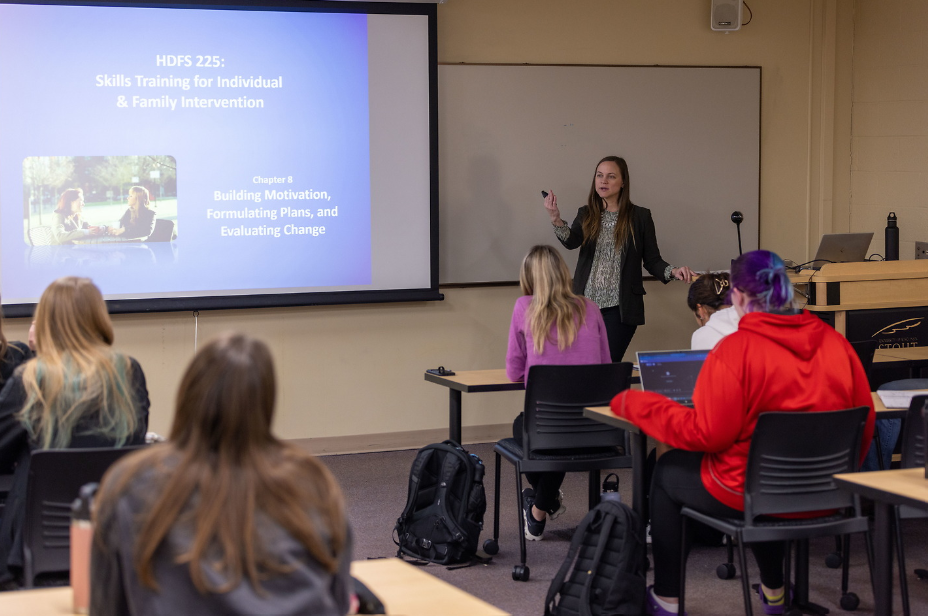
I hope that comes across in my teaching and my relationships with students. We have a pretty diverse student base at (UW-Stout) as well. We have a lot of non-traditionally aged folks, second career folks, people from all different walks of life, and hopefully they’re learning from each other. I really hope to bring back humility, kindness and understanding when I return next fall.