
Artificial intelligence is taking the business world by storm, driving the largest AI firms — NVIDIA, Microsoft, Apple and Alphabet — to market capitalizations in the trillions of dollars.
Jobs like customer service are now completely outsourced to computers programmed to carry on conversations with you.
But what does AI, including large language model products like ChatGPT, mean for businesses in smaller and rural communities, such as in northern Wisconsin?
News with a little more humanity
WPR’s “Wisconsin Today” newsletter keeps you connected to the state you love without feeling overwhelmed. No paywall. No agenda. No corporate filter.
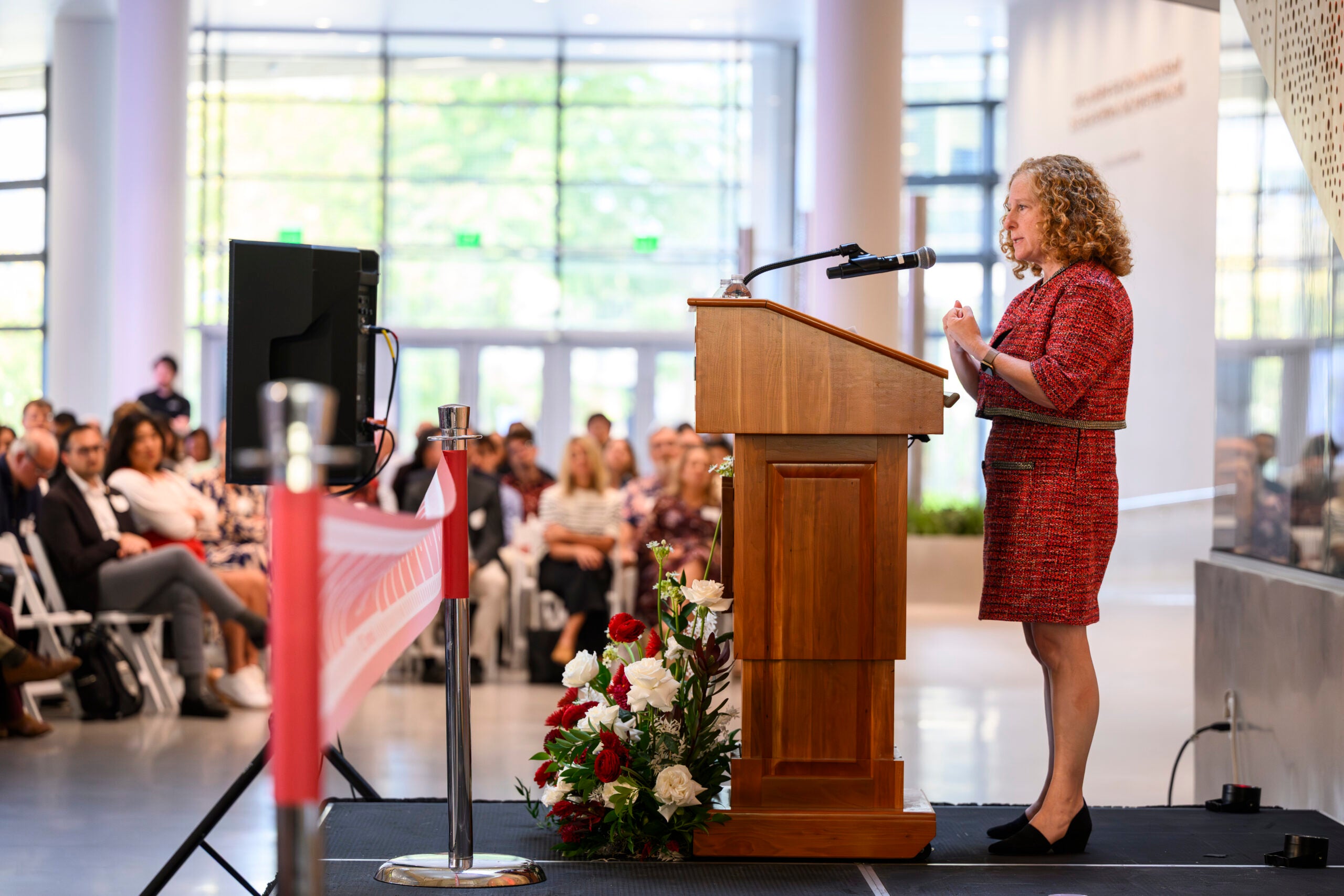
“This moment with AI is really akin to the rural electrification that happened in the 1920s and 30s,” said Ed Vocke, CEO of Superior Communications, who recently led a Superior-Douglas County Area Chamber of Commerce event on the subject.
“If I were in 1928 explaining to a carpenter how electricity was going to make his tools more powerful and that it was also going to light his dinner table, it would have been very difficult for him to wrap his head around what that meant. It’s the same thing with artificial intelligence.”
Vocke spoke with WPR’s Robin Washington on “Morning Edition” about AI applications for smaller and rural businesses.
The following interview has been edited for clarity and brevity.
Robin Washington: What was the main takeaway from your Chamber event?
Ed Vocke: The main message was we’re reaching a point in artificial intelligence where the honeymoon phase is coming to an end.
About a year and a half ago, the sky was the limit — people thought this technology was going to change everything. You saw a lot of companies going into projects to integrate AI into their legacy systems and coming away with less than they would have assumed.
We’re reaching a second level with artificial intelligence in businesses. In my presentation, I was advocating for starting small; think about what you already measure in your business. That will give you a baseline to go off of, and you can figure out where AI fits from there.
RW: What are some specific applications for local or rural companies?
EV: Marketing is one area that has already arrived.
To be able to write marketing copy with a technical voice of your choosing, crafting to different segmentations and audiences very quickly — all of that is possible and supercharged right now with artificial intelligence. And human beings’ creativity kind of turns into a curation process. Our real power as human beings using our ability to curate the results.
RW: When you say curate, you’re saying use AI for ideas, not necessarily its final results. A classic example of what not to do was by the Chicago Sun-Times last summer where one of the editors went to ChatGPT and came up with a summer reading list. It had wonderful authors like Isabel Allende on it, but it also included books she never wrote, and the editor didn’t go back and double check what ChatGPT told him.
EV: In the industry, that would be called hallucinations. Large language models like ChatGPT are programmed to give you an answer, and to give you that answer confidently, regardless of whether the information is correct or not.
There are places in the world like the European Union that are rolling out laws to protect citizens in regards to how artificial intelligence is used. One of the main things is to keep human oversight over the system. That’s called the human in the loop.
RW: I was reading about a company with an AI app for restaurant operations. I had to scratch my head because I’m wondering, how can AI make my dinner order more efficient? You still need waiters.
EV: During the presentation at the Chamber of Commerce, one mention was of utilizing a large language model in order to streamline carryout orders. The entirety of the menu could be ordered by voice over the phone using a large language model.
The ability to streamline your operations when it comes to bookkeeping is of large benefit. It has the ability to perform complex equations that you or I would never be able to program ourselves into QuickBooks. When it comes to manufacturing, if the only downtime you ever have is when something breaks, AI-powered sensors are getting deployed to predict the next time that machine is going to need to be serviced before it ever actually has to be.
If you have an idea about something in northern Wisconsin you think we should talk about on Morning Edition, send it to us at northern@wpr.org.