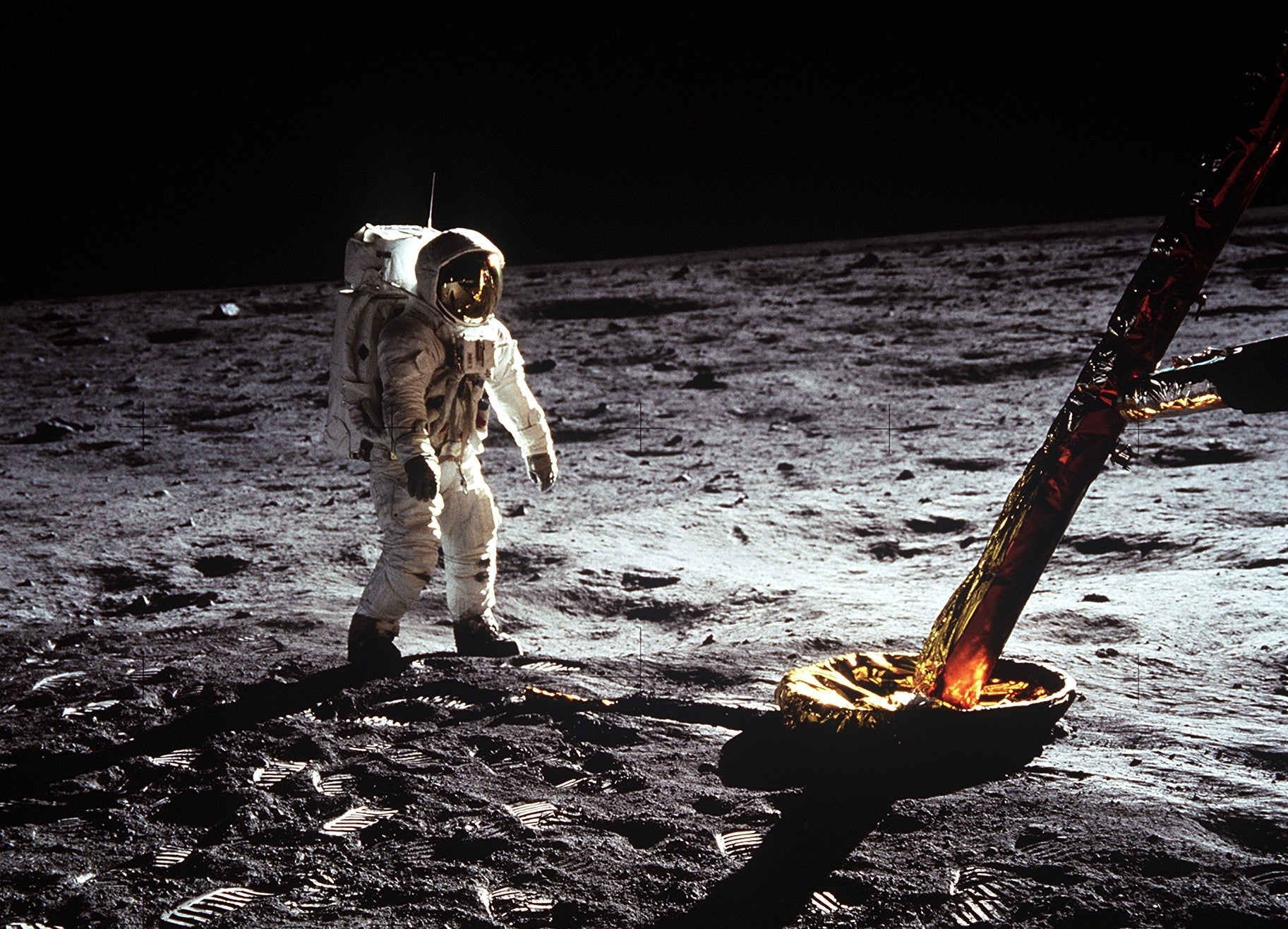
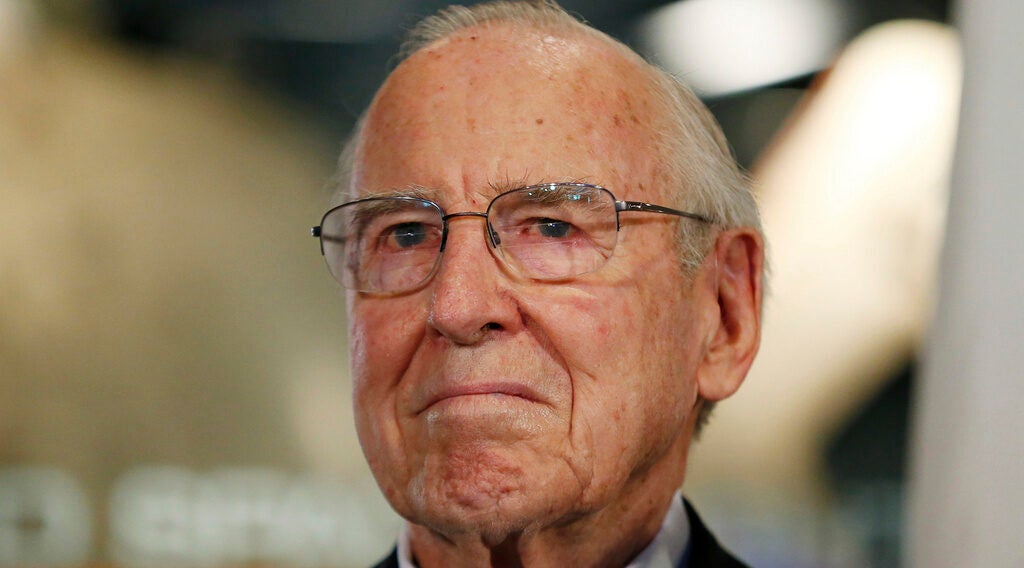
Astronauts in the Gemini and Apollo space missions had a common saying for Milwaukee astronaut and Apollo 13 commander Jim Lovell.
“If you can’t get along with Jim Lovell, you can’t get along with anyone,” said Jeffrey Kluger, editor at large at Time Magazine and coauthor of “Lost Moon: The Perilous Voyage of Apollo 13.”
Kluger wrote a Lovell tribute for Time earlier this month, dubbing him Earth’s “most down-to-earth astronaut.”
News with a little more humanity
WPR’s “Wisconsin Today” newsletter keeps you connected to the state you love without feeling overwhelmed. No paywall. No agenda. No corporate filter.
“I found Jim not terribly taken with his fame and his celebrity,” Kluger recently told WPR’s “Wisconsin Today.” “I described him as a man who went to the moon twice, but was also a homeowner, a mortgage payer and a father. And he just happened to have gone to the moon. That was the humility and the nonchalance with which Jim wore his fame.”
Lovell died Aug. 7 at age 97.
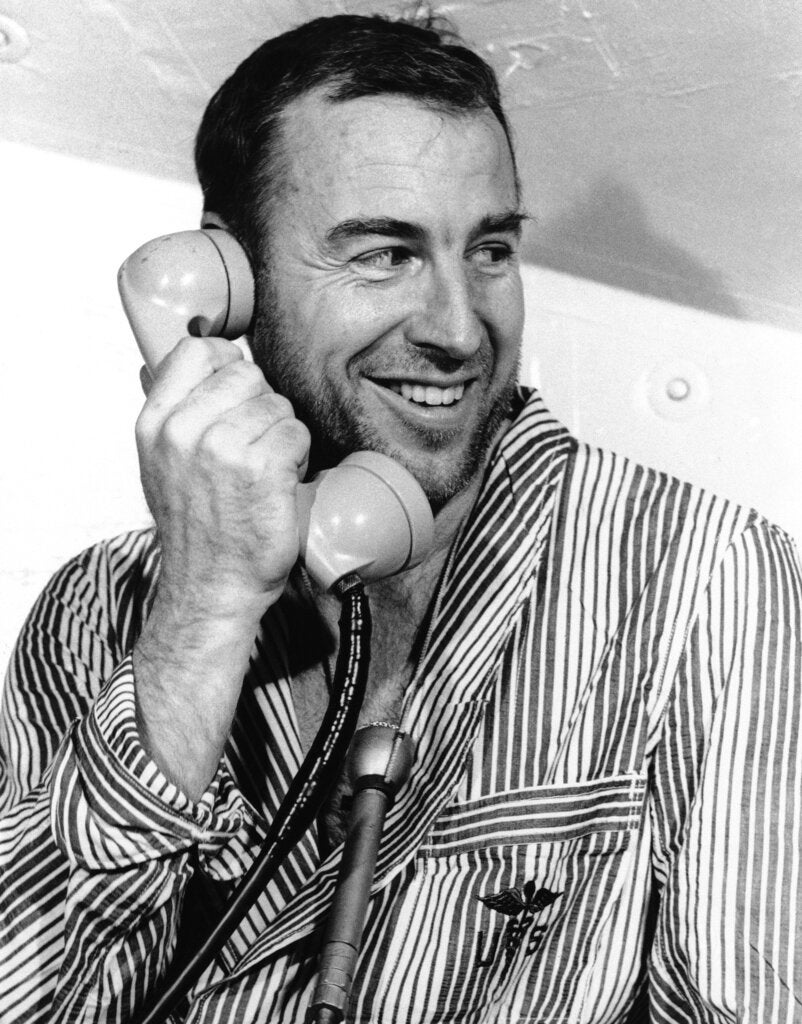
Lovell was a part of the crew of two Gemini and two Apollo space missions, and he was the first astronaut to go to space four times. Kluger said Lovell’s temperament made him vital for missions like Gemini VII — which involved two weeks in space in a module the size of the front seat of a Volkswagen Beetle.
“You need somebody imperturbable, unflappable and preternaturally genial to make a mission like that (successful),” Kluger said. “Jim was that person.”
Lovell was born in Cleveland but moved with his mother to Milwaukee following his father’s death. Lovell attended Juneau High School and spent two years at the University of Wisconsin-Madison pursuing a degree in engineering before he was accepted into the U.S. Naval Academy and got on the track to becoming an astronaut.
“I think he really liked the coziness and the familiarity of his hometown,” Kluger said. “I think he would have stayed in Wisconsin, and he may have lived in Wisconsin. He certainly was there until he was selected by NASA and then, like all of the astronauts, moved down to Houston.”
Listen to Jim Lovell’s interview on WPR’s “The Larry Meiller Show” in 2016.

Lovell was a member of Apollo 8, the first mission that took humans to the moon. It was on this trip that the image “Earthrise” was taken by astronaut William Anders — one of the first images of Earth captured by a human in outer space.
But Lovell might be most well known for his role as the commander of Apollo 13 in 1970.
The mission would have marked the third time mankind had walked on the moon. But a damaged oxygen tank spent two of the vessel’s three fuel cells, forcing an immediate return to Earth.
The explosion prompted Lovell to contact mission control, uttering the often-misquoted line, “Houston, we’ve had a problem.”
The three-man crew endured dehydration, sleep deprivation and near freezing temperatures for the 90-hour return flight.
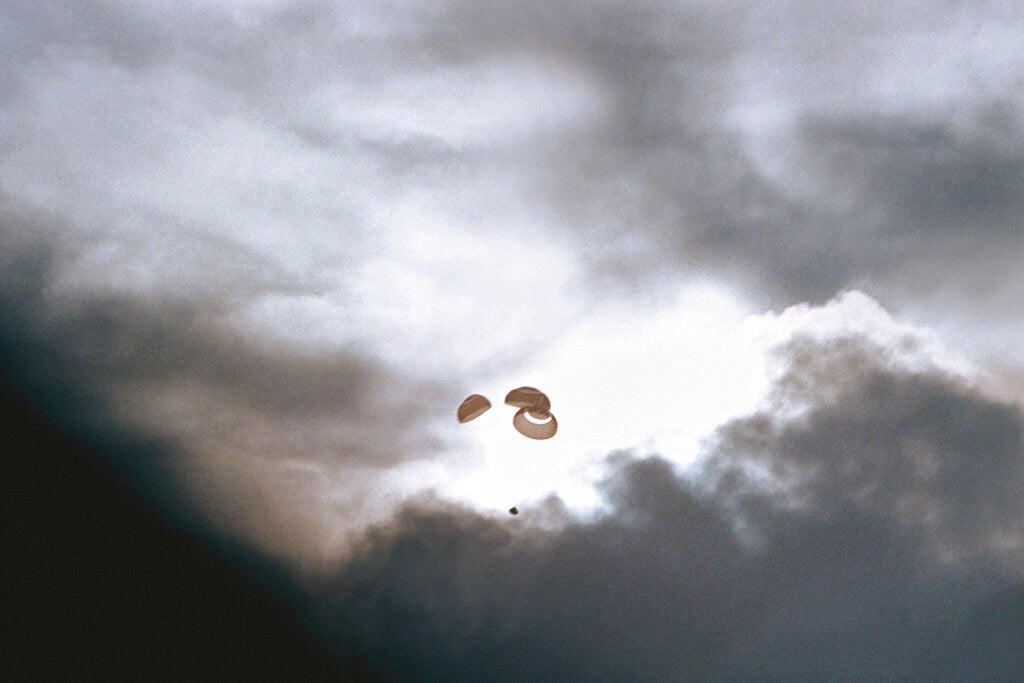
“I think the biggest thing (Lovell) did right was in the atmospherics, in the attitude, in the mood in the spacecraft,” Kluger said. “He said, ‘Our attitude was: We can flip out, we can bounce off the walls for 10 minutes and we’re going to wind up right back where we are trying to figure out how to get home. So let’s not waste our time and energy on emotion when we could better expend that time and energy on figuring out how to get home.’”
Lovell piloted the craft and ultimately landed the vessel in the south Pacific Ocean. NASA would later refer to the mission as a “successful failure” given the crew’s survival from the perilous conditions.

Lovell retired from the Navy and the space program in 1973. Milwaukee would later name a street after him. The EAA Aviation Center in Oshkosh also established a longstanding relationship with Lovell, according to the Milwaukee Journal Sentinel.
When asked about Lovell’s legacy, Kluger recounted how Jim proposed to his wife Marilyn — a story that appears in “Apollo 8: The Thrilling Story of the First Mission to the Moon”.
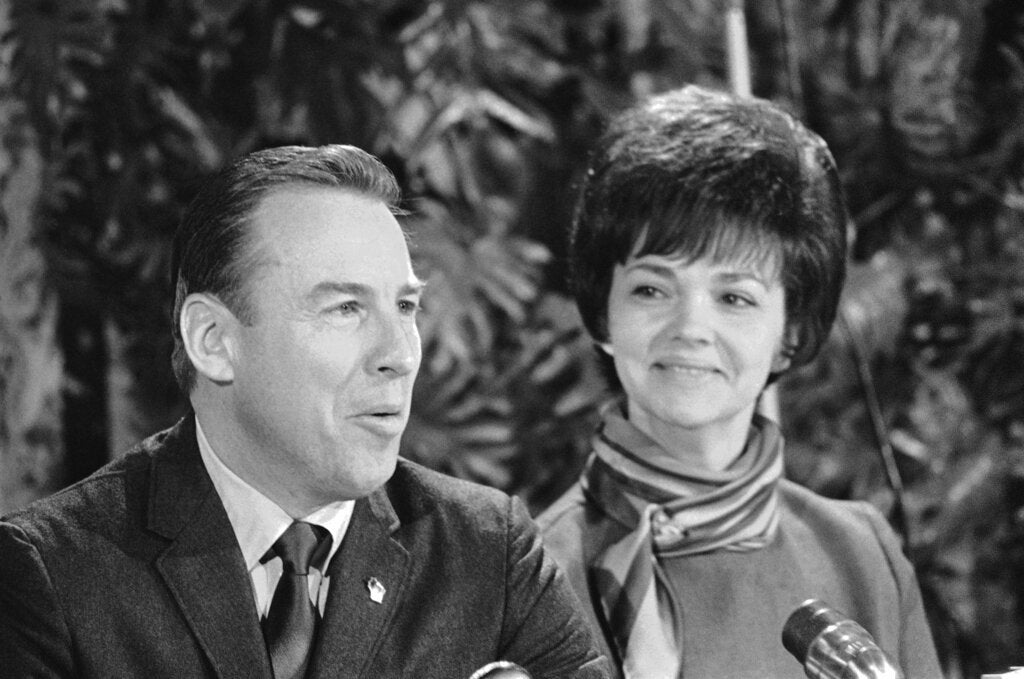
Kluger said that Lovell and his then-girlfriend Marilyn were walking by a jewelry store in Annapolis, Maryland shortly before he graduated from the Naval Academy. He said Lovell pointed at engagement rings and asked her to choose one.
“She said, ‘James Lovell, do you think I’m going to say yes if you don’t ask me properly?’” Kluger said. “And on the sidewalk in Annapolis, in front of that jewelry store, Jim promptly dropped to one knee and proposed to Marilyn, his high school sweetheart.”
“It was always true,” Kluger continued. “If you can’t get along with Jim Lovell, you cannot get along with anyone.”