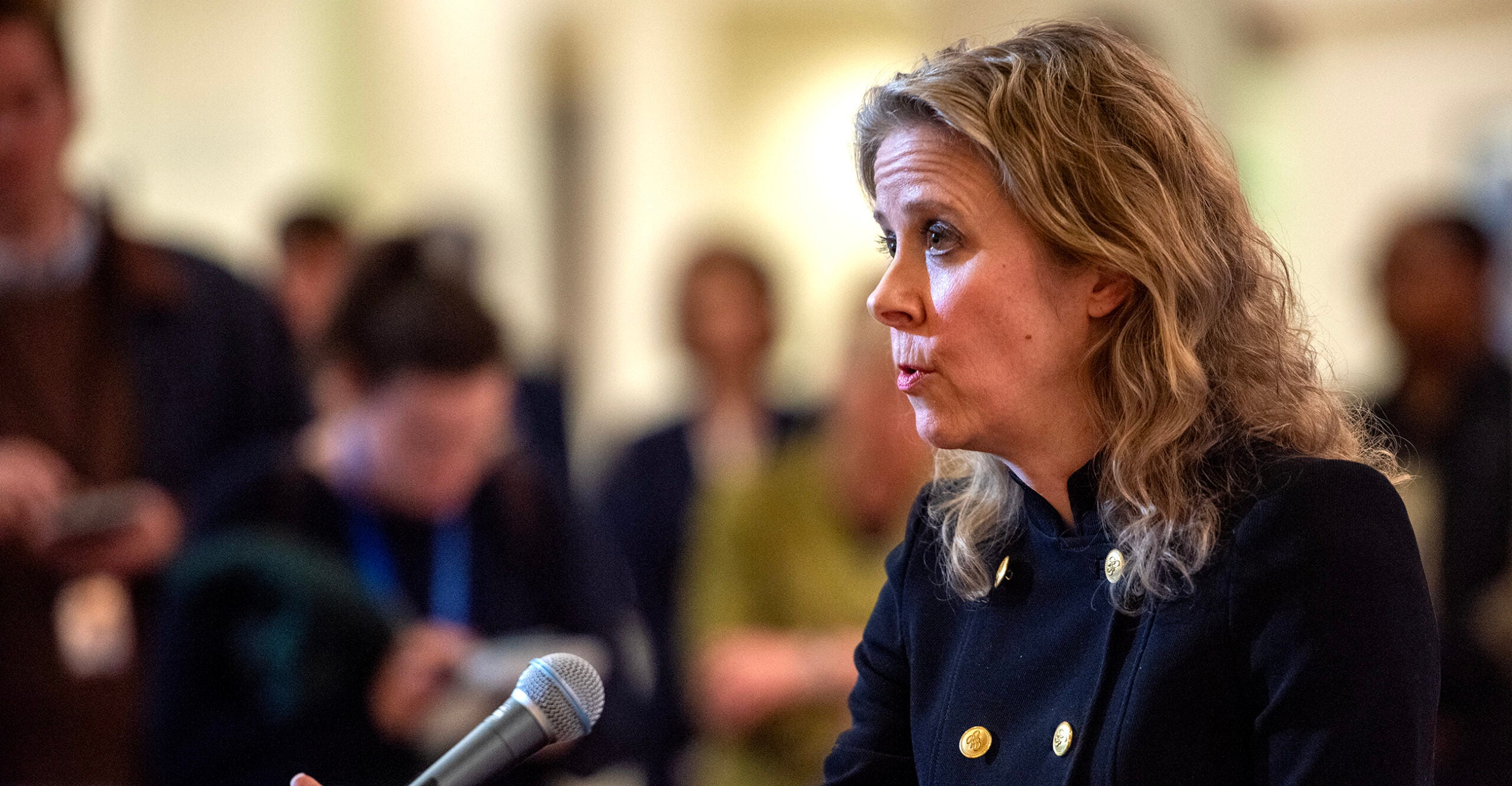
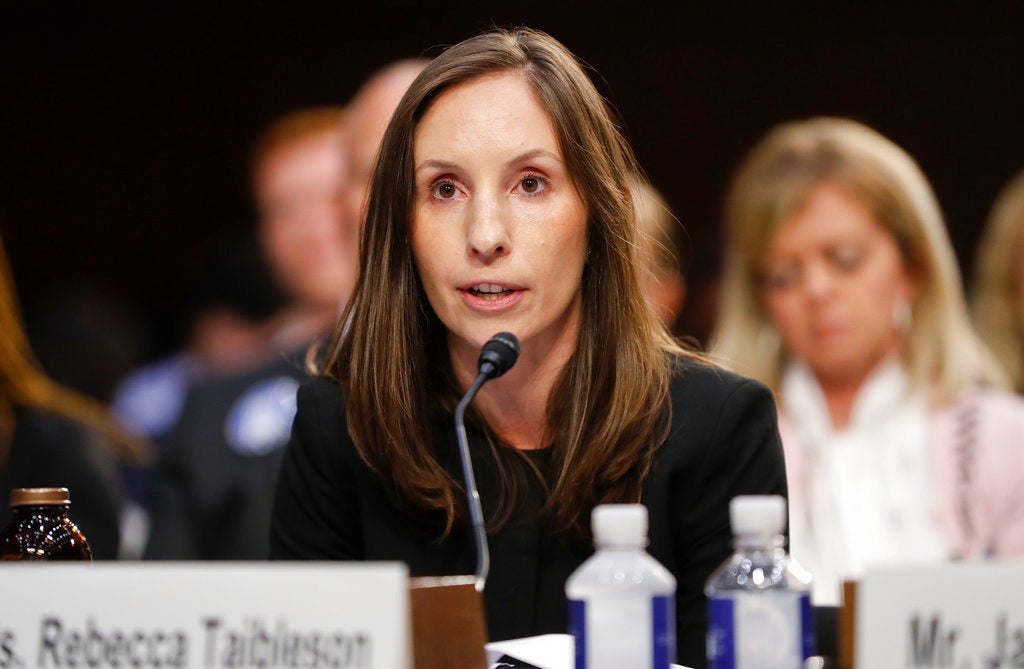
By a party-line vote Thursday, Milwaukee prosecutor Rebecca Taibleson was approved by the U.S. Senate Judiciary Committee to be the next judge for the 7th Circuit Court of Appeals — a high-profile federal position reserved for a Wisconsin jurist.
But Taibleson’s journey to the federal judiciary has been unusual, as she faced a degree of pushback from fellow conservatives that legal experts say marks an internal division in President Donald Trump’s administration over conservative legal values and priorities.
Taibleson, who serves as assistant U.S. attorney and appellate chief in the Eastern District of Wisconsin, received 12 votes from all Republican members of the Senate Judiciary Committee, advancing her to the full Senate. She received no support from the committee’s 10 Democrats.
News with a little more humanity
WPR’s “Wisconsin Today” newsletter keeps you connected to the state you love without feeling overwhelmed. No paywall. No agenda. No corporate filter.
But that party division was less surprising than the slew of public statements from Republicans, including a letter signed by more than 50 conservatives and submitted before her confirmation hearing in September, arguing that she was insufficiently conservative because of her husband’s affiliations and some political and religious donations.
At the time, U.S. Sen. Ted Cruz, a Republican from Texas, described the opposition to Taibleson’s nomination as more robust than “any other judicial nomination in the second Trump term.”
Those concerns seemed to indicate an “emerging conflict between the Federalist Society right and the MAGA right,” said David Fontana, a constitutional law expert at the George Washington University Law School, using shorthand terms for two conservative schools of thought.
The Federalist Society, an organization that promotes constitutional originalism, has for decades strongly influenced who Republicans tap for court positions. On the other hand, Fontana argued, MAGA, short for Make America Great Again, is more interested in upholding Trump priorities.
“The pushback … seemed to be less about her on her own, and more about this emerging fight between and among (conservatives) about what they want from a judge in the second term.”
Taibleson’s conservative record is more in line with the Federalist Society. A former clerk for Supreme Court Justices Brett Kavanaugh and Antonin Scalia, she also worked as an assistant to the solicitor general at the U.S. Department of Justice, beginning in Trump’s first term in 2019. She spoke out in support of Kavanaugh, a Trump nominee, when he faced allegations of sexual misconduct during his high court confirmation hearing.
If confirmed, Taibleson would fill a seat on the 7th Circuit Court of Appeals being vacated by Judge Diane Sykes, who was nominated by former President George W. Bush. The 7th Circuit covers Wisconsin, Illinois and Indiana.
The influential court could be poised to weigh in on significant moves in the Midwest, including the deployment of the National Guard to Chicago. It could also handle challenges to election laws from swing state Wisconsin.
Taibleson is the sixth nominee from Trump’s second term for a federal appeals court seat. In his first term, Trump appointed 54 judges to appeals courts.
An unusual confirmation process
The process for filling seats on the federal court has historically paid great deference to the wishes of a home state’s U.S. senators. Taibleson’s path to her nomination followed a slightly different path.
In Wisconsin, a bipartisan Wisconsin Federal Nominating Commission, set up by Republican Sen. Ron Johnson and Democratic Sen. Tammy Baldwin, has identified potential candidates to then recommend to the White House.
In July, Taibleson was one of five jurists on a list forwarded by Johnson and Baldwin. But according to reporting by WisPolitics, the White House had separately interviewed prospective candidates in a “parallel process.” Taibleson was reportedly one of them.
That’s unusual, said Fontana, “because it suggests a degree of presidential involvement in the selection that might compromise the person’s independence … or at least the appearance of it.”
In August, Trump announced that he had nominated Taibleson via a social media post. Shortly thereafter, criticism emerged from conservative groups — another unusual reaction to someone handpicked by Trump.
Before her Sept. 17 confirmation hearing, Taibleson received letters of support from several conservative groups.
But in one letter, representatives from more than 50 conservative groups, including the Conservative Action Project and the First Liberty Institute, a pro-Trump legal group, argued that Taibleson was not sufficiently conservative.
“Her history of left-wing donations and work history suggest she does not possess the judicial temperament required for an even-handed, equal application of the law along originalist grounds,” the letter stated.
“The President would be free to select one of the proven conservative warriors who applied,” the groups said. “Taibleson’s donation and work history raise significant questions about her commitment to the judicial philosophy espoused by the Trump administration.”
Critics pointed to donations that Taibleson, who is Jewish, had made to the Milwaukee Jewish Federation, which offers some LGBTQ+ programming, and to former U.S. Sen. Joe Manchin, a West Virginia Democrat who sometimes voted with Republicans.
And they highlighted the record of her husband, Ben Taibleson, a fellow assistant U.S. attorney. He once clerked for former U.S. Attorney General Merrick Garland, and has made donations to former President Joe Biden and Wisconsin’s Democratic Attorney General Josh Kaul, according to public records.
During Taibleson’s confirmation hearing, she defended her conservative credentials and Jewish background.
“It felt like we were the only conservatives at our Jewish day school in the 1990s,” she said. “Especially back then, if you were Jewish and conservative, you had to really mean it, and we did.”
She said that she and her husband disagree about many matters of politics and the law.
“Although I’m quite certain my husband is wrong on many matters of policy and law, I love him very deeply, and we have a wonderful family life,” she said.
The statement of resistance to her nomination no longer appears on the Conservative Action Project’s website.
A shift in judicial processes and priorities
The open seat on the 7th Circuit comes after Sykes announced she would enter semi-retirement. Although she was nominated by a Republican president, she received a number of Democratic votes in 2004, including by Wisconsin’s sitting Democratic senators of the time, Russ Feingold and Herb Kohl.
This time around, Taibleson received no Democratic votes in committee, and isn’t likely to receive many from the rest of the Senate, said Carl Tobias, an expert in federal judicial selection at the University of Richmond School of Law.
That’s reflective of a “downward spiral of partisanship and polarization, which kind of makes me sick to my stomach,” Tobias said.
“Some of the older traditions and customs really are much more effective than the lockstep party line voting that we tend to see since Trump took office,” he added.
Tobias argued that the shift toward hyperpolarization is also reflected in the high standards that some conservative critics had for Taibleson.
“Everything about her career and her political views seemed to align with a lot of the appellate nominees from (Trump’s) first term,” he said. “And if you want more than that, then good luck. You should see that she’s going to be very good. You’ll agree with her rulings 90 percent of the time. What do you want?”
After clearing the committee vote Thursday, Taibleson’s nomination will head to the full Senate, where Republicans hold a 53-47 majority.

Wisconsin Public Radio, © Copyright 2026, Board of Regents of the University of Wisconsin System and Wisconsin Educational Communications Board.