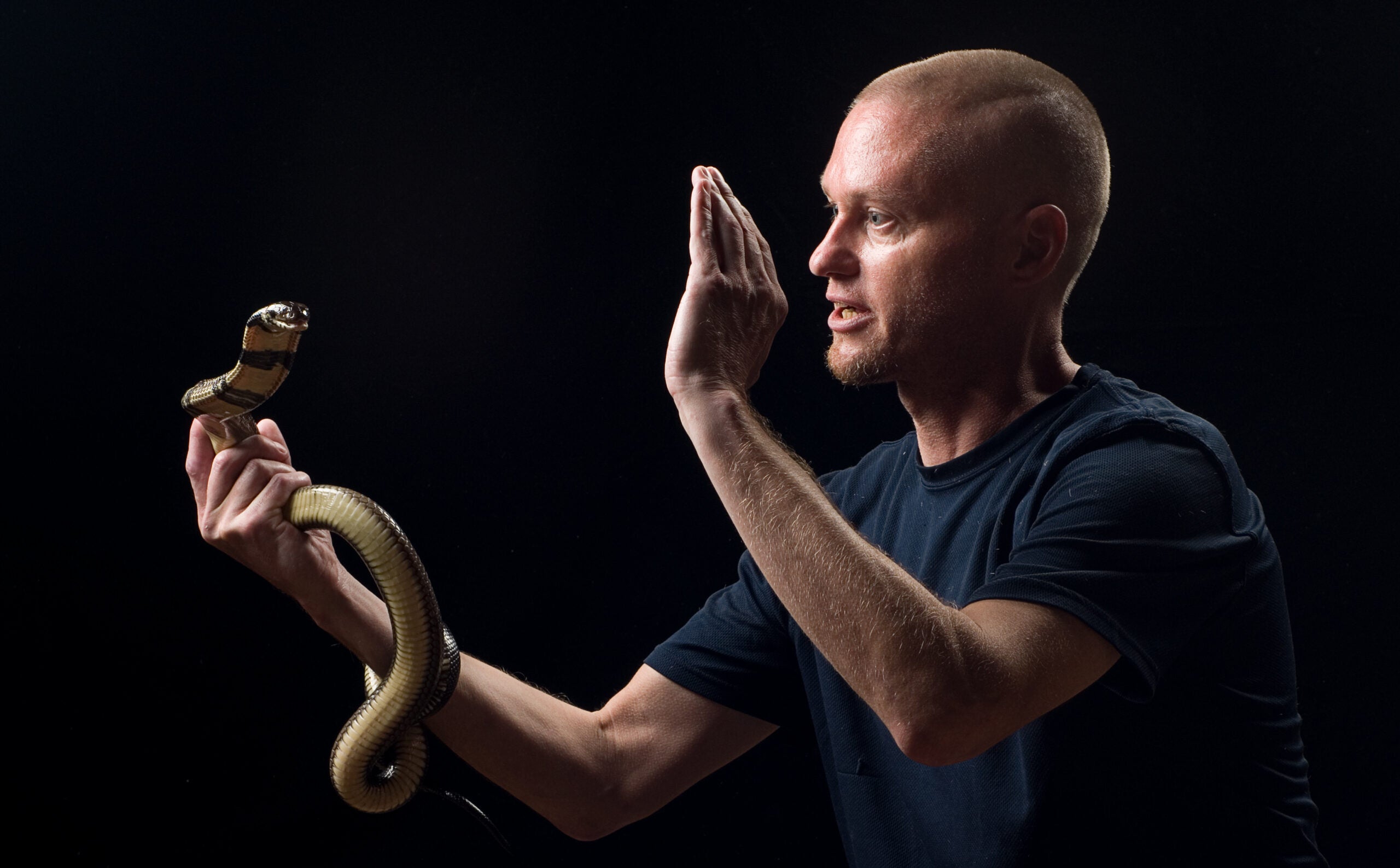
Tim Friede swears he wasn’t addicted to being bitten by venomous snakes. But the Wisconsin man admits he misses the painful, potentially fatal bites he subjected himself to in an attempt to help develop a universal antivenom.
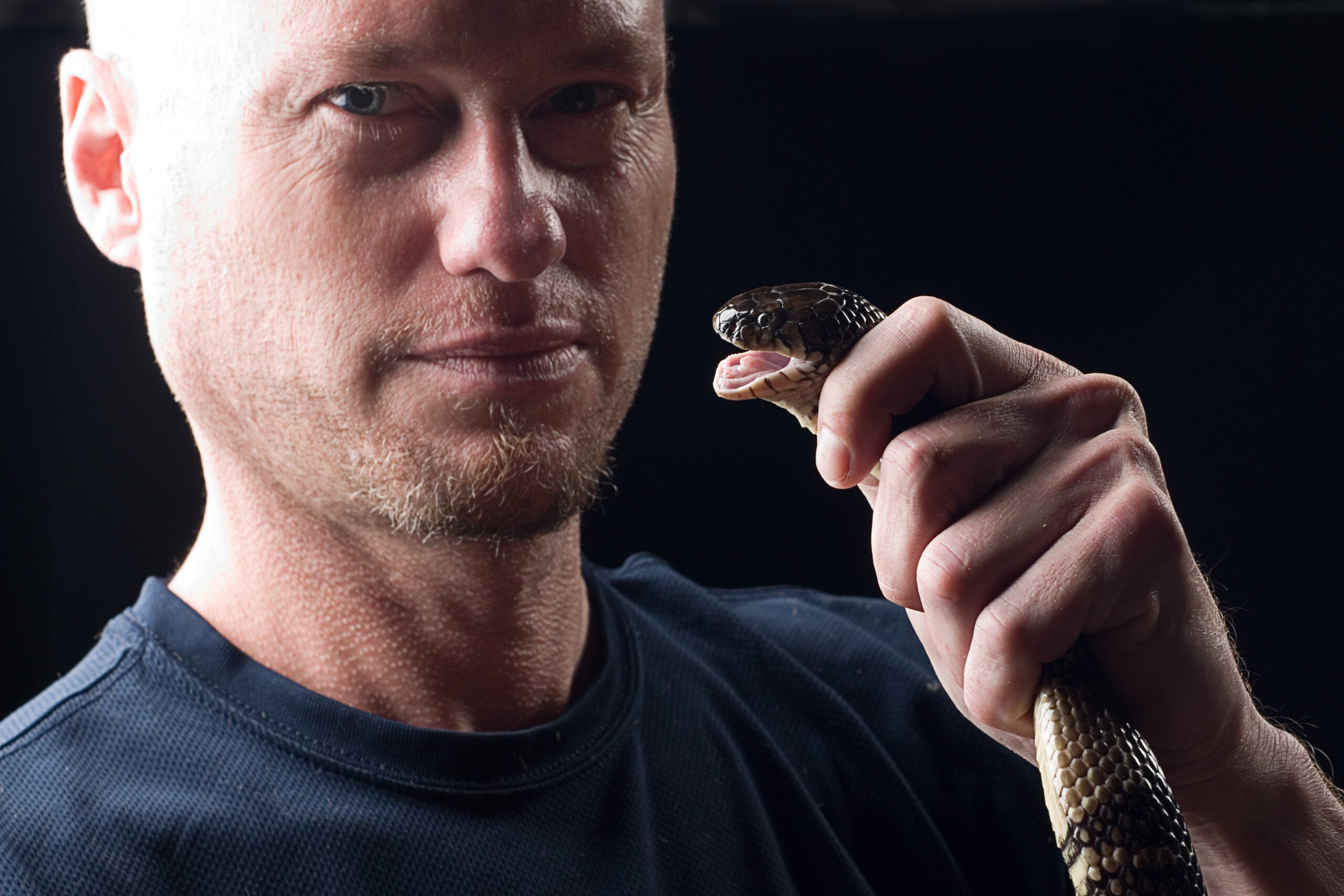
Over almost two decades in the basement of his Two Rivers home, Friede injected himself with venom and let venomous snakes — including cobras, mambas, rattlesnakes and taipans — bite him about 200 times.
His sacrifice is starting to pay off as his colleagues at the San Francisco vaccine company, Centivax, have made strides towards developing a broad antivenom in hopes of saving people from snake bites, which kill more than 100,000 every year.
News with a little more humanity
WPR’s “Wisconsin Today” newsletter keeps you connected to the state you love without feeling overwhelmed. No paywall. No agenda. No corporate filter.
Early on in his experiments, a cobra bite landed Friede in a coma for four days. But he learned from the experience and continued injecting himself and getting bit, while Centivax tested his blood and developed antivenom.
Friede stopped letting snakes bite him in 2018, but he confessed to WPR’s “Wisconsin Today” that he misses his part in this endeavor.
“I miss it a lot. You know, it’s not like a drug or an addiction. I missed that what I was doing was for humanity, for people that die from snake bites, which is 125,000 people a year,” Friede said. “For me, it was knowing that I’m doing something good, where I can change medical history. I can change immunology or herpetology or zoology or toxicology. That made me feel really good to do that because I don’t have a degree. So, that was basically my contribution to medical science, is to use my own body and make a difference with it. And it worked. Wasn’t easy, but it worked.”
Friede, who is the director of herpetology at Centivax, explained to “Wisconsin Today” how he came upon this potentially lethal mission and what lies next for him and his antivenom work.
The following has been edited for clarity and brevity.
Kate Archer Kent: You’ve been bitten more than 200 times by venomous snakes. Can you take us back to that first time? You owned venomous snakes. What prompted you to let them start biting you?
Tim Friede: What prompted me is I didn’t want to use antivenom. I didn’t want to die. I didn’t want to lose a finger. I didn’t want to miss work. All that stuff was just basically a logical decision to make myself immune from snake venom. I didn’t want to use antivenom, so I became the horse. I used my body for self-experimentation to create immunity through time. It doesn’t happen overnight. You have to start real slow and then slowly work your way up to pure venom or bites. So it took me a lot of years to do it, but the first couple bites were scary.
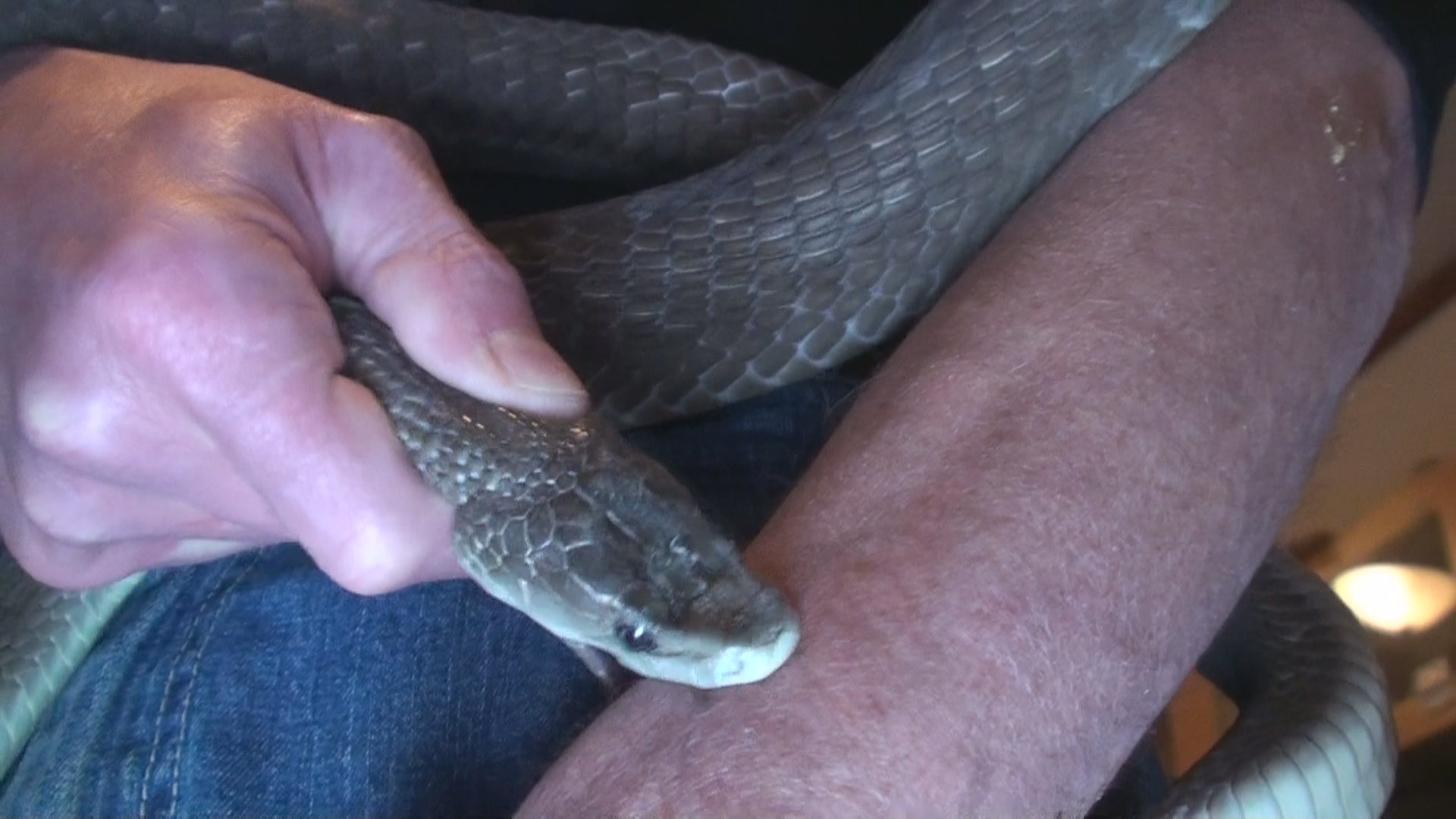
Even though I was injecting myself with venom and I knew I was immune, that’s different than getting bit by the snake because when the snake bites you, you’re getting way more than a lethal dose. My booster shots are pretty much lethal injections with mambas and taipans and cobras and kraits. But when they bite you, you’re getting a lot more venom, which makes it a lot more dangerous. So you don’t know if you’re going to make it. So the first couple bites, I just kind of sat back and breathed and tried to calm down and cross my fingers that I didn’t biff it.
The more you do it, the better you get at it. I wanted to do it a lot, and that makes a regular bite really easy to do when you can do like a black mamba bite [and] taipan bite two minutes back to back. So after that, everything was pretty easy to do. It depends on the venom. All venoms are different. That’s the problem that we have. Venom variation can vary from a juvenile to an adult, from a male to a female, from a wild-caught to captive-born. So venom varies, and that’s why antivenom is a problem because sometimes it doesn’t recognize those venom variations, and that’s the problem that we have within our antivenom right now. So hopefully we can fix that.
KAK: How many snakes do you have access to right now?
TF: I don’t have any. I retired from it in 2018 for many reasons, but at the time, I probably had 60 to 70 snakes. My whole basement was converted into a lab where I did all my research and my injections and bites and a lot of filming.
KAK: Did the bites ever get less painful?
TF: No, they’re always painful. Venom is very inflammatory by nature, so even with the 100 percent immunity that I had, it still swells and still hurts. Rattlesnake bites, I could be down for a month because the venom is that necrotic. Some of my bites, I would swell from my fingertips to my neck.
KAK: Why do snakes bite us in the first place?
TF: They’re afraid. They just want to defend themselves. They’re not going to waste venom for the most part because they can’t really eat you. A lot of the bites result from people trying to pick up the snakes or trying to pin the snakes down. Normally, if you walk away from a venomous snake, it’s going to go the opposite direction.
KAK: If you’ve retired from snake bites, what keeps you focused today? What do you do?
TF: What I’m doing right now, to be honest, is contacting people all over the world for education. Because it doesn’t matter how good your vial of antivenom is — you have to get it in the field, and you have to make it accessible to get to it and [have it be] financially accessible.
The people I [advocate for] are broke. They don’t have any money, so they can’t afford a $2,000 antivenom. I educate people to wear boots, sleep on a cot, have a tent, have a cell phone, have a car, have gas in your car, know where your doctor is and where the antivenom is. Is it going to be four hours to get there? Well, by that time, you’re probably going to be dead. Don’t go to witch doctors. That’s where people die, too.
KAK: What are the venomous snakes in Wisconsin and how might we encounter them?
TF: We have the timber rattlesnake and the massasauga, both pit vipers, and they’re pretty much by the Mississippi River. But there’s not many populations left. I’ve only found one my entire life, in Spring Green. Because of habitat destruction a lot of their territory was taken away, so they’re really hard to find.
KAK: Do you know other people who donate their live body this way to science?
TF: There’s a long history with self-experimentation in medical history, including three Nobel winners. They didn’t use venom like I do, but they’ve done different things to their bodies to prove something works. It’s a really ancient thing. A lot of people in the past have used their own bodies to see if something’s going to work or cure something or figure something out.
KAK: You’re 57. What does the next chapter hold for Tim Friede?
TF: The next chapter is Australia. We want to build a plant in Australia. And we want to start with the vets, dogs and cats and cattle, which I love, because I love dogs and cats. So we could not only save humans, but we can save animals. So we reached out to some vets in Australia that are really excited about it. It also makes it easier if we can save a dog that weighs more than a mouse to take it to the three phases of FDA clinical trials for humans.
So if we can prove it works in cats and dogs, and make that step, not only will we save dogs and cats and cattle, but it’s going to be an easier transition at that point, if it works to humans.
I don’t have to be in the field. My job’s done. I gave them my blood. I gave them my knowledge the best I could, and now I just kind of sit back in the weeds and wait and talk to people like you and communicate how [big of a problem] snake bite deaths are. A lot of people just aren’t aware of it because it doesn’t really exist here. We only lose like maybe a dozen people a year in North America to snake bites. Asia, you lose 100,000 or so.