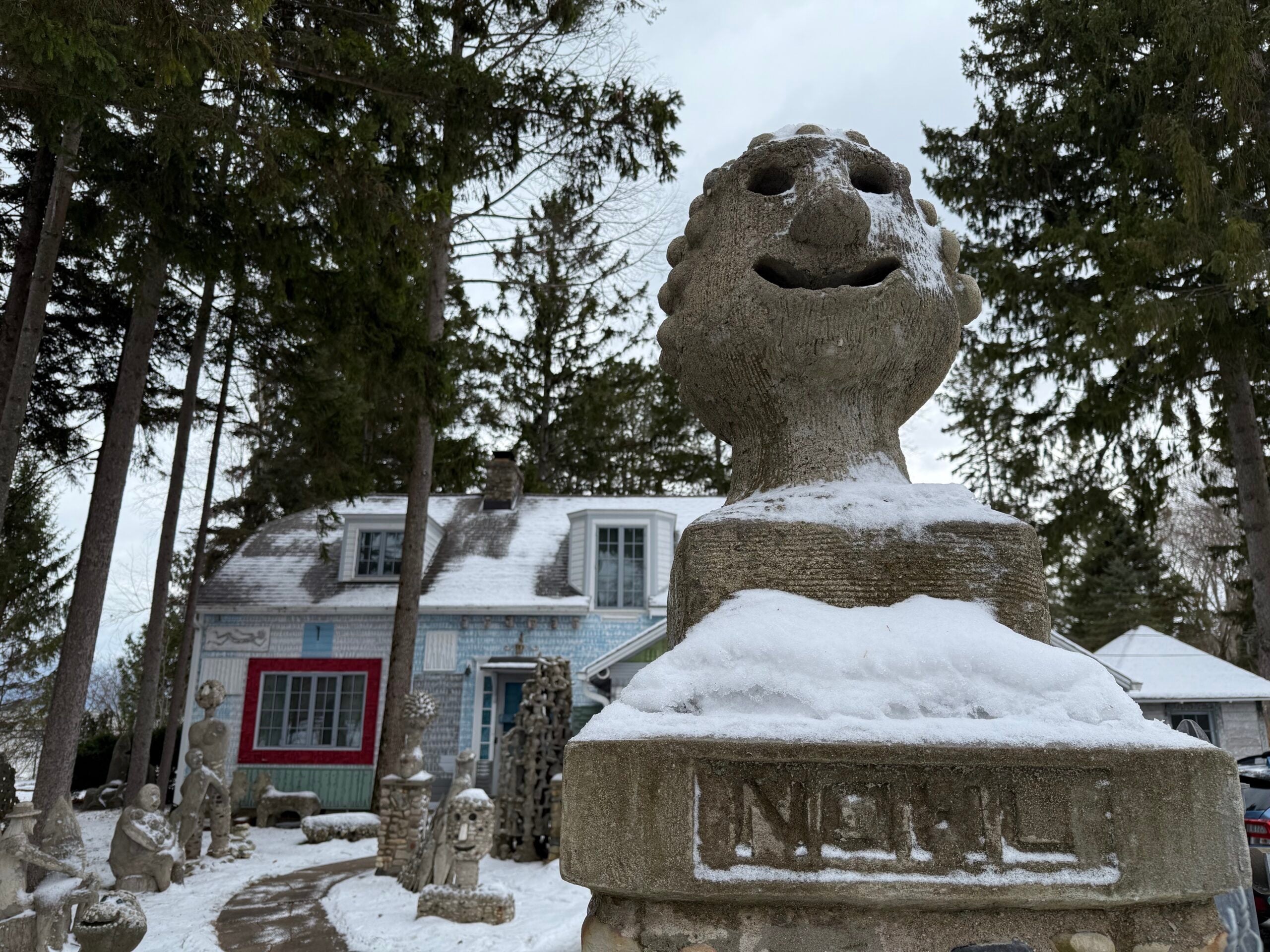
Along the shore of Lake Michigan in picturesque Fox Point stands an eccentric and controversial cottage.
Today, the yard is filled with dozens of driftwood sculptures and cement statues decorated with rocks from the beach. It sticks out in this quiet, residential neighborhood. The garage is lined with wood carvings of faces and fish.
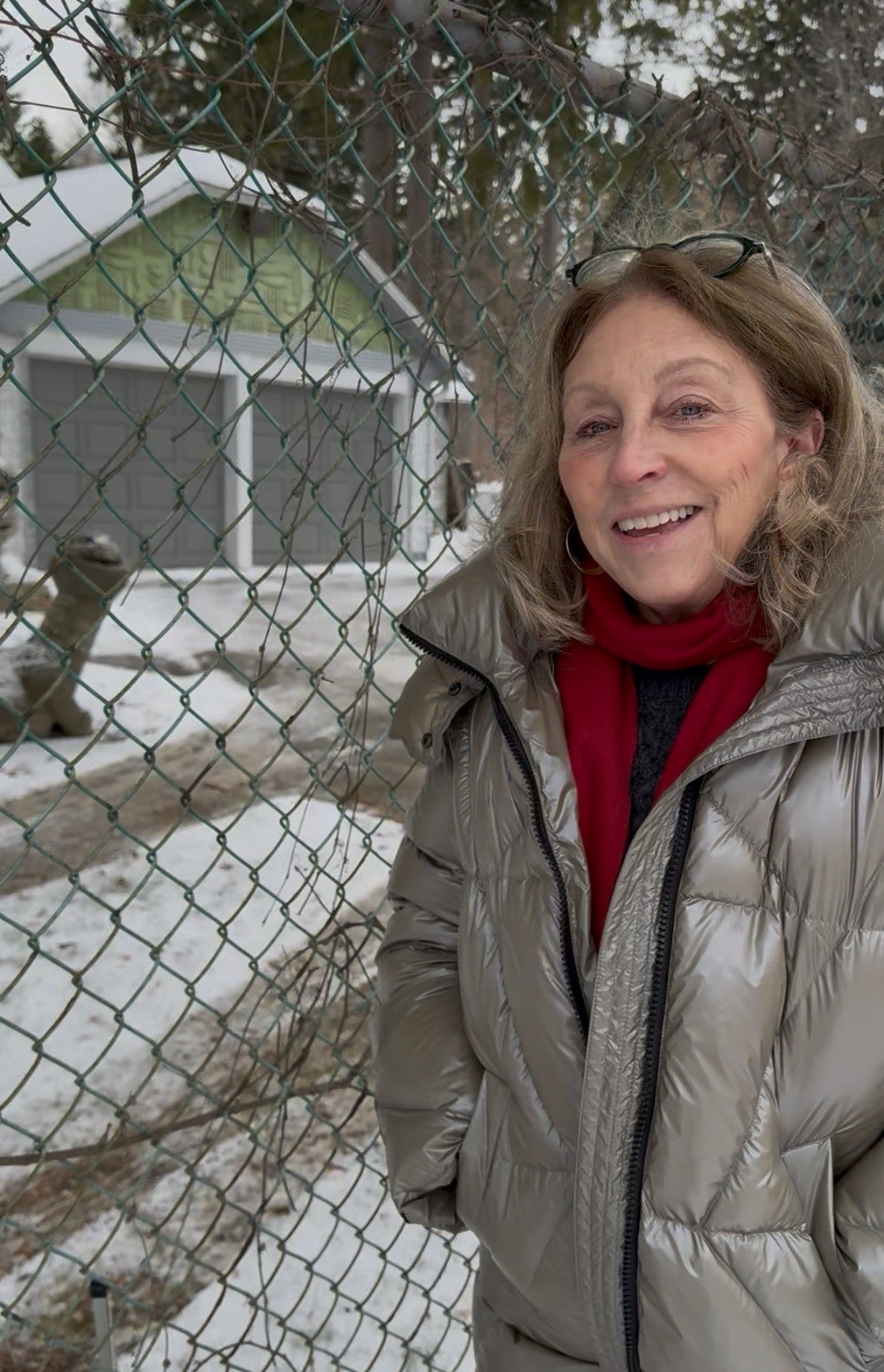
“I love the fish. And these (sculptures), of course, always remind me of Easter Island — the big heads,” said playwright Marie Kohler of Milwaukee, who looks through the chain-link fence surrounding the home, pointing out her favorite works of art in the yard.
News with a little more humanity
WPR’s “Wisconsin Today” newsletter keeps you connected to the state you love without feeling overwhelmed. No paywall. No agenda. No corporate filter.
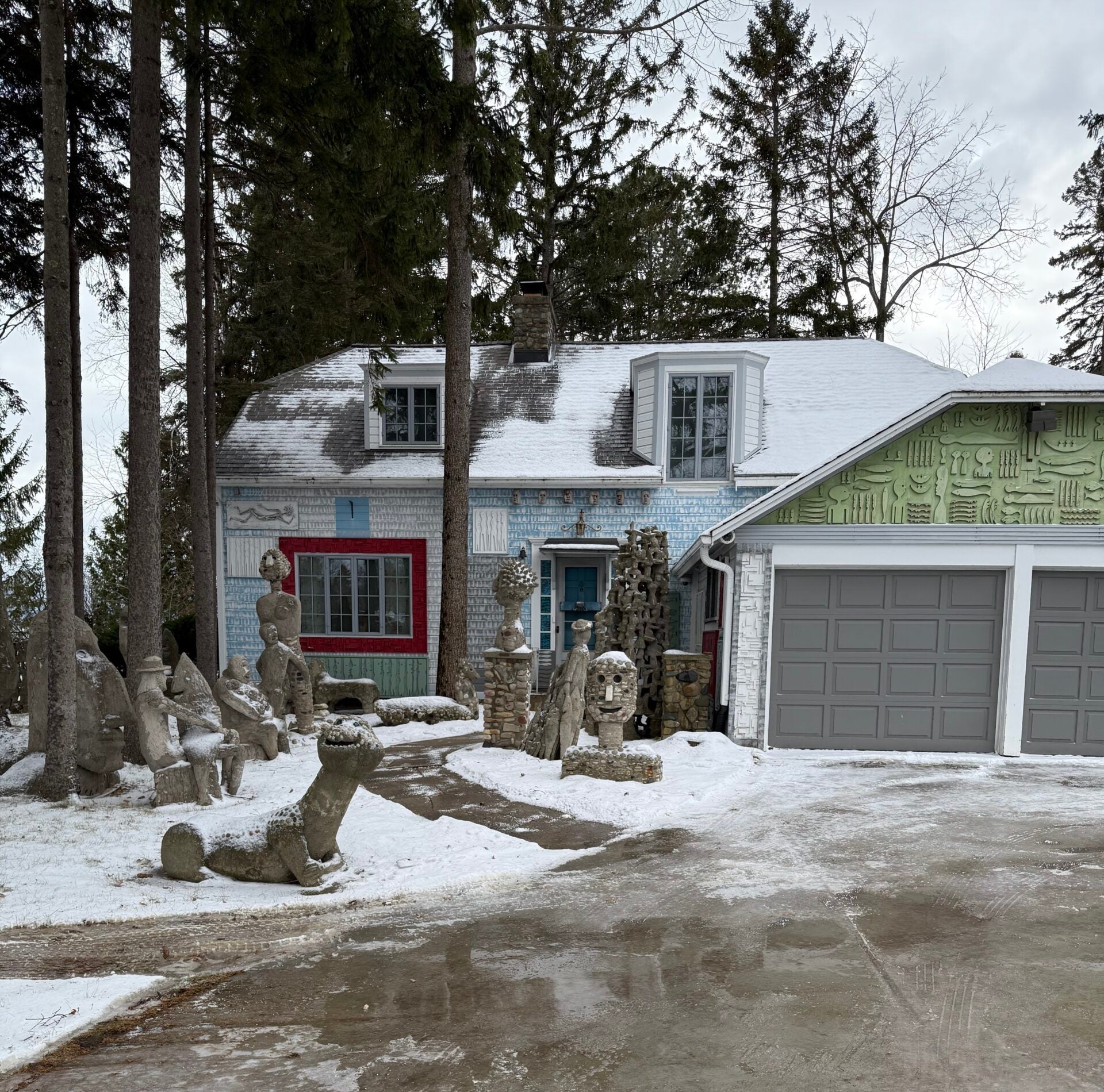
All of this work was created by the late artist Mary Nohl. Her home was her canvas, as she filled nearly every inch of the inside and outside with her sculptures and paintings. Her home was known as the “Witch’s House.”
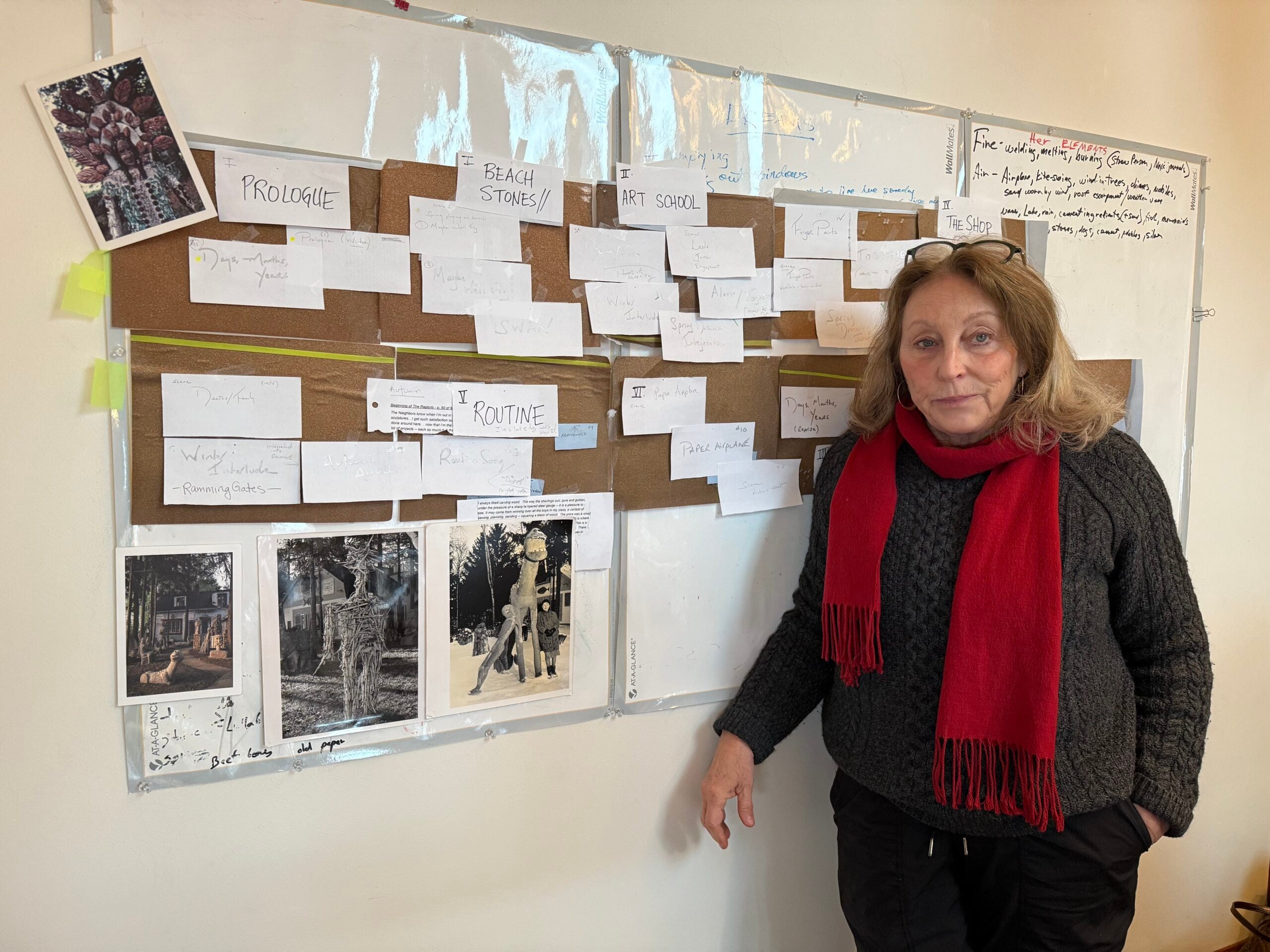
Kohler has been a long-time fan of Nohl’s outsider art. One way she wants to keep the artist’s legacy alive is through a new play with music, called “Maybe We’ll Fly.”
Mary Nohl: The artist and the house
Mary Nohl was born in 1914 in Milwaukee. She became interested in art at an early age and attended the School of the Art Institute of Chicago, graduating in 1939. Like many female art graduates at the time, she became a teacher, but realized it was not the life for her. According to the book, “Mary Nohl: Inside & Outside,” she then ran a pottery studio making mugs and vases in Milwaukee from 1947-1954 with her father’s financial backing.
But Nohl’s most notable work was created at her family’s lakeside cottage home on Beach Drive in Fox Point. Her home became her canvas as she decorated nearly every square inch of the inside and outside of the home with her painted and sculpted creations. Her yard became filled with sculptures made of cement, Lake Michigan rocks and driftwood.

That home became the center of controversy for decades. Nohl and her work have their admirers: the art aficionados and drive-by gawkers.
There were also young vandals, who stole her art or knocked over statues.
“Here’s a big statue made of driftwood, that was her ‘straw man,’” said Kohler, looking at a photo of a Nohl sculpture. “That was burned completely to the ground by vandals.”
Nohl took what was left from the “straw man” and recreated a piece that looks like “a fierce dragon with teeth,” Kohler said.
Not only did Nohl build off these moments, but she eventually added colored, jagged glass to the top of a wall around her home to keep people out. Today, that’s been replaced with a chain-link fence.

The main controversy surrounding Nohl’s home has been with nearby neighbors. Even in Nohl’s lifetime, some residents disliked the extra traffic and parking her home brought to the scenic and usually quiet Beach Drive.
Since Nohl wanted her house to be preserved, she left it to the Kohler Foundation after she passed away in 2001 at age 87. The John Michael Kohler Arts Center then became the stewards of her home in 2012, calling it an art environment and also moving much of her work to its Art Preserve. The Foundation has wanted to open Nohl’s home to visitors, but clashed with neighbors for years over access to it.
John Michael Kohler was Marie Kohler’s great-grandfather, but she is not involved in the home or the art acquisition.
But she admires Nohl’s drive and the artwork she created — sculptures that can seem eerie to some people. That could be part of the reason some people call it the “Witch’s House.” Marie Kohler has another theory.
“I think she was a single woman, to start with. She lived by herself very happily,” said Kohler. “So, I think it’s the combination of her art in nature that might have instigated that witch thing, plus the fact that she didn’t care what anyone thought.”
Not only did Nohl want her home’s and art’s legacy to live on, but she wanted to invest in future viual artists in the region. Nohl left $9.6 million to the Greater Milwaukee Foundation and created the Mary L. Nohl Fund Fellowships for Individual Artists.
Marie Kohler’s ‘Maybe We’ll Fly’
All this controversy surrounding Nohl and her outsider art is at the center of a new play by Kohler, called “Maybe We’ll Fly.”
“I have been interested in her forever. She was a character,” said Kohler, who was able to meet Nohl once. “She became a local celebrity whether she wanted to or not. And I don’t think she minded, because the stuff was out there for everyone to see.
Kohler co-wrote “Maybe We’ll Fly” with composer Josh Schmidt of Mequon. It’s being directed by Elizabeth Margolius of Chicago. They call it a play with music, since a cello accompanies the occasionally singing actors on stage. The team wanted to explore Nohl’s artistic drive.
“What I really admire about her is her ability to persist, to keep on doing what she loved doing. She didn’t allow people or society to stop her,” said Kohler.

She also explored other themes, like aging.
“In my play, I also deal with the question of how to let go as she gets older and feebler and (is) not able to get down the hill to work on the statues. She’s stuck in the house with just a very diminished palette,” said Kohler. “So that whole question — that I think is a universal one for artists and for everyone really — is how as your powers begin to fade, how to let go? What do you grasp, what do let go of? How do you do that?”
Kohler comes from a family that has long supported the arts in Wisconsin.
Her mother instilled a love of theater in her at an early age. She grew up in Kohler, Wisconsin and often traveled to Milwaukee to see plays with her family, notably productions at the Skylight Music Theatre.
In 1993, Kohler co-founded Renaissance Theaterworks, a women-centered company based in Milwaukee. She’s been involved in the theater world for much of her life and written plays for decades, including another one about Nohl called “Witch House.”
Kohler calls herself a theater “addict.”
“When you’re there in the theater, there’s this world that’s created. It’s communal, it’s shared by everyone in that theater,” Kohler said, smiling. “It’s this special moment in time, isolated, away from the real world. You’re in darkness, and a world is brought to life before you. And if it’s successfully done, you enter that world through those characters, through those words, through that music, and you empathize, you expand and your imagination soars. You go inward and you think, ‘Am I like that? Could I be better?’ There’s always the conflict, the dark and the light.”
Readings of “Maybe We’ll Fly” are being presented by Milwaukee Opera Theatre and will be performed at the Florentine Opera Center on Jan. 16-17. It will also be performed in Sheboygan at the Art Preserve of the John Kohler Arts Center on Jan. 18. The play with music will also be a part of World Premiere Wisconsin in 2026, which helps develop new plays produced in the state.
Kohler hopes to see a more widespread distribution of the production so more people can enter the world of Mary Nohl.
As for the Mary Nohl house, The Mary Nohl Art Environment is open on a limited basis by appointment only, in order to limit traffic for the neighbors. Interested visitors can contact the John Michael Kohler Art Center by email. Appointment scheduling prioritizes educators, students, scholars, artists and Fox Point residents.

“Wisconsin Life” is a co-production of Wisconsin Public Radio and PBS Wisconsin. The project celebrates what makes the state unique through the diverse stories of its people, places, history and culture.