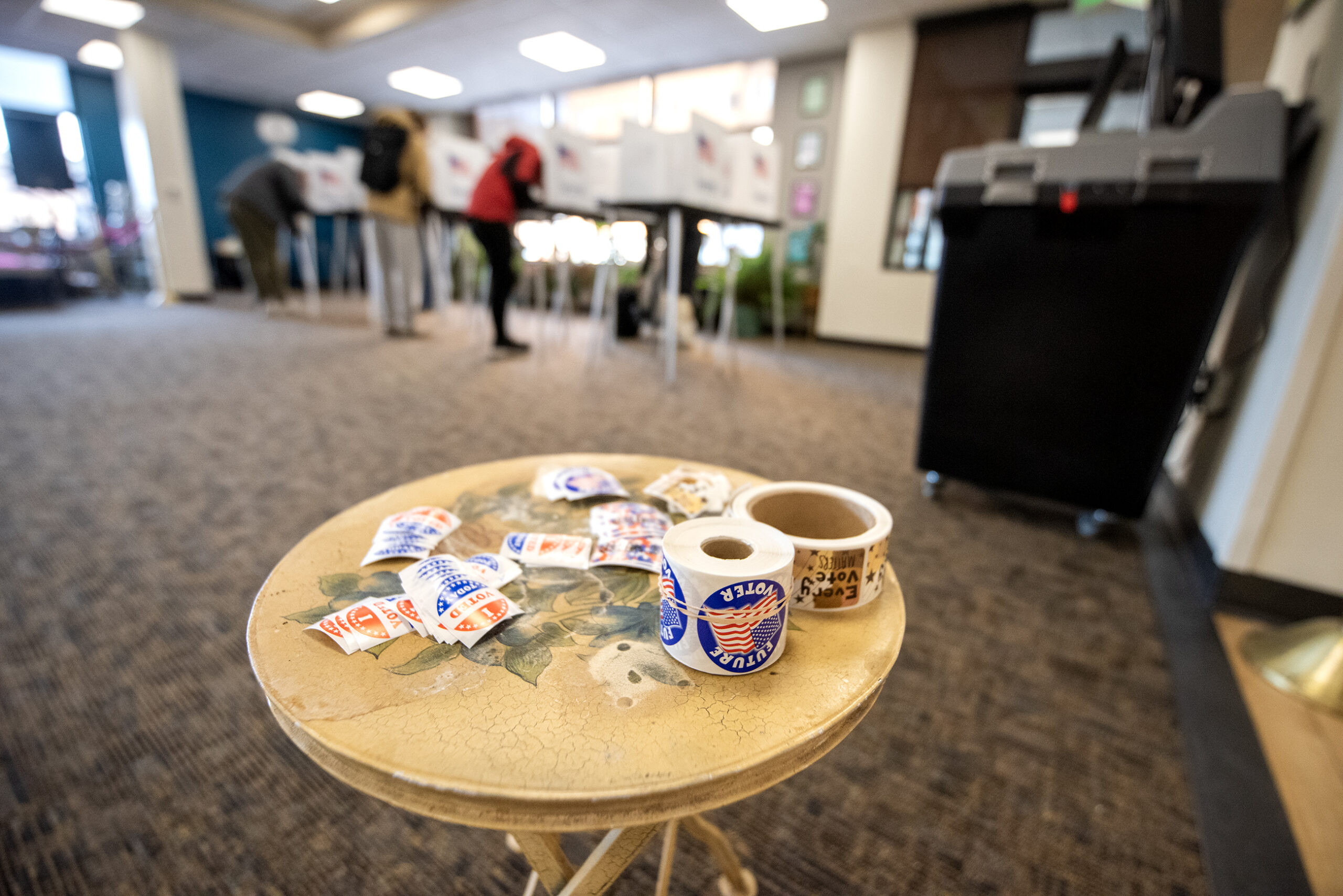
Gov. Tony Evers is blasting the City of Madison for arguing in a lawsuit that absentee voting is a “privilege” and not a “right.”
Wisconsin’s second-largest city is advancing that argument as it tries to fight a lawsuit over 193 ballots that went uncounted in the November 2024 election.
Those untallied ballots would not have changed the outcome of any local, state or national race or referendum. Nonetheless, the bipartisan Wisconsin Elections Commission has lambasted the Madison clerk’s office for a “profound failure” that led to an “unconscionable result” in which nearly 200 lawful votes went uncounted.
News with a little more humanity
WPR’s “Wisconsin Today” newsletter keeps you connected to the state you love without feeling overwhelmed. No paywall. No agenda. No corporate filter.
In March, the progressive firm Law Forward filed a notice of claim against the City of Madison, seeking to bring a class action lawsuit on behalf of the disenfranchised absentee voters. The suit filed in Dane County Circuit Court also names Madison’s former clerk, Maribeth Witzel-Behl, and Deputy Clerk Jim Verbick as defendants.
The suit asks for an unspecified amount of monetary damages to compensate the people suing for “harm, suffering (and) the deprivation of the right to vote.” It says that the people suing were denied their right to vote, as guaranteed under Wisconsin’s Constitution.
Meanwhile, Madison is asking Dane County Judge David Conway to toss out the case. Among other arguments, the city has contended that the people suing should have filed a complaint first with the Wisconsin Elections Commission.
And, late last year, Witzel-Behl argued that the case should be dismissed because, under Wisconsin law, absentee voting is a privilege and not a right.
“The manner which Plaintiffs exercised their right to vote — by absentee ballot — took the process out of its core constitutional protection,” the former clerk’s attorneys wrote. “When the absentee process unfortunately results in a vote not being counted, it is not a violation of a constitutional right.”
The City of Madison later adopted Witzel-Behl’s arguments in full as part of the city’s own briefs seeking to get the case thrown out.
Evers: Absentee voters are not ‘second-class’ voters
That prompted Evers to enter the fray. The Democratic governor filed an amicus brief on Friday, in which he said that Madison’s position on absentee voting could lead to “absurd results” in which absentee voters are treated as “second-class voters.”
“The will of voters who chose to use legally available absentee ballots could be ignored for a myriad of reasons and all without recourse,” the governor’s brief says. “A drop box full of ballots could be damaged by fire or rain, but there would be no obligation to send them duplicate ballots so the votes could be counted.”

Sections of Wisconsin law refer to absentee voting as a “privilege,” and Wisconsin’s Republican Legislature has used that language to defend restrictions on absentee voting.
But Don Millis, a Republican member of Wisconsin’s Election Commission, said Madison is trying to apply the law in an “outrageous” way.
“To be sure, voters don’t have a constitutional right to cast their votes using absentee ballots as opposed to voting in person at the polls on Election Day,” Millis wrote in an op-ed published in the Milwaukee Journal-Sentinel. “But once a state permits absentee voting, a voter returning an absentee ballot in accordance with the law, has a constitutional right to have the ballot counted. To argue otherwise is sophistry.”
Millis called on Madison’s elected leaders to “disavow” Madison’s legal arguments about absentee voting.
On Tuesday, the Wisconsin Elections Commission met in closed session to discuss the ongoing lawsuit against Madison. The commission did not take action on the matter Tuesday.
Legal expert: Madison’s argument ‘conflating two different things’
In an interview with WPR, Bryna Godar, a staff attorney at the State Democracy Research Initiative at the University of Wisconsin Law School, said Madison’s argument is “conflating two different things.”
“The Legislature has, in these absentee voting statutes, made clear that it considers absentee voting to be a privilege, in that absentee voting as a method is not constitutionally required, and that the Legislature can impose some additional procedures on absentee voting that it maybe couldn’t impose on in-person voting,” said Godar. “That privileged language does not mean that when you vote absentee, you don’t have a right to have your vote counted.”
The Wisconsin laws describing absentee voting as a “privilege” have been used in lawsuits where people are trying to get certain absentee ballots thrown out, because voters didn’t follow proper procedures, Godar noted. That could include instances where an absentee ballot envelope is missing a signature or a witness address is not completely written out.
But Godar said that’s not the same as the Law Forward case, in which no one is disputing that the 193 voters followed the process correctly.
Madison mayor: City supports absentee voting
In a statement Friday afternoon, Madison Mayor Satya Rhodes-Conway said the city supports all forms of voting — including via absentee ballot.
“This lawsuit is not about fixing an error, correcting the voting process, or improving the ability of voters to vote absentee – it is solely about seeking millions of dollars of taxpayer money for human error,” the statement read.
That’s not the case, said Scott Thompson, staff counsel with Law Forward.
“It is true that money is at stake in many lawsuits,” Thompson said. “But I would argue that something much more profound is at the heart of this case, and that’s voting. And we’re always going to fight for that.”
Godar, the legal expert from UW, said it’s “not super common” for plaintiffs to seek financial compensation in voting-rights cases. More often, she said, the people suing ask for non-monetary remedies like a recount.
In this case, however, she noted it’s too late for the 193 votes to be counted.
“All of those processes had finished by the time that this came to light, and so the plaintiffs here are seeking monetary damages instead,” Godar said.
Thompson, the Law Forward attorney, said the blame for the uncounted ballots does not lie with the Madison residents who are suing.
“The people in this case, they don’t want to sue anybody,” Thompson said. “They wanted to vote.”
After investigating the matter, the Wisconsin Elections Commission concluded the 193 ballots were overlooked because of a “confluence of errors.” But the commission also criticized Witzel-Behl for failing to take action in a timely manner once the problem was discovered.
According to the commission report, election staff first notified Witzel-Behl about some of the uncounted ballots on Nov. 12, weeks before Wisconsin’s election results were certified. In other words, it may have been possible for those votes to still have been counted if the problem had been reported to appropriate officials.
Witzel-Behl resigned in April after being placed on leave. City officials have since agreed to work with the Wisconsin Elections Commission on changes that will prevent the debacle from happening again.
While asking for the case to be dismissed, Witzel-Behl’s attorneys noted that the Madison residents bringing the lawsuit “chose” to vote absentee. While that process is designed to count every ballot, it “can result in errors,” the attorneys wrote.
“The sorting and handling of thousands of absentee ballot envelopes creates the opportunity for human error,” the attorneys wrote in their argument that was later adopted by the city. “This potential for human error, as well as the potential for abuse of the absentee process or even potential fraud in the process, that presumably led the Legislature to declare that submitting a ballot by the absentee process is a ‘privilege’ and not a ‘right.’”
Despite making that argument in court, Madison has previously positioned itself as a champion of absentee voting. After Wisconsin’s then-conservative-controlled Supreme Court overturned the ability to vote via absentee drop box in 2022, the city protested the decision by commissioning artist Jenny Holzer to put up messages on unused ballot drop boxes.
When liberal justices overturned the drop box ban two years later, Rhodes-Conway was among the people celebrating the decision.
Absentee voting in this state dates back to the mid-1800s, and there’s evidence it was first adopted so that Union soldiers could vote while they were away from Wisconsin fighting in the Civil War.
More than a century later, absentee voting exploded in popularity when the COVID-19 pandemic struck. That’s despite President Donald Trump’s criticisms of absentee voting ahead of his unfounded attempts to overturn the 2020 results.
In November 2024, roughly 45 percent of the ballots cast in Wisconsin were absentee, Evers noted in his brief.
That includes people who turned in absentee ballots by mail, drop box or at a clerk’s office. It also includes people who filled out those absentee ballots in-person at an early voting location.
“The constitutional right to vote would mean little if close to half of all voters in Wisconsin were deprived of it because they chose to legally cast an absentee ballot, ” the governor wrote.

Wisconsin Public Radio, © Copyright 2026, Board of Regents of the University of Wisconsin System and Wisconsin Educational Communications Board.