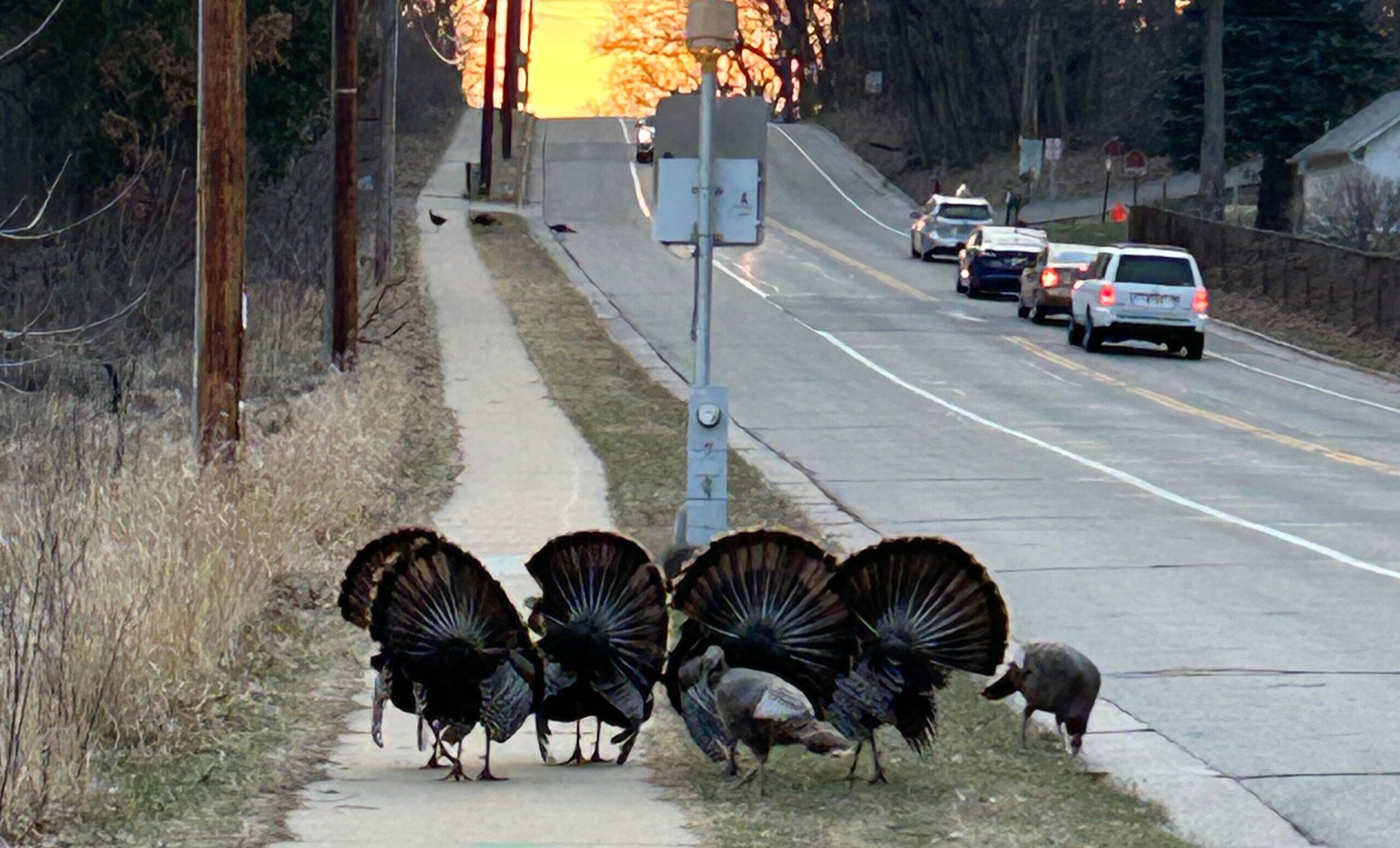
Wild turkeys are increasingly settling in Wisconsin’s urban areas and finding them hospitable places to live. But these new residents don’t always get along with people living there.
“Turkeys quickly find out that in urban areas, they have very few predators, and usually there are a lot of bird feeders,” said Taylor Finger, a game bird specialist with the Wisconsin Department of Natural Resources. “There’s a lot of food and very few dangerous situations. So they tend to make themselves right at home.”
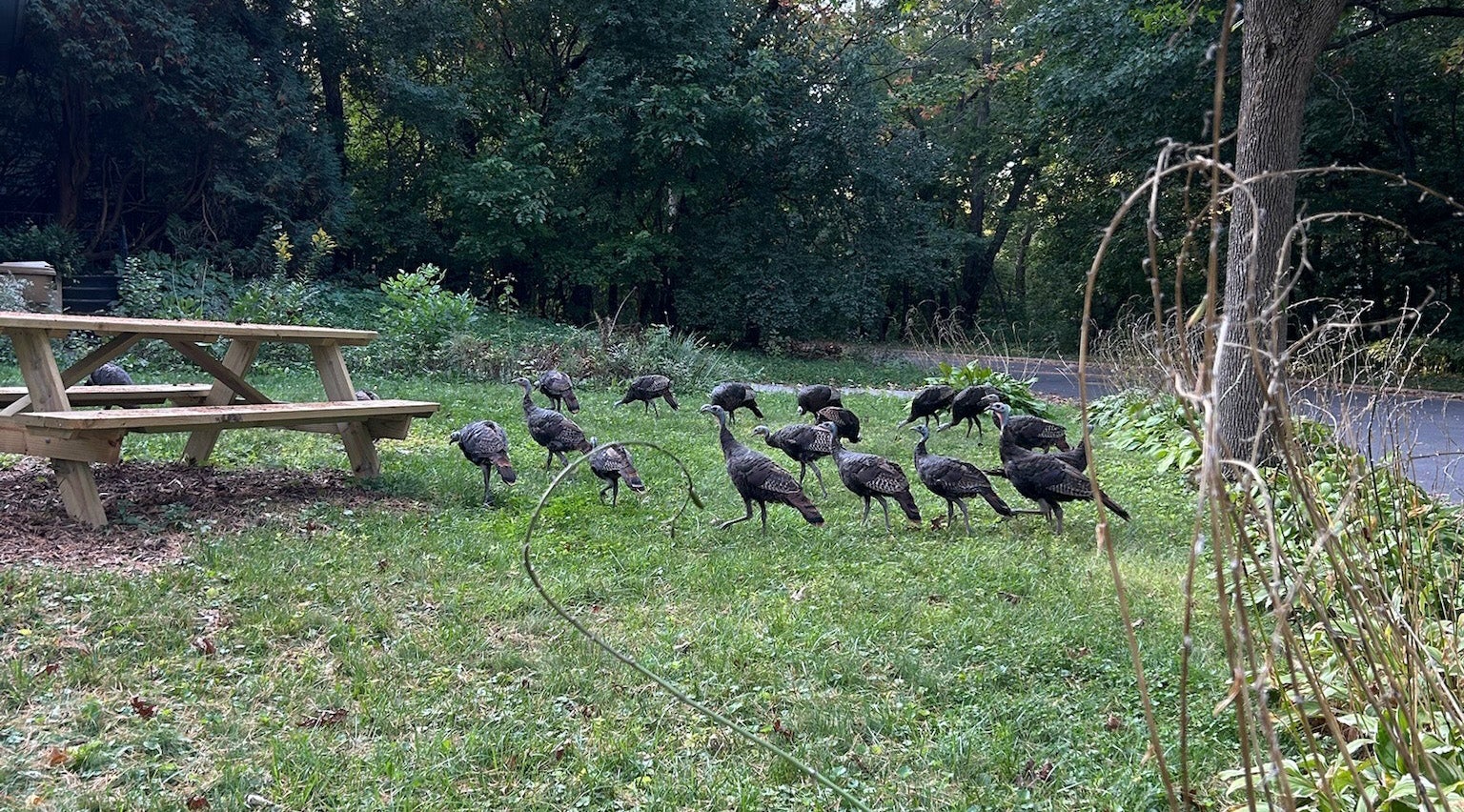
Cities around the state are seeing a spike in turkey-human conflicts. The city of Eau Claire recently fielded complaints about birds harassing and even attacking residents on major walking trails. The Fox Valley dealt with similar problems last spring.
News with a little more humanity
WPR’s “Wisconsin Today” newsletter keeps you connected to the state you love without feeling overwhelmed. No paywall. No agenda. No corporate filter.
This comes as the DNR is in the process of updating its 10-year turkey management plan for the state. The agency is accepting public input through Dec. 18.
Finger joined WPR’s “Wisconsin Today” to explain what’s going on with the state’s turkey population and what individuals and communities can do when they encounter aggressive turkeys.
The following interview was edited for clarity and brevity.
Rob Ferrett: Why are we seeing more turkeys in these urban areas than we used to?
Taylor Finger: It’s a combination of multiple things. We’ve had real mild winters. We’ve had good breeding success. So our turkey numbers are sitting in really good shape. And then in combination, we keep seeing urban sprawl grow and grow.
RF: If someone comes face-to-face with an aggressive turkey, what are the best practices in that situation?
TF: It all depends on who you are. If you’re a bigger adult, you can try to pretend to be big and be the dominant force there, and usually they’ll back down.
But if you’re an older person or smaller, and they see you running away, they interpret that as “I’m winning,” and they will pursue you. So generally, just back up slowly, don’t make any quick movements, and don’t try to be the hero.
We always encourage folks to let wildlife be wild. So don’t try to get as close to them as you can. Don’t try to pull out your camera. It’s nice to get pictures, but don’t put yourself in a situation where you’re going to make everyone uncomfortable, including the birds. If that’s the case, there are usually some ramifications along with that.
RF: How can local municipalities handle situations when they have problems with aggressive turkeys?
TF: So the DNR works with the U.S. Department of Agriculture’s Wildlife Services, and then they work together with the local municipality. It’s generally on the local municipality to make the call in terms of what they would like to do. If they want to relocate those birds, they generally have to foot the bill of what it’s going to cost to capture, move and transport those birds.
Municipalities tend to hold public meetings and then they’ll make a decision on whether to just let the situation figure itself out, relocate them, or they’ll have USDA Wildlife Services come in, capture the birds, and generally they euthanize those birds. Then they’ll donate them to either food pantries or zoos or big cat rescues, so we’re not just landfilling birds.
RF: The DNR considers wild turkeys a big conservation success story. Can you give us some of that history?
TF: Turkeys were essentially hunted until they were extirpated from the state in the late 1800s and early 1900s. We did numerous reintroduction efforts throughout the mid-1900s into the late ‘70s and early ‘80s. We traded ruffed grouse with the state of Missouri for turkeys. On that last reintroduction effort, it worked. Now, we are 50 years down the road, and Wisconsin has probably one of the healthiest turkey populations in the entire country.
RF: What role do wild turkeys play in Wisconsin’s ecosystem?
TF: They’re one of these keystone species that we’ve had here in the state for a long time. They’re omnivores, so they help to control our insect and pest populations. They also are a great species for dispersing seeds, because they’ll feed on a lot of our tree and plant species. And then when they defecate, they move those seeds around the landscape. They’re also a good food source for a lot of our other predators like coyotes, bobcats and raptors.
RF: We’ve seen deer hunting decline in the state. What trends are you seeing with turkey hunting?
TF: Turkeys are still relatively new in terms of their introduction and their growth, so our turkey hunters are extremely avid. Last year was the highest number of tags that we have sold ever. So it’s an extremely popular thing. We don’t seem to be seeing the declines like we’re seeing in some of our other hunts, but we really do tightly control the turkey seasons. There’s only a limited number of tags available, so you can keep interest high if you limit opportunity.
RF: The DNR is in the process of updating the state’s 10-year turkey management plan. What changes could be on the table?
TF: We’re having discussions with all of our partners: the Conservation Congress, Wildlife Federation, National Wild Turkey Federation, every entity. We have a public comment period that is open right now.
We don’t see a ton of changes on the horizon just because we recently did a survey and found that roughly 75 to 85 percent of turkey hunters are satisfied with the way the season is. If the DNR can get over 70 percent satisfaction in anything that we do, you don’t want to do too much in terms of changing things. We’ll see where we can tweak it and add opportunity without negatively affecting the population or the hunting experience.