
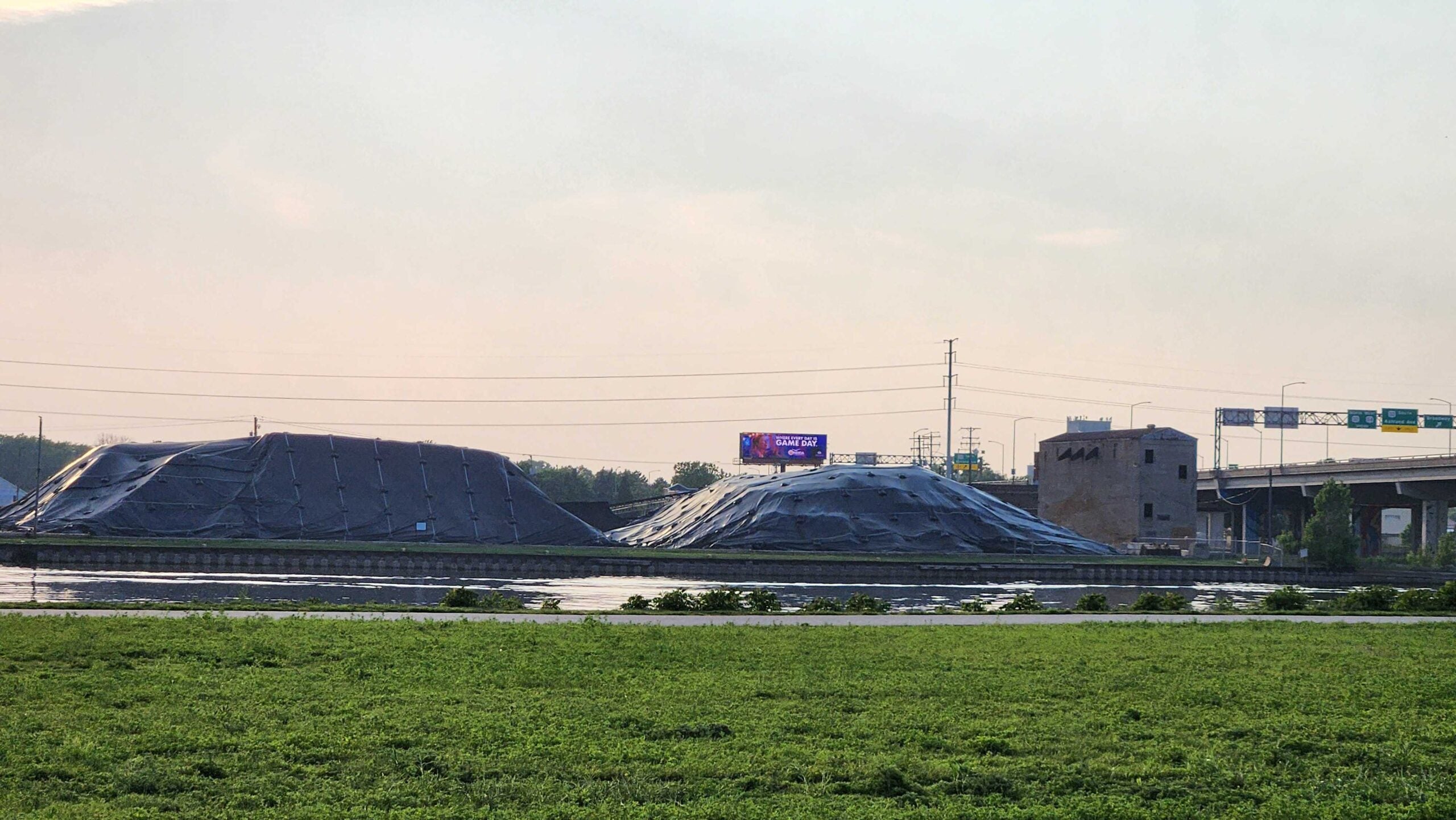
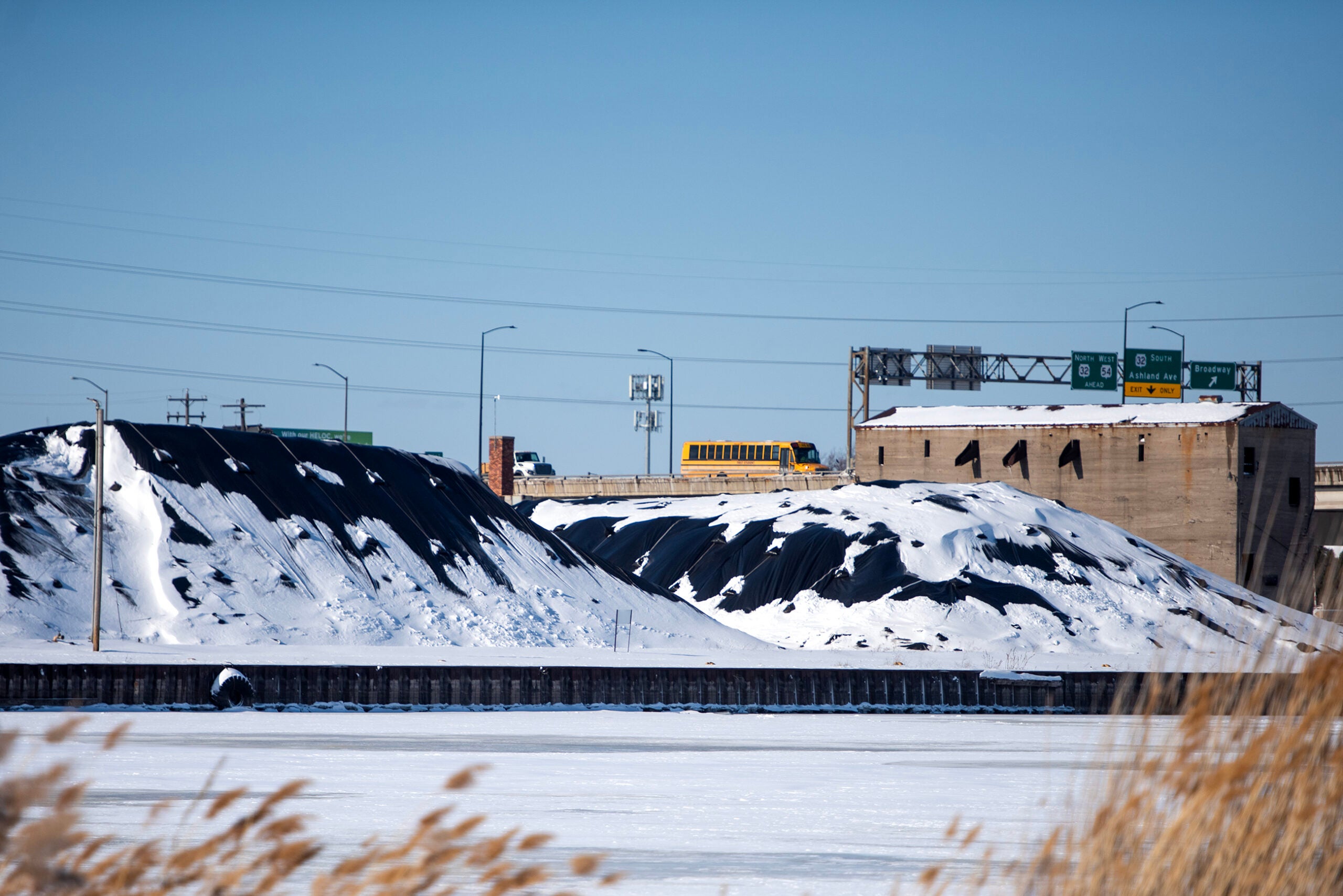
Local leaders reached a tentative deal to move Green Bay’s century-old riverfront coal piles last month. But the downtown home of the mounds of coal likely won’t be development-ready for several years.
The Brown County Board of Supervisors unanimously approved the framework for a lease agreement with the C. Reiss Co. The company has owned a bulk commodities storage facility along the Fox River in Green Bay, home to the coal piles, since 1900.
The lease will allow C. Reiss to lease space at a decommissioned power plant the county owns and intends to use for a project to expand the Port of Green Bay.
News with a little more humanity
WPR’s “Wisconsin Today” newsletter keeps you connected to the state you love without feeling overwhelmed. No paywall. No agenda. No corporate filter.
C. Reiss plans to store salt at the power plant site, and relocate its coal storage from its Mason Street site to another site along the Fox River, called Fox River Terminal. But it isn’t planning to move the coal all at once. Rather, it plans to use up its coal storage on Mason Street and bring new shipments to Fox River Terminal.
The company has said it has about two years of supply stored along the river in downtown Green Bay.
The company and county also still need to iron out the final details of a lease agreement for the power plant site. And there’s still engineering and construction work that needs to be done to allow the power plant to store salt.
For Green Bay, that means “it’s probably going to be several years” before ground is broken on new development at C. Reiss’ Mason Street site, according to Mayor Eric Genrich.
Genrich said he anticipates a final lease agreement between the county and company coming to fruition in September. The deal between the county and C. Reiss last month included a provision that would require them to go to arbitration if they struggle to find consensus on a final lease.
“The county and C. Reiss came together on a high-level term sheet, but [they] need to figure out some of those details by the end of the summer,” he said. “A lot of the planning and engineering is moving forward as they continue to negotiate the final details.”
The Brown County executive’s office and C. Reiss did not respond to requests for comment.
Genrich said depleting the piles, instead of moving them all at once, has “always been the way that this would have been handled.”
“It doesn’t really make sense to expend resources on physically relocating those piles of coal,” he said. “It makes much more sense for C. Reiss to simply move their operation when appropriate, and allow for those piles to be depleted.”
Last month, the Green Bay City Council unanimously approved an updated agreement between the city and C. Reiss. It changed an agreement the council approved in March to reflect the deal between the county and C. Reiss.
As part of that deal, the city agreed to commit up to $2.2 million to the coal pile relocation effort if the county faces funding shortfalls.
During last month’s meeting, Council President Brian Johnson said moving salt to the power plant site instead of coal could create additional costs for the relocation effort, which is why the city offered to fill the potential gap.
“This is the best path forward not only to achieve this longtime goal, but also for the city to really participate in a meaningful way that addresses our primary concern,” he said last month. “The county’s primary concern is port expansion. Ours is relocation of coal. This, to me, felt like a good compromise.”
Removing the coal piles has been a decades-long goal for city leaders, who see that site as prime real estate for development. All of Green Bay’s surviving current and former mayors attended the county board meeting last month where the deal between C. Reiss and the county was approved.
Genrich said redeveloping the coal piles site would be “transformational” for the waterfront.
“The ability to open up 35 acres of our near downtown waterfront for much more appropriate use is exciting, of course, for the community and for a number of us who’ve been engaged in this for some time,” he said.
He declined to specify just how many years away that transformation will be beyond “several.” He said the city will be more comfortable talking about a timeline once there’s more certainty with the county and C. Reiss’ final lease, and a timeline for redeveloping the portion of the power plant site that will be used for salt storage.

Wisconsin Public Radio, © Copyright 2026, Board of Regents of the University of Wisconsin System and Wisconsin Educational Communications Board.