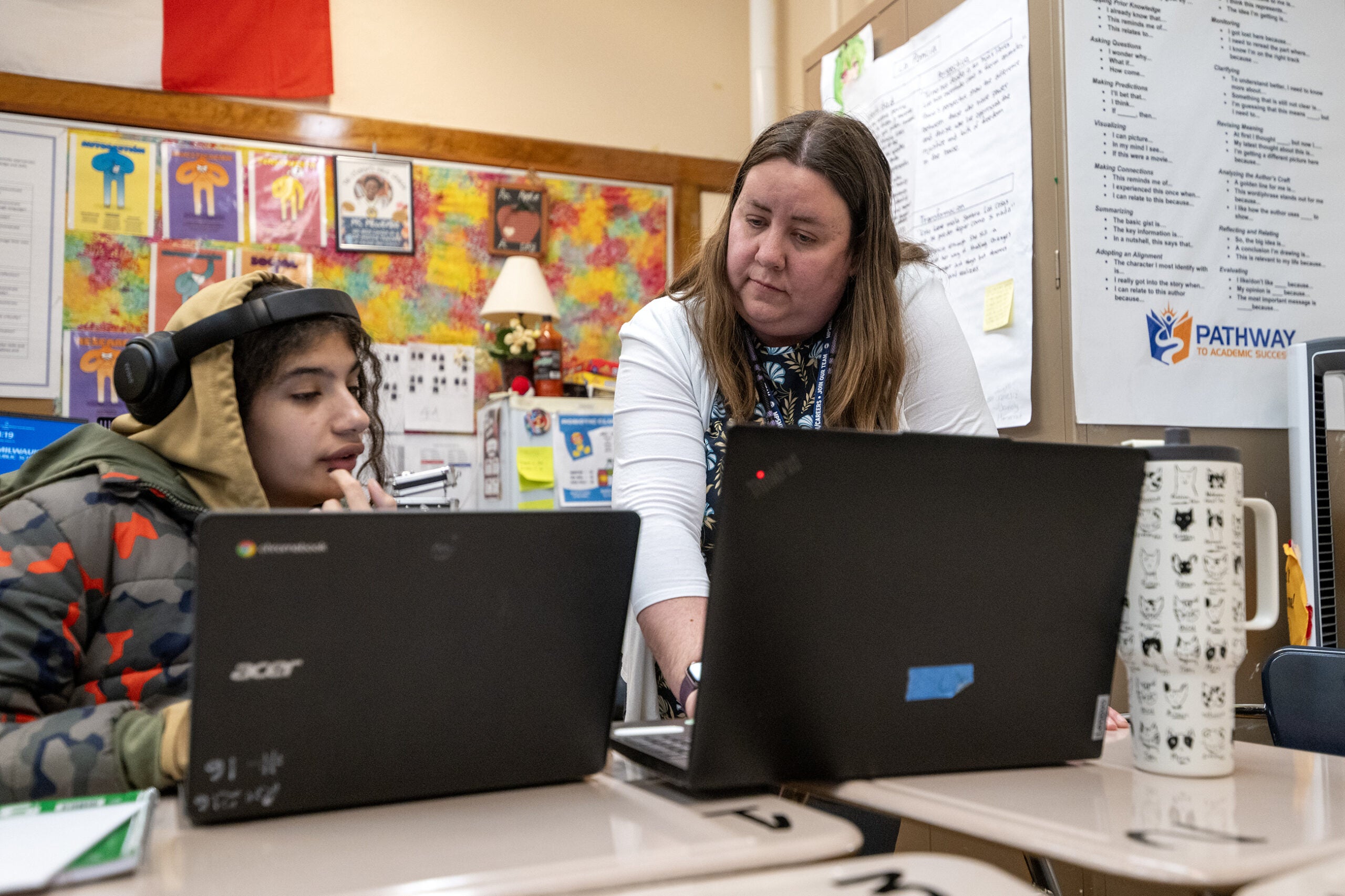
The day is almost over at Casimir Pulaski High School on Milwaukee’s south side.
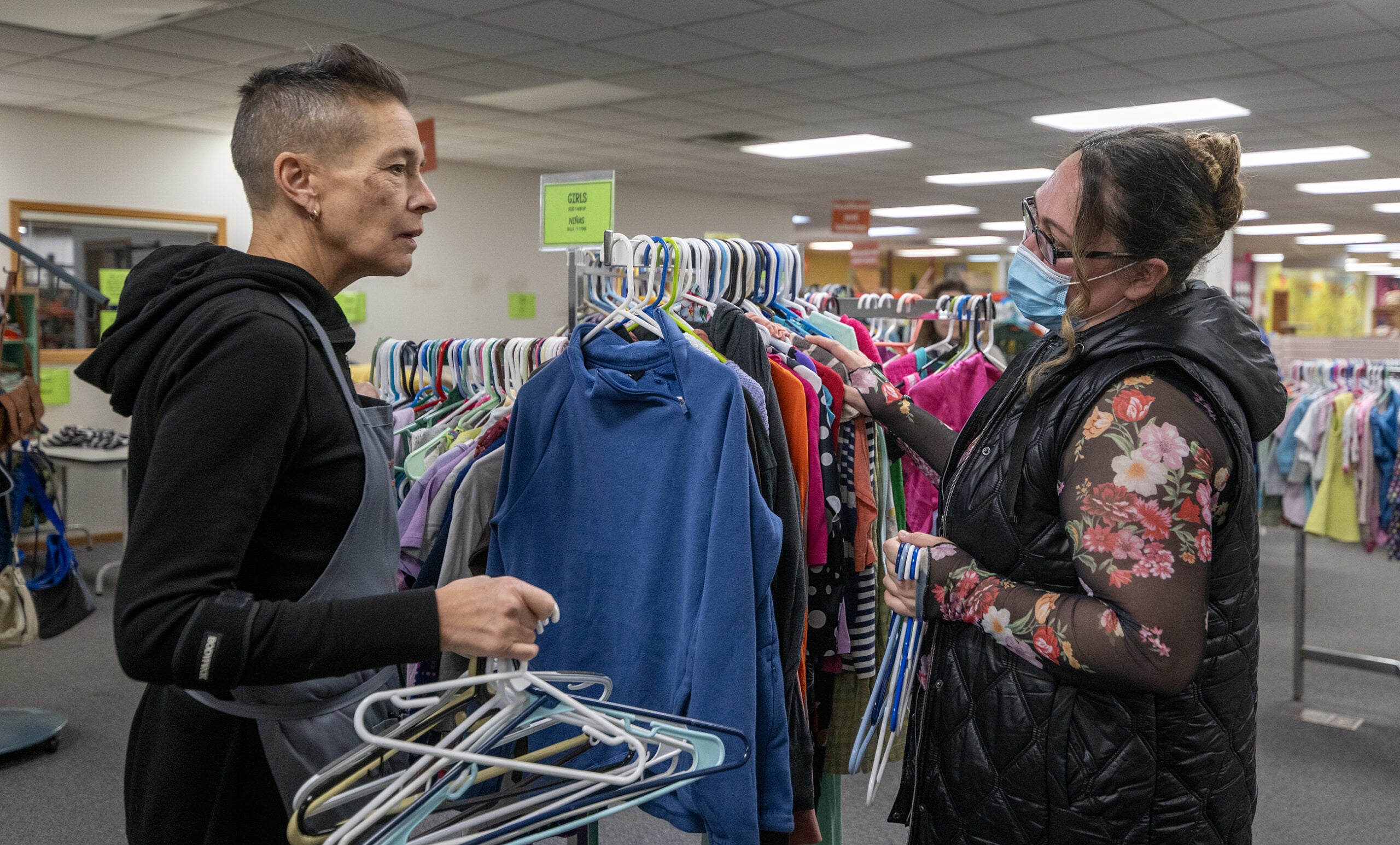
Most students are packing up their things to leave, but Sarah Lind is still helping a student struggling with her English homework.
“So what’s different about these two paragraphs?” Lind asks the freshman student.
News with a little more humanity
WPR’s “Wisconsin Today” newsletter keeps you connected to the state you love without feeling overwhelmed. No paywall. No agenda. No corporate filter.
It takes some time, but together, Lind and the girl figure it out before the last bell.
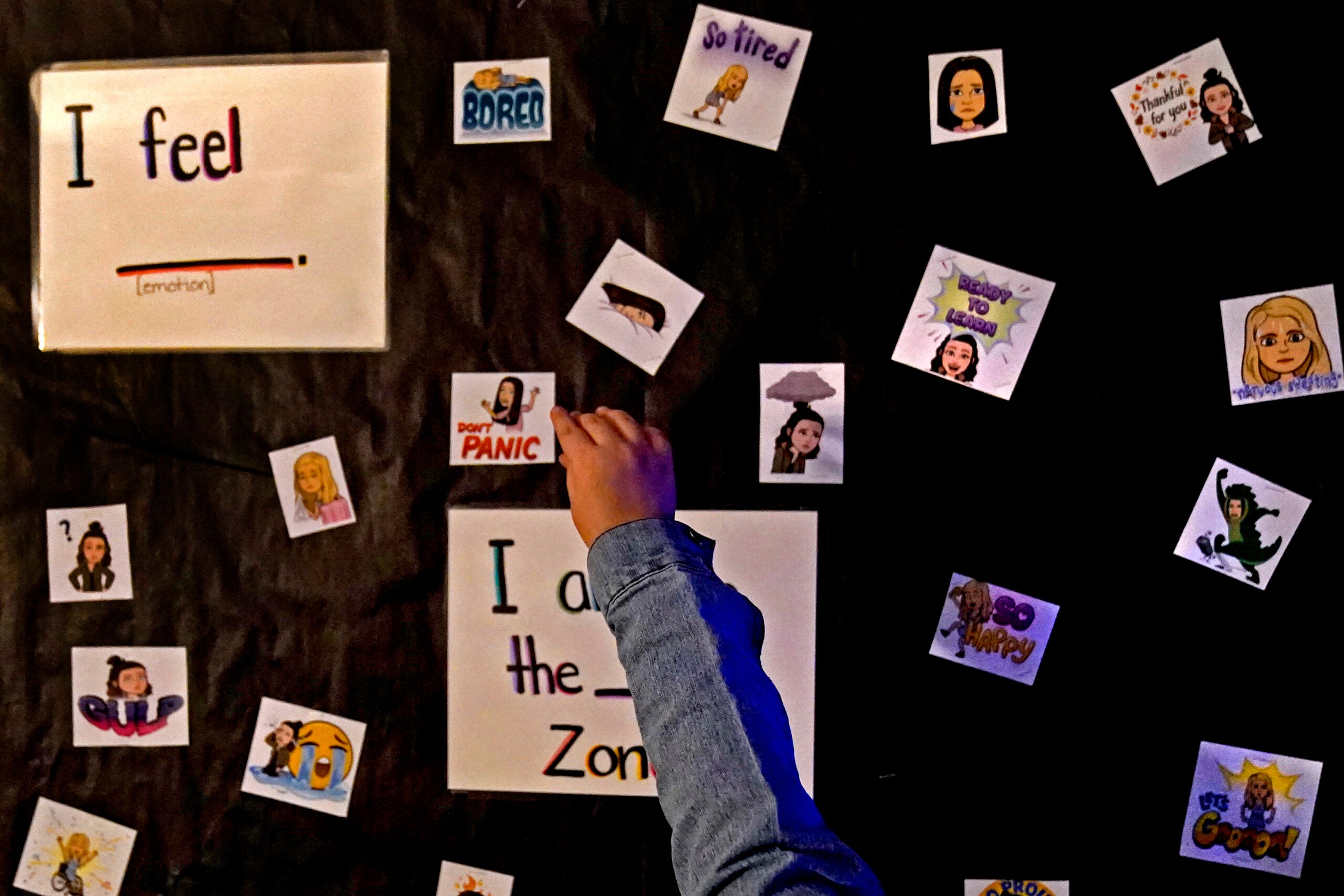
Pulaski is a full-inclusion school, meaning general education and special education students are in the same classrooms.
Lind is a special education teacher who moves from classroom to classroom, helping students where needed.
It’s a second career for Lind, a former journalist, that almost didn’t happen.
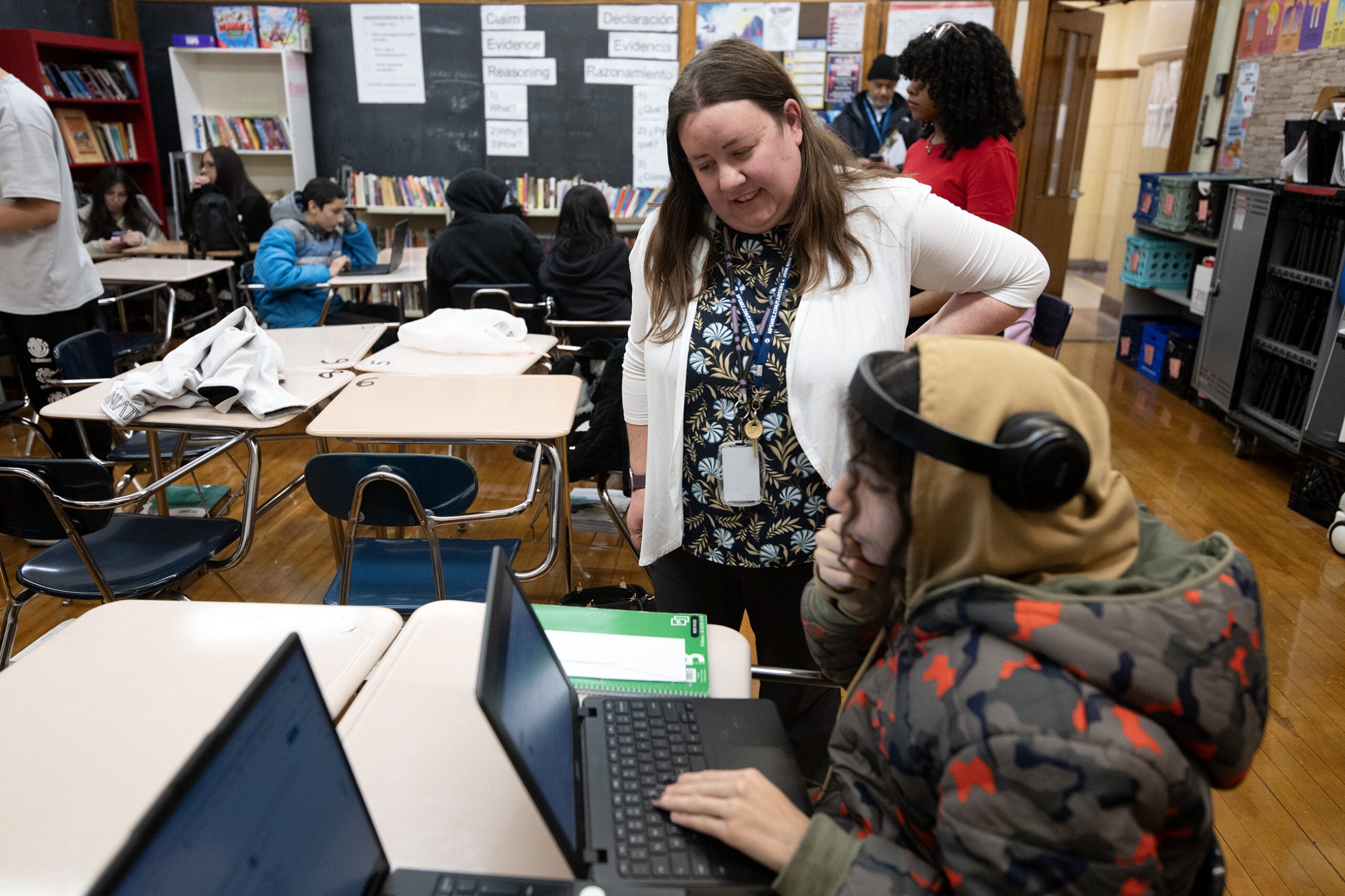
Last year, just as she was finishing a teacher residency program through the University of Wisconsin-Madison, federal funding for the project was cut by the Trump administration.
“So we were in the spring semester and we were all like, are we going to be able to continue?” Lind said. “Are we going to still be able to get our teaching license? Are we going to have to pay this back?”
In 2023, Lind was selected as one of 36 people to join the UW-Madison Teacher Residency Program.
The university partnered with Milwaukee Public Schools to provide graduate students with on-the-job training for a year while they completed their master’s degree in special education. The partnership was funded by a five-year, $3.28 million grant from the U.S. Department of Education.
Michael Harris, chief of staff for MPS, called the program “the best thing that’s happened in a long time.”
At the time, MPS had 70 openings for special education teachers.
“We’ve always struggled to fill our special education vacancies,” Harris said. “So what a great opportunity to recruit individuals who would go through a high-quality program? And it was the gold standard because these folks would be partnered with a highly-qualified special education teacher. So how great is that?”
Grant was abruptly canceled due to DEI
In February 2025, the Education Department abruptly canceled the grant, which was scheduled to run through 2028, along with dozens of other Teacher Quality Partnership grants.
A press release at the time said taxpayer funds were being used to “train teachers and education agencies on divisive ideologies.”
“Training materials included inappropriate and unnecessary topics such as Critical Race Theory; Diversity, Equity, and Inclusion (DEI); social justice activism,” the release said.
A temporary restraining order reinstated the federal money in March 2025, but a Supreme Court ruling in April lifted the restraining order.
With the money in limbo, the MPS school board approved funding to keep the Teacher Residency Program alive. UW-Madison covers the tuition.
“We knew that we needed to take care of these individuals so that we could retain them in the long run,” Harris said. “Part of the program requires them to stay with the district for three years. So we knew that we needed to invest with them early while they were going through this very rigorous program.”
Meanwhile, UW-Madison was continuing to appeal to the Department of Education.
Project Director Kimber Wilkerson said UW-Madison’s grant application, under the Biden Administration, described the ways the school would recruit teachers from as “diverse a pool as possible.”
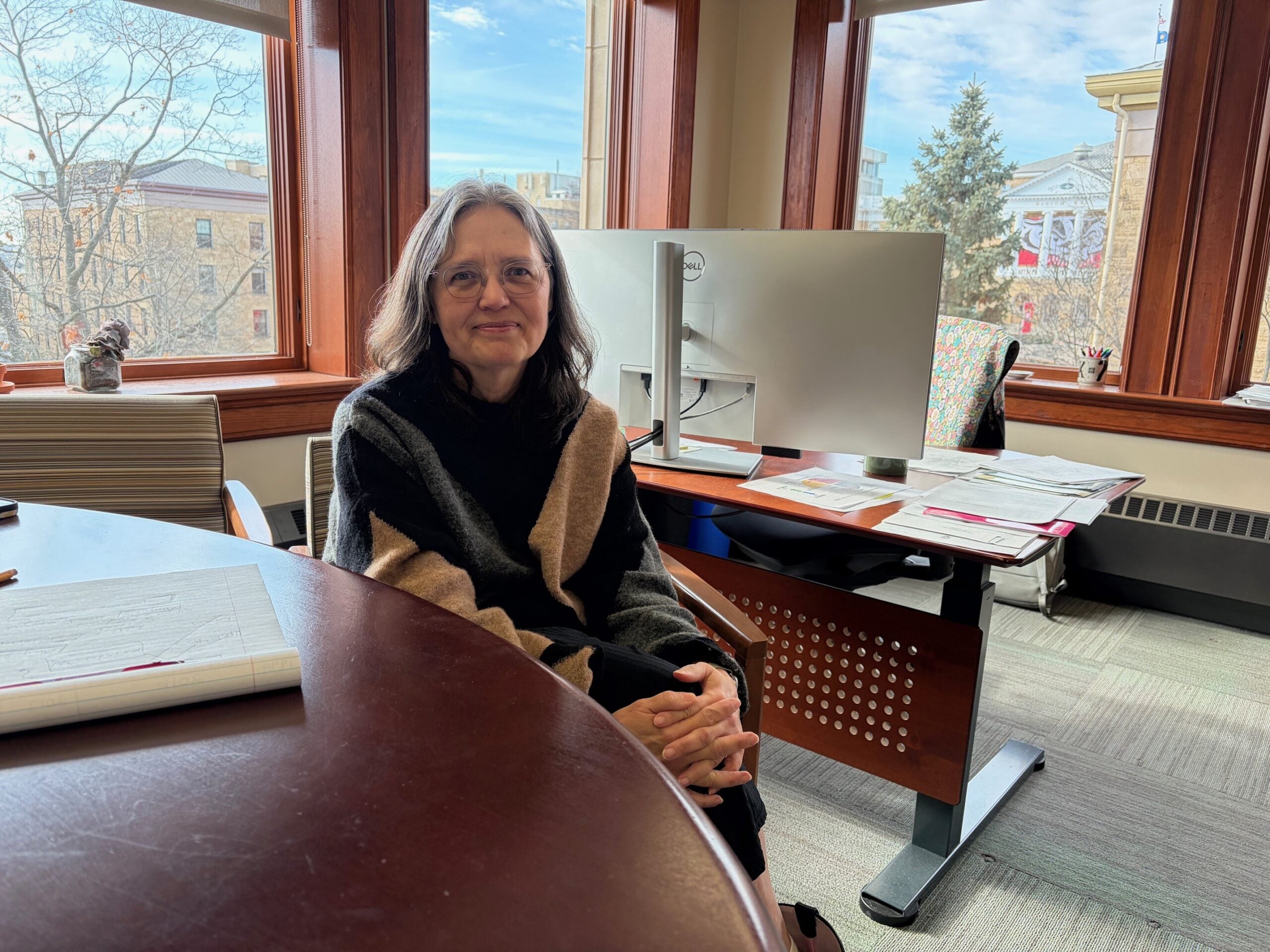
In her view, that didn’t make the program a DEI initiative.
“So it almost feels like it’s just this topsy-turvy, like things being turned on their head,” Wilkerson said. “So it’s hard to appeal when the basis for the termination feels like it’s hard to understand.”
Wilkerson learned in August 2025 the Department of Education rejected the appeal.
Education has seen unprecedented changes in Trump’s second term
This week marks one year since President Donald Trump was sworn in for his second term. From immigration, to the federal workforce, to the economy, to education, the last year reshaped the country. This week, WPR is taking a look at how the administration’s policies are impacting Wisconsin so far.
From the dismantling of the U.S. Department of Education to withholding billions of federal dollars, K-12 and post-secondary education saw unprecedented changes during the first year of Trump’s second term in office.
In an interview on X in August 2024, Trump told Elon Musk that, if elected, “I want to close up the Department of Education, move education back to the states.”
Just weeks after being elected, Trump picked former professional wrestling executive Linda McMahon to lead the Education Department, and has largely followed through on his promise.
Three days after his Jan. 20 inauguration, the president issued an executive order to eliminate diversity, equity and inclusion from schools.
“These actions are in line with President Trump’s ongoing commitment to end illegal discrimination and wasteful spending across the federal government,” the Jan. 23 order stated. “They are the first step in reorienting the agency toward prioritizing meaningful learning ahead of divisive ideology in our schools.”
Dozens of education-related executive orders followed, ranging from expanding school choice to freezing billions of dollars for research on college campuses.
In Wisconsin, this has resulted in the termination of previously-approved, federally-funded projects across the state’s public universities.
At UW-Madison, 145 federal awards received stop work orders or were terminated by the Trump administration, according to university officials. Of those, 43 have been reinstated so far as the result of ongoing litigation efforts.
Will Flanders, research director at the Wisconsin Institute for Law & Liberty, believes the Trump administration has made common-sense reforms to education that most Americans support.
He cited reinstating Title XI regulations in girls’ sports, federal tax credits for private schools and dismantling the Department of Education to remove bureaucracy.
The conservative law firm, known as WILL, opposes public unions and federal programs that guide public education, and promotes classroom transparency and parental rights over curriculum decisions.
Past lawsuits or threats of suits led by WILL have targeted Wisconsin school districts and the Universities of Wisconsin system over issues like transgender student policies, Title IX policies and DEI.
Flanders said the Trump administration has made it clear that by removing DEI from education, people will no longer be judged by their skin color.
“You know, if you want to have programs that benefit downtrodden individuals, there’s still an opportunity for that,” Flanders said. “You just can’t use racial terms to do it. Create a program for low-income families, and oftentimes you’ll benefit African American families and Hispanic families as well. But we just can’t use the language of race.”
‘This feels like unusual terrain’
At UW-Madison, projects to address concerns about the health and well-being of adolescents in an era of digital and social media, research studies to prevent future coronavirus pandemics and research intended to address mental health disparities among transgender and nonbinary people were all terminated by the Trump administration last year.
The cancellation of the Teacher Residency Program came as Lind was finishing her program.
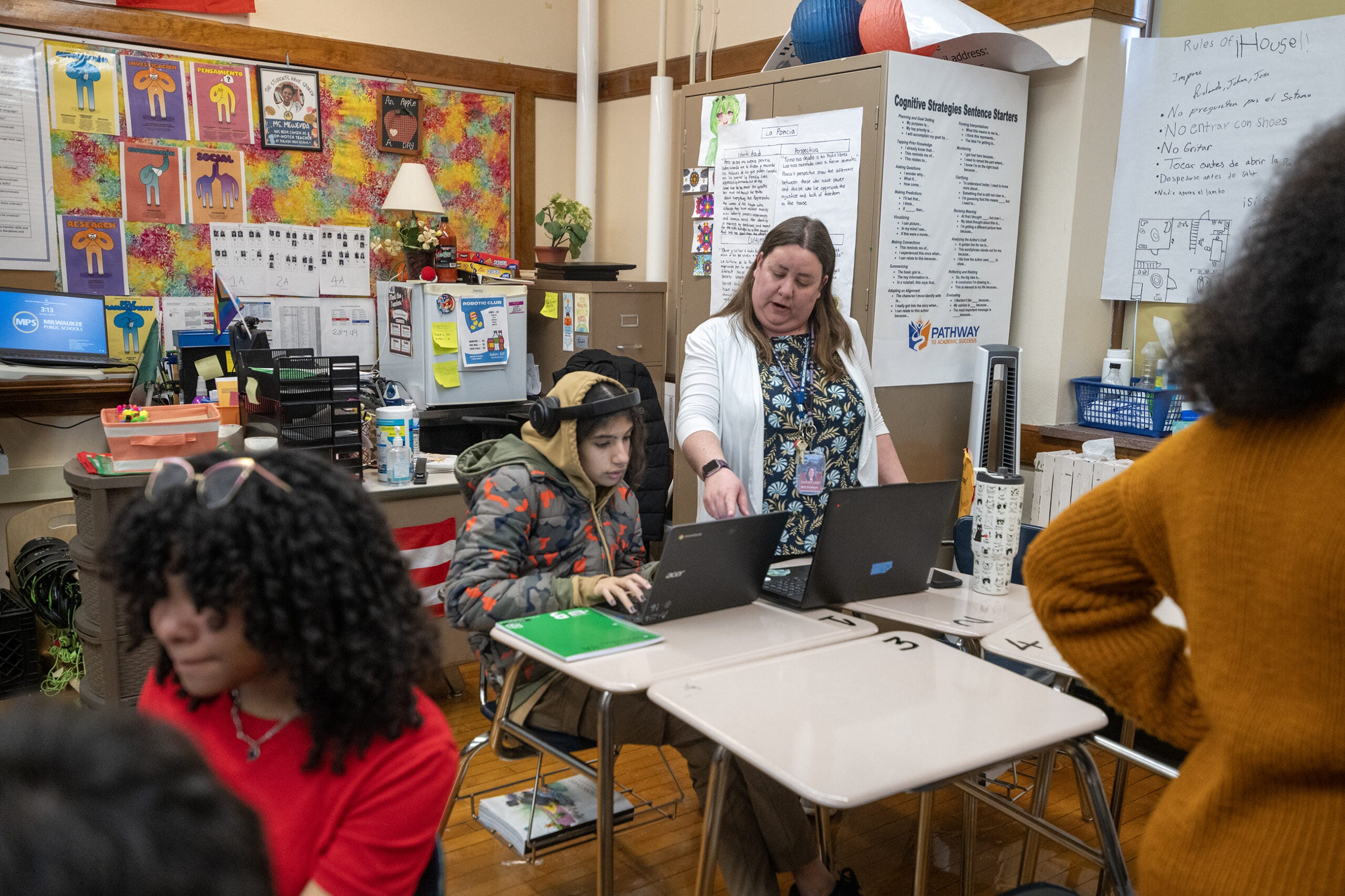
Lind was in the first cohort of students in the teacher residency program. Another 12 teachers have since gone through the program and 14 more are on deck to complete training.
“It’s critically important to schools and to kids with disabilities and their families to have access to well-educated special educators,” Wilkerson said. “And Milwaukee, like many districts around the country, has had a shortage of special education teachers.”
Wilkerson has worked as a professor of special education at UW-Madison for nearly 25 years.
Her programs haven’t focused only on Milwaukee schools. She led a similar teacher residency project with rural Wisconsin school districts from 2018 to 2022.
She says in her more than two decades at UW-Madison, she has never had a federal grant rescinded.
In fact, until last year, she felt like her work is an extension of the work being done by the Department of Education.
“So it’s disconcerting to have to feel like there’s some schism that people on the ground preparing educators, or the people in schools, are sort of having to reinterpret or think, what are the goals now?” Wilkerson said. “I’ve never, ever questioned that. So that that feels like unusual terrain.”

Wisconsin Public Radio, © Copyright 2026, Board of Regents of the University of Wisconsin System and Wisconsin Educational Communications Board.