As the United States becomes more and more accepting of marijuana, many police and public health experts worry about the dangers people using those drugs pose on the road.
Heather Barkholtz has been experimenting in a laboratory at the University of Wisconsin-Madison to try to understand how cannabis products affect people’s driving.
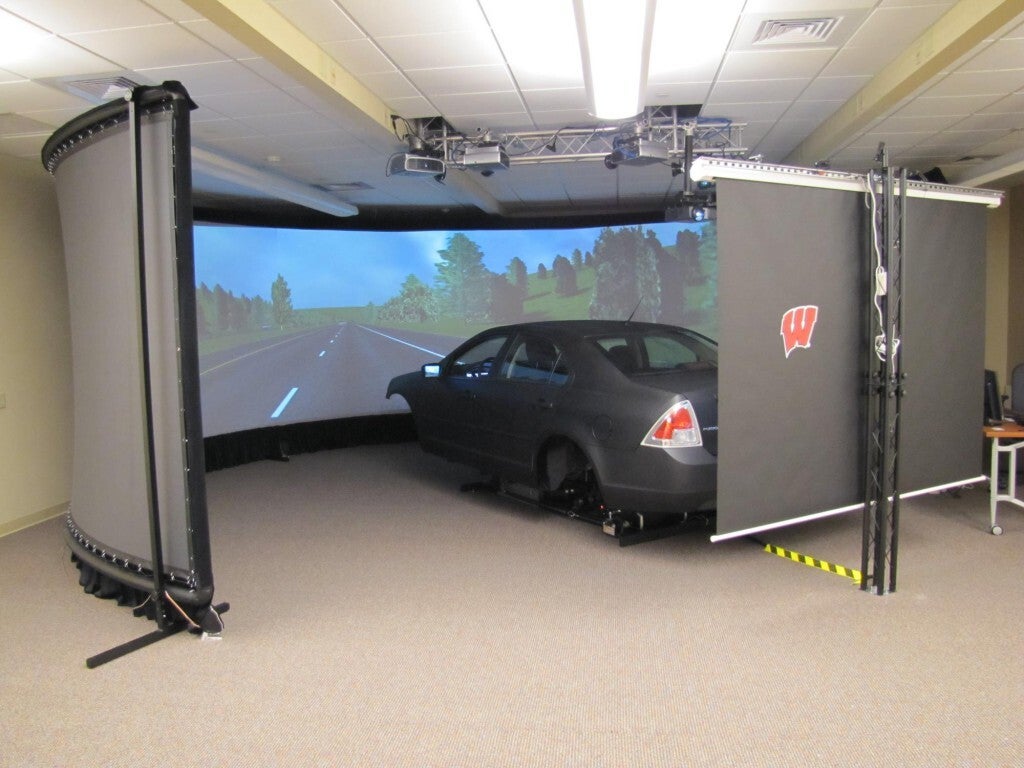
Participants are given doses of Delta-8 or -9, or a placebo, and then get behind the wheel in a driving simulator.
News with a little more humanity
WPR’s “Wisconsin Today” newsletter keeps you connected to the state you love without feeling overwhelmed. No paywall. No agenda. No corporate filter.
“It’s a four-door vehicle that they drive in, but they’re not actually on the roadway. And we have conflicts set up in the simulation to try to capture how people are responding to things,” Barkholtz told WPR’s “Wisconsin Today.” “So you may have somebody jaywalk across the street and you need to recognize that that is happening and stop in time.”
One participant who took the test failed to react when a car veered into their lane. On the road, it would have been a head-on collision. After the test, Barkholtz asked the participant how they thought they did.
“They said, ‘Oh, it went great,’” Barkholtz said. “They were involved in a head-on crash in a simulation, but they said, ‘I did fine.’ So there’s a disconnect, which is really concerning from a traffic safety perspective, because we need people to be more on point with where their level is in terms of how safe they’re able to drive a vehicle.”
Andrew Yockey, an assistant professor of public health at the University of Mississippi where he studies the effects and risk factors of drug use, said drugged driving is a growing problem.
“(Nationally), about 1 in 10 people drive under the influence of alcohol, but about 1 in 15 or 20 people now drive under the influence of marijuana and other drugs,” Yockey told “Wisconsin Today.” “We’re starting to see data that shows drugged driving is actually going to become more prevalent than drunk driving. So this is really a very scary time to be on the roads and actually see what people are doing behind the wheel.”
Although it remains illegal in Wisconsin, 24 states have legalized marijuana for recreational use — including Illinois, Michigan and Minnesota.
Detecting drugged driving is more difficult than drunk driving, because there isn’t yet a simple roadside test like a Breathalyzer that can measure alcohol levels. Deputy Robert Leisher with the Rock County Sheriff’s Office told WPR that during traffic stops, officers look at motorists’ eyes to gauge whether they might be under the influence of a drug.
“If it is midnight and it’s complete darkness outside and their eyes are pinpoint, then that gives us an indicator that they could be on a drug, such as a narcotic like fentanyl or heroin,” he said. “If it’s broad daylight and their eyes are dilated, that’s an indicator that they could be on a drug as well.”
If police suspect a motorist is impaired by drugs, they can order a blood test. But Leisher added that some impairing drugs — such as anti-psychotic medications — aren’t currently restricted under state law.
Yockey said as the legalization movement grows, states are starting to rethink how to monitor and discourage impaired driving.
Some states have adopted zero-tollerance laws, meaning it is illegal to drive with any trace of THC in your body.
Other states — including Wisconsin — have adopted what are called “per-se laws,” which set legal limits for how much of a substance someone can have in their body. In Wisconsin, it is illegal to drive under the influence of 1 nanogram or more of Delta-9-tetrahydrocannabinol (an active ingredient in cannabis) per milliliter of a person’s blood.