
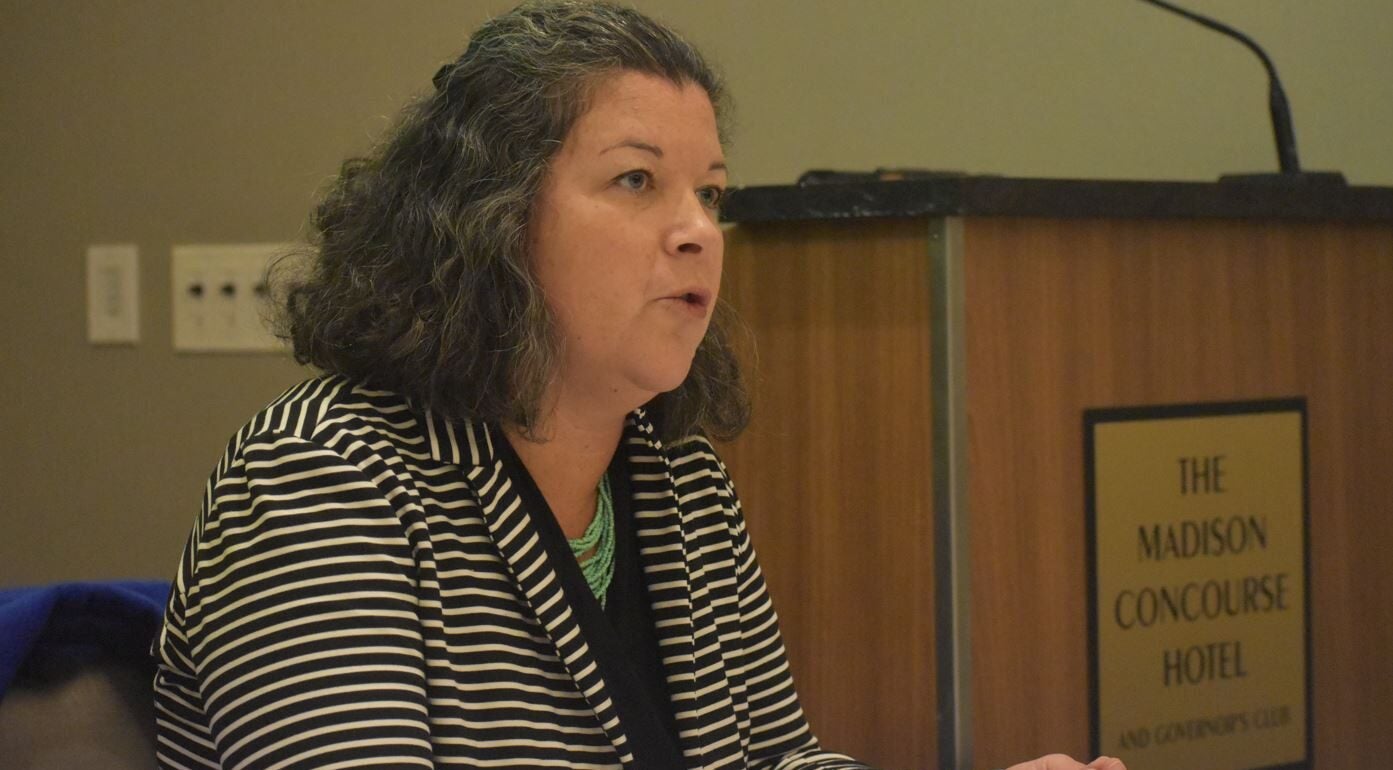
Early next year, the former chairperson of the Public Service Commission of Wisconsin will take a key leadership role with a utility she was once tasked with regulating.
It’s an example of what watchdog groups call a “revolving door” in Wisconsin and nationwide, where former regulators take jobs at companies they regulated during their time in public service.
Rebecca “Becky” Valcq was appointed to the Public Service Commission by Gov. Tony Evers in 2019. During her time with the PSC, she served as commission chair and led the state’s energy office, broadband office and office of energy innovation.
News with a little more humanity
WPR’s “Wisconsin Today” newsletter keeps you connected to the state you love without feeling overwhelmed. No paywall. No agenda. No corporate filter.
She also faced criticism during her tenure on the commission for previously serving as a regulatory attorney for We Energies.
Valcq stepped down from the state utility regulator in February 2024. About six months later, she joined Alliant Energy in August 2024 as the company’s assistant vice president of regulatory affairs, according to her LinkedIn profile.
Last week, Alliant Energy announced that Valcq has been appointed to succeed David de Leon as president of Alliant’s Wisconsin energy company and to serve as vice president of energy delivery effective Jan. 5.
In 2024,the most recent public data available, de Leon’s total compensation package with Alliant was $1.37 million.
Valcq’s salary with the PSC in 2023 was $144,313, according to a national government salaries database.
As president of Alliant’s Wisconsin utility business, Valcq will oversee Wisconsin-based operations, the company says.
Lisa Barton, president and CEO of Alliant Energy, said in a statement the company has “full confidence” in Valcq, calling her a “highly respected leader” with a “distinguished record of service.”
“Her deep experience, strategic perspective and unwavering commitment to our values make her uniquely equipped to lead during this pivotal period,” Barton stated.
In a LinkedIn post, Valcq said she couldn’t be “more humbled nor excited” to take the new role with Alliant and that she was “committed to maintaining our strong track record of safety, reliability and community partnership.”
Watchdog group: Revolving door raises concerns
Karlee Weinmann is the research and communications manager at the Energy and Policy Institute, a clean energy advocacy group and self-described utility watchdog. She said it’s often “disappointing” to see a regulator go on to take a job with an entity they once regulated. That’s because their priority shifts from serving the public to serving utility shareholders.
She also said the situation raises questions about whether a utility would want to hire or put in leadership positions a regulator that they felt “regulated them very rigorously.”
“That’s the concern, when we see this revolving door pattern, that regulators may be affected in their work by their assessment of their future opportunities,” Weinmann said. “It’s very fair for people to be concerned about the dynamic that the revolving door tradition in Wisconsin creates for regulators during their time on the commission.”
Weinmann said Valcq’s tenure on the commission saw progress made on the clean energy front but mixed results when it came to reining in utility profits and keeping rates affordable for Wisconsinites.
“She did join her colleagues in challenging utility profit hikes in some scenarios but also supported overall raising rates in other scenarios,” she said. “I think on the affordability side, (it was) a bit more of a mixed bag than her leadership on the clean energy side.”
According to the governor’s office, Valcq oversaw the approval of 3.9 gigawatts of solar energy and measures to make PSC proceedings more transparent, like the creation of a PSC YouTube channel.
In response to a question regarding a former regulator moving into a high-profile role with the utility, an Alliant spokesperson said Valcq’s nearly 30 years of energy industry experience help the company better serve customers. The Public Service Commission declined to comment.
Valcq isn’t the first PSC commissioner to go work for a utility company after leaving the PSC.
Former commissioner Ellen Nowak, appointed by former Gov. Scott Walker, took a job with American Transmission Co. in 2023. Since 1996, four other former PSC commissioners took jobs either with utilities themselves or for law firms that work with them in regulatory proceedings, according to the Wisconsin State Journal.
Those who leave the commission and do work for utilities are prohibited from appearing before the commission within 12 months of their departure under state law.
Revolving door issue exists at the state and federal level
Jerry Kim, an associate professor at the Rutgers University Business School, said the revolving door between regulators and regulated entities is fairly common at both the state and federal levels of government.
“Regulatory roles are not the most lucrative careers, and, of course, over time they build up tremendous amounts of expertise that are thought to be very valuable,” he said.
Kim worked on a 2023 study looking at how the exchange of employees between regulatory agencies and regulated firms affect regulatory outcomes. Kim and his co-author studied U.S. Department of Agriculture regulators who later joined agribiotech firms as lobbyists, and tracked nearly 13,500 planting approvals of genetically engineered crops between 1998 and 2017.
They found that the firms benefited in the two years before regulators transitioned to the private sector, primarily from shortened approval times. Once the regulators transitioned to their lobbying jobs, the benefits to firms disappeared.
“Statistically, the evidence suggested that the only advantage that firms gain were from before the regulator moved,” Kim said. “It’s a little more problematic than the post-move advantage bump that many had assumed.”
The primary tool to address the revolving door challenge are “cool-off” periods where former regulators can’t lobby before their former regulating agency. But addressing benefits firms may see before a regulator moves would be difficult, he said.
“I think it’s very hard to regulate these types of incentives — or at least the way regulators see this situation — because they’re rational economic agents, so they see that being difficult on firms may not be in their best interest,” Kim said. “I think to regulate this with certain laws or bans is very difficult, unless you go to the extreme and say you can never move across those boundaries.”

Wisconsin Public Radio, © Copyright 2026, Board of Regents of the University of Wisconsin System and Wisconsin Educational Communications Board.